Red Wednesday in European Parliament; Voice of Persecuted Christians and Cases in Iran
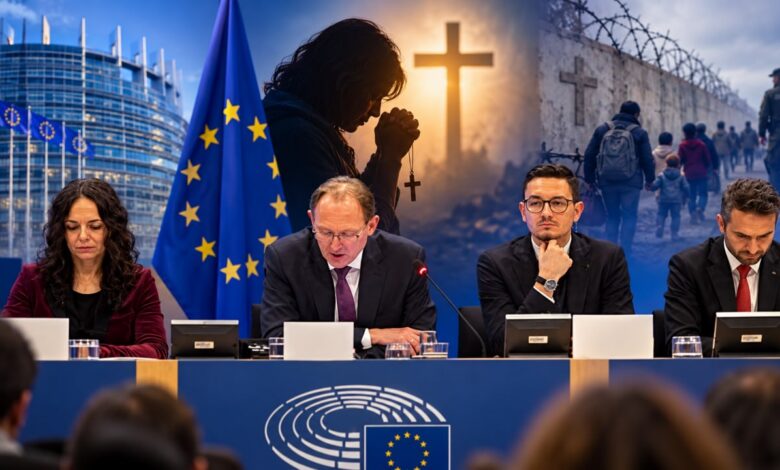
The European Parliament in Brussels hosted a conference in support of Christians who face harassment, detention, and deprivation due to their religious beliefs in various parts of the world; a session in which the situation of Christians in Iran and the danger of deporting Christian refugees from Turkey were also discussed.
The conference “Red Wednesday; If Your Life Depended on Your Faith” was held on Wednesday, November 18, 2026, corresponding to 27 Aban 1405, in the European Parliament in Brussels. This program was initiated by the organizations “Aid to the Church in Need” and “Open Doors” and hosted by the interparliamentary group on freedom of religion, belief, and conscience.
Bert-Jan Ruissen, “Dutch representative to the European Parliament” from the European Conservatives and Reformists group, and Miriam Lexmann, “Slovak representative from the European People’s Party,” serve as co-chairs of this group. Samson Shukardin, “Bishop of Hyderabad, Pakistan,” Anastasia Hartmann from Open Doors organization, Marcela Shimanksi from Aid to the Church in Need, Jabez Moses, “Nigerian lawyer and human rights advocate,” and Emanuela Di Leo from the Steadfast organization, were among the speakers at this session.
Ruissen in his opening remarks emphasized Europe’s capacity to use its diplomatic relations with various countries to support persecuted Christians. Miriam Lexmann also considered freedom of religion a fundamental right, not a privilege that governments can grant or revoke.
The “Red Week” campaign has been launched since 2015 on the initiative of Aid to the Church in Need. In this campaign, churches, public buildings, and historical symbols in various countries are illuminated with red light; a color that in Christian tradition is linked to the commemoration of martyrs and the blood of those who have lost their lives due to their faith.
In 2026, Red Week runs from November 15-22, with Wednesday, November 18, as its focal day. The European Parliament building in Strasbourg is also scheduled to be illuminated with red light on the evening of Monday, November 23; a symbolic gesture intended to draw public attention to violations of religious freedom and the situation of persecuted Christians.
However, the importance of such programs is not limited merely to building illumination and holding symbolic ceremonies. The fundamental question is whether this solidarity will also lead to concrete actions, diplomatic follow-up, and legal support for victims of religious persecution.
Aid to the Church in Need, in a 43-page report titled “Persecuted and Forgotten 2024-2026,” examined the situation of Christians in 18 countries. This report, which relies on the testimony of church leaders, witnesses, and local Christian communities, reports an intensification of pressures on Christians in several of these countries.
According to this report, in Iran severe restrictions against Christians, particularly Christian converts and members of evangelical churches, continue. Prohibition or restriction of worship in the Persian language, raids on house churches, detention and prosecution on charges related to national security, and attribution of connections with foreign intelligence services, are among the matters mentioned in the report.
Aid to the Church in Need’s report states that the number of Christian detentions in Iran in 2025 was 254 cases; a figure that, according to the organization’s assessment, is approximately double the recorded cases in 2024. The report also speaks of intensified judicial penalties and ancillary deprivations, including restrictions on access to education, employment, and medical services.
One example cited in this report is the case of Ghazal Marzbaan, “a Catholic Christian citizen,” who has been sentenced to nine years and eight months in prison and is serving her sentence in Evin Prison. According to the report by Article 18 organization, her Bible and other Christian materials were confiscated during her detention. Reports also indicate her deprivation of family visits and restriction of access to the Bible in prison.
The case of the historic St. Peter’s Evangelical Church in Tehran has also been covered in the report. In this case, UN special rapporteurs have expressed concern over the confiscation of the church complex, closure of the place of worship, and eviction of its residents. According to these experts, 27 residents of the complex, including Armenian and Assyrian families, face the risk of losing their homes, and the church has been forcibly closed.
These cases show that the issue of religious freedom in Iran is not limited merely to the detention of individuals; restriction of worship, pressure on religious communities, deprivation of religious resources, and assault on historic church sites are also part of the concerns raised in human rights reports.
One of the topics raised during the Q&A session of the conference was the situation of Iranian Christian refugees in Turkey. According to reports from this session, warnings were issued about the danger of deporting Christian refugees and returning them to Iran, and demands were made for European institutions to pay attention to this issue.
A representative of Article 18 organization considered direct contact with Turkish authorities and providing legal support for individuals at risk of deportation to be among the followable actions. He also reminded that this situation is not limited to Christian refugees and that Baháʼí refugees may also face similar dangers.
The case of Marjan Massoudi, “a Christian media activist” and Iranian refugee in Turkey, is an example of these concerns. According to Iran Wire’s report on 26 Aban 1405, her asylum case was closed, her residence permit was invalidated, and she and her mother were transferred to immigration detention and a deportation camp. Her relatives said that the failure to register periodic attendance signatures due to a technical defect in Turkey’s immigration administration system played a role in this situation.
Iran Wire also reported that Marjan Massoudi’s physical condition has deteriorated, and on 25 Aban, she was hospitalized due to severe stress and stomach bleeding. She had a history of detention and interrogation before leaving Iran due to religious activities, and her deportation could expose her to the risk of legal persecution.
The principle of “non-refoulement” or prohibition of forced return is one of the fundamental principles of refugee rights and international law. According to this principle, an individual should not be returned to a country where they face serious risk of torture, persecution, or threat to their life. Therefore, Marjan Massoudi’s case is not merely an administrative matter related to residence, but an issue that could relate to a refugee’s security and right to life.
Open Doors organization, in its annual report “World Watch List 2026,” announced that more than 388 million Christians worldwide face high levels of persecution and discrimination due to their faith; a figure equivalent to approximately one out of every seven Christians globally. This figure encompasses a spectrum of pressures and discrimination and should not be construed as equivalent to the number of individuals all facing physical violence or imprisonment.
Holding the conference in the European Parliament and illuminating buildings with red light can be an opportunity for the voices of victims to be heard; however, the real test of commitment to religious freedom lies in following up on specific cases and supporting those who are currently in prison, deprived of the right to worship, or at risk of being deported to their country of persecution.
For Christians in Iran, this question remains: “Can international condemnations and declarations of solidarity lead to the freedom of prisoners of conscience, reopening of closed churches, an end to pressure on Christian communities, and ensure the security of refugees? The answer to this question will not be revealed by the red light on buildings, but by the concrete actions of governments and international institutions.