Arrest and Beating of Participants in Peaceful Gathering at Babak Castle
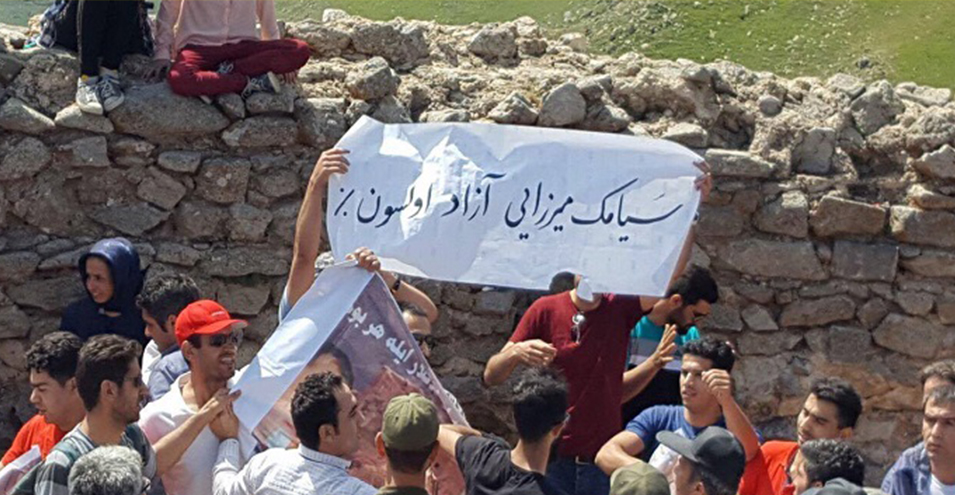
An informed source told the Iran Human Rights Campaign that security forces arrested more than ten Turkic activists on June 30 following a peaceful gathering at Babak Castle in East Azerbaijan Province.
One of the participants in this gathering, who requested anonymity, told the campaign on July 4 that some of the detainees were released after a few hours, but six remain held in the detention facility of the Ministry of Intelligence and Ahar Prison: “Security forces attacked with batons and beat 12 people just as the gathering was ending. Six people, one of whom was 11 years old, were released the same day. Two were taken to the Ahar Intelligence Office and four were transferred to Ahar Prison.”
Morteza Parvin and Akbar Jahangiri are currently held at the Ahar Intelligence Office, while Milad Akbari, Rahim Zarei, Hamed Ravaji, and Rahim Norouzi are among four individuals who were transferred to Ahar Prison after a bail of 15 million tomans was set.
The informed source told the campaign that the gathering’s slogans and demands included “Protesting discrimination against Turks in Iran,” “Addressing the situation of imprisoned Turkic activist Siamak Mirzaei,” and “Teaching in the mother language.”
The source told the campaign that four days after these activists’ arrest, none of them have had contact with their families or lawyers.
Article 27 of the Constitution of the Islamic Republic of Iran declares peaceful assembly and demonstration without weapons to be free, provided it does not contradict Islamic principles.
Article 46 of the Citizens’ Rights Charter, which was drafted during the moderate government of Hassan Rouhani, recognizes “assembly and demonstration in accordance with the law” as a citizen’s right: “It is the right of citizens to freely and in compliance with the law undertake the formation of and participation in assemblies and demonstrations, and to benefit from the neutrality of responsible bodies and protection of the security of gatherings.”
Between 16 to 25 percent of Iran’s population are Turkic speakers, most of whom reside in East Azerbaijan, West Azerbaijan, Ardabil, and Zanjan provinces. Protesting citizens view the Islamic Republic’s and the Persian-speaking majority’s treatment of Turkic-speaking citizens as discriminatory. The prohibition of teaching non-Persian languages in schools and the prevention of mother language instruction are among the most prominent issues that have continuously faced protests from some civil activists in these regions.
In early March 2017 and coinciding with International Mother Language Day, a court in Baharestan County sentenced four Turkic civil activists to a combined 45 years in prison for “peaceful activities aimed at preserving and promoting the mother language.”
UNESCO, the United Nations Educational, Scientific and Cultural Organization, designated February 21 as “International Mother Language Day” on its annual calendar, and media outlets in Iran annually publish materials celebrating the mother language and hold scattered informal ceremonies for this occasion.
Hassan Rouhani, Iran’s moderate president, promised during the presidential election campaign on June 4, 2013 by issuing a statement that “the issue of teaching Iranians’ mother languages (Kurdish, Azerbaijani, Arabic, etc.) will be formally implemented at schools, universities, and the complete implementation of Article 15 of the Constitution.”
Article 15 of Iran’s Constitution permits the use of local and ethnic languages in the press and mass media and the teaching of their literature in schools only alongside the Persian language.
Source: Iran Human Rights