Trump Calls for Trial of Islamic Republic Leaders: “They Are Not Worthy Representatives of Iran”
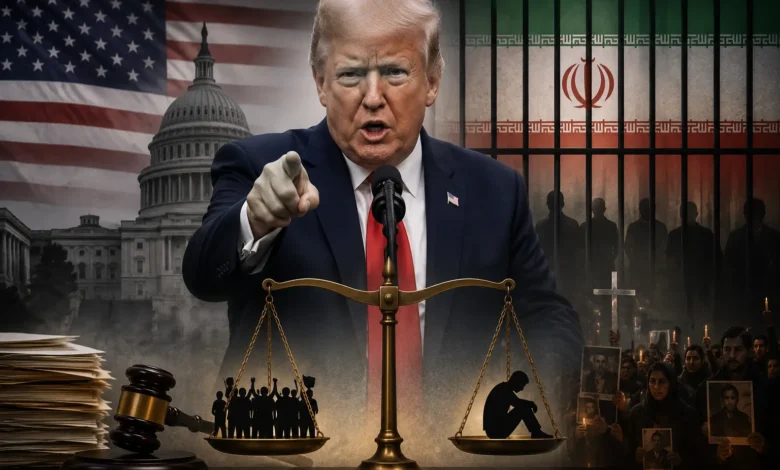
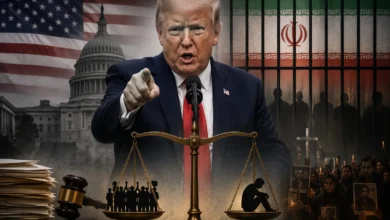
Donald Trump, the President of the United States, has accused the leaders of the Islamic Republic of killing protesters and called for their trial on charges of “crimes against humanity.” These remarks come amid a renewed escalation of tensions between Iran and the United States, at a time when international reports continue to document ongoing suppression of dissidents, particularly religious minorities, including Christians in Iran.
Donald Trump, in a post on the social media network Truth Social, described the Islamic Republic as a “failed” government, stating that Iran’s leaders are in a chaotic situation and lack the ability to properly represent the country. In this message, he accused the Iranian government of killing protesters and claimed that the death toll has exceeded 100,000 people.
Trump wrote at the end of this section of his message: “They should be tried for war crimes and crimes against humanity.”
He also wrote about Iran’s domestic conditions: “Their leadership is completely in disarray and incapable of properly representing the country.”
The U.S. President, in the same message, criticized Iran’s economic and military situation, claiming that the Islamic Republic lacks a navy, air force, and even an effective national currency, and is unable to pay its military and police forces. Trump also stated Iran’s inflation rate at 300 percent; a figure that does not align with estimates published by independent economic sources and international media and should be considered as a claim made by the U.S. President.
Trump’s claim regarding the death toll has not been independently verified to date. The Anadolu Agency and other media outlets, in covering these remarks, have clarified that the figure of over 100,000 deaths is a claim put forward by Trump and remains unconfirmed by independent verification.
Nevertheless, the core concern about suppression and human rights violations in Iran is not a matter limited to Trump’s statements alone. The U.S. Commission on International Religious Freedom, in its 2026 annual report, stated that conditions for religious freedom in Iran remain highly unfavorable, and the Islamic Republic government intensified systematic pressure on religious minorities, including Christians, Jews, Baha’is, Sufis, and Sunnis in 2025.
The report states that Islamic Republic officials used security and religious charges last year to deal with opponents and religious minorities. Regarding Christians, the Islamic Republic’s Ministry of Intelligence claimed in July 2025 that it had identified and neutralized more than 50 Christians, whom it calls “Mossad agents.” The USCIRF report also references statements by government media against evangelical Christians and accuses them of connections with foreign churches.
These pressures persist while Persian-speaking churches, particularly house gatherings, remain for many Iranian Christians the only opportunity for assembly and worship in the Persian language. Earlier human rights reports have documented the arrest of members of these gatherings, prison sentences, and security measures against Christian activities.
Under such circumstances, the question of accountability of Islamic Republic officials is not limited to political suppression alone, and religious freedom is also part of a broader discussion about the rights of Iranian citizens. Persian-speaking Christians are among the groups that have faced security pressures due to religious activities, forming house gatherings, propagating their faith, or maintaining connections with churches outside the country.
On the other hand, Trump’s recent remarks come in a context where military tensions between Tehran and Washington have once again increased. The United States has recently targeted Iranian Revolutionary Guard positions on Lark Island, and Iran, in response, has fired missiles and drones at American positions in the region. In this tense atmosphere, Trump has threatened that if Iranian attacks continue, the U.S. response will be more severe.
Meanwhile, human rights organizations emphasize the importance of documenting human rights violations in Iran and creating mechanisms for accountability of perpetrators. The question of trying Islamic Republic officials has previously been raised among human rights groups, and projects have been initiated to collect documents related to possible crimes and use them in future legal proceedings.
These developments hold special significance for Iran’s Christian community, as freedom of conscience and the right to worship are pursued in circumstances where the government continues to pursue the activities of some Persian-speaking Christians with a security lens. The USCIRF report demonstrates that pressure on Christians in Iran is part of a broader pattern of restricting religious freedom, not an isolated phenomenon separate from the general suppression of opponents and critics.
Trump’s remarks about trying the leaders of the Islamic Republic, if implemented, raise important questions about the legal mechanism of such a trial, the jurisdiction of courts, and how evidence would be gathered and presented. Simply declaring a political position does not mean initiating legal proceedings; however, reiterating emphasis on “accountability” can draw greater attention to the subject of documenting human rights violations in Iran.
Ultimately, what was highlighted in the recent remarks of the U.S. President was the distinction between the Iranian people and the Islamic Republic government; Trump did not consider the Islamic Republic’s leaders worthy representatives of the country, while human rights reports show that various segments of Iranian society, including Christians, have paid the price for the government’s security policies and religious restrictions for years.
For Iran’s Christians, the fundamental question remains: Can pressure and suppression silence a community that continues its worship even in homes, or will the process of documenting human rights violations and increasing international attention to religious freedom eventually open a new path for accountability of those responsible for suppression?