The Bitter Account of “Mojtaba Azhdai”: A Wounded Protester Who Still Carries Pellets in His Body
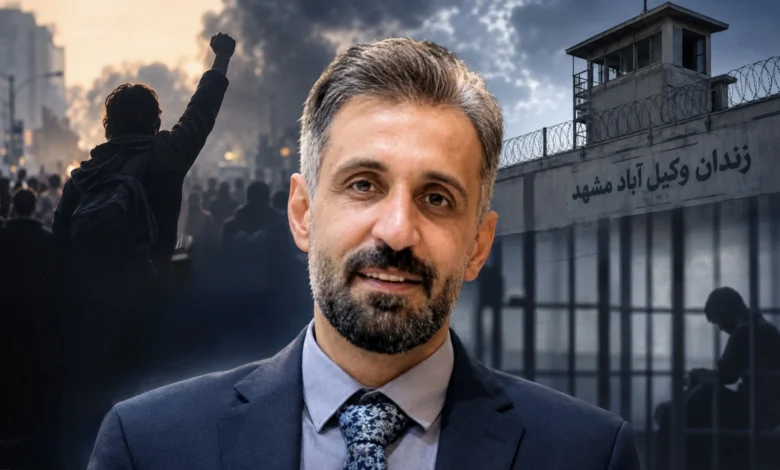
“Mojtaba Azhdai,” a 45-year-old citizen from Jovin and father of one child, has been languishing in limbo at Vakil Abad Prison in Mashhad for months following his arrest during the December 2024 protests. Shot with pellets during the demonstrations, he still carries pellets embedded in his forehead and behind his eye, and according to reports, has been denied full access to medical treatment. This case once again raises serious questions about the suppression of protesters and the observance of basic prisoners’ rights in the Islamic Republic.
Mojtaba Azhdai, a citizen from Jovin city in Razavi Khorasan Province, remains detained at Vakil Abad Prison in Mashhad, nearly eight months after his arrest in connection with the nationwide protests of December 2024, while his legal status remains unclear.
According to the latest report from Hrana news agency published on September 9, 2026, despite 238 days having passed since his arrest, Azhdai is still awaiting trial, and temporary release on bail has not been granted. A hearing on the charges against him is scheduled for September 27 at the First Branch of the Revolutionary Court in Sabzevar.
However, what transforms Azhdai’s case from an ordinary legal matter into an illustration of the consequences of protest suppression is his physical condition.
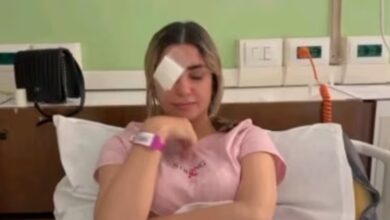
According to published information and statements from a source close to the family, Azhdai was shot with pellets in the face and neck area during the protests. Although he underwent surgery, several pellets remain embedded in his forehead and at least one pellet is lodged behind his eye. According to this source, he requires specialized medical attention and additional surgery to remove the pellets, but has been prevented from being transferred to a hospital outside the prison.
This account aligns with the picture presented by international human rights bodies regarding how the Islamic Republic’s security forces dealt with December protesters. Amnesty International and Human Rights Watch stated in the early days of the crackdown that the Islamic Republic’s security forces used live ammunition and pellet guns to disperse protesters, with metal pellets striking the heads and bodies of demonstrators in some cases. Both organizations also reported widespread arrests and dangers of torture and other abuse for detainees.
Amnesty International, in another report on events from that period, stated that security forces shot and pelted protesters during the crackdown, and after mass killings, thousands were arrested. The organization also described the nationwide internet shutdown as a measure to conceal the scale of the suppression and prevent information from reaching the outside world.
Human Rights Watch, referring to the killing of protesters in January 2026, warned that the repeated and consequence-free use of lethal force against protesters demonstrates that this pattern is deeply rooted in the Islamic Republic’s suppression policy. The organization later stated that thousands of political prisoners and those detained in connection with the protests were at risk.
Regarding Azhdai, his path after arrest has also involved multiple transfers between prisons in Jovin, Sabzevar, and Vakil Abad. According to published information, after being transferred from Jovin to Sabzevar, he was moved to Mashhad for surgery and held for a time at Vakil Abad. After the operation, he was returned to Jovin Prison and went on a hunger strike in protest of his condition, during which he was held in solitary confinement, and was then transferred again to Vakil Abad Prison in Mashhad.
Thus, for a 45-year-old citizen who holds a master’s degree in accounting and is a father of one child, months of detention, lack of judicial review for most of this period, and continued deprivation of specialized medical treatment raise a serious set of concerns about the right to fair legal proceedings and access to medical care.
The significance of this case is not limited to the fate of one prisoner. Azhdai’s situation has emerged at a time when international human rights bodies have reported widespread arrests, forced disappearances, torture, and unfair trials of protesters in Iran. The Iran Human Rights Center, in a report on the protests, documented the extensive scale of killings, increased arrests, and mass trials of protesters.
Under such circumstances, denying an injured prisoner specialized treatment is not merely a medical issue; it is part of a larger problem stemming from the government’s treatment of those arrested during the protests.
Mojtaba Azhdai’s case has yet to be accompanied by charges formally and transparently made available to the public. Hrana also stated in its report that at the time of publication, precise information about the charges against him had not been obtained.
Meanwhile, according to published information, a court hearing on his case is scheduled for September 27 at the First Branch of the Revolutionary Court in Sabzevar. Until then, he remains behind prison bars with pellets in his face and months of detention and limbo.
Azhdai’s case serves as a reminder of the bitter reality that for many detained during the December 2024 protests, the end of the street was not the end of suppression; for some, protest has continued with wounds on the body, followed by months in prison, limbo, deprivation of treatment, and persistent anxiety about their legal fate.