Israeli Defense Minister “Israel Katz” Issues Unprecedented Warning to Islamic Republic
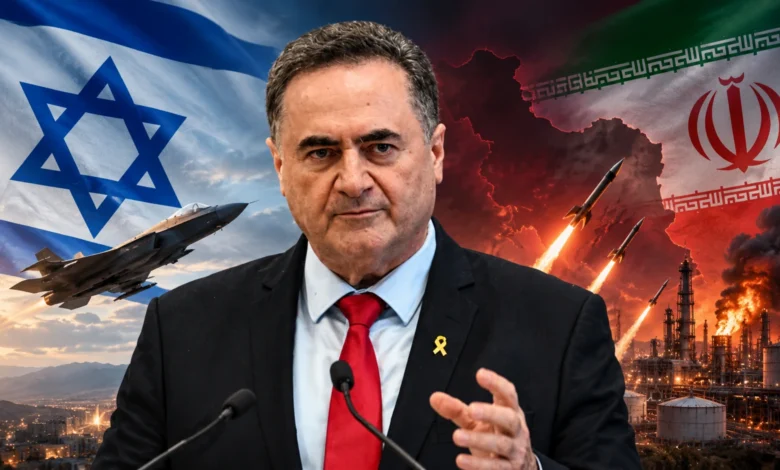
Israel’s defense minister, at a Jewish New Year ceremony, issued a warning about the possibility of “desperate” action by the Islamic Republic, declaring that any Iranian attack on Israel could remove all existing constraints on Israel’s military response; a warning under which Iran’s military infrastructure, civilian facilities, and particularly energy installations could also become targets.
Israel Katz, Israel’s defense minister, at a Jewish New Year ceremony at this country’s defense ministry, made strongly-worded remarks warning the Islamic Republic against any attack on Israel, saying that heavy economic pressure and the Iranian government’s concern over potential uprising and state collapse could push Islamic Republic leaders toward dangerous decisions.
Katz said: “We see signs indicating that severe economic pressure on Iran and fear of another uprising and government collapse could push them toward desperate measures.”
He then directed a direct threat at Iran’s infrastructure, stating: “An Iranian attack on Israel will free us from all constraints. We will target all infrastructure, including energy infrastructure, and will return Iran to the stone age and darkness.”
This portion of Israel’s defense minister’s remarks was also reported by international media including The Times of Israel, Jerusalem Post, and Anadolu Agency.
Katz also emphasized that Israel has prepared itself for various scenarios, saying: “Israel is well-prepared both defensively and offensively for any possibility, and the Israeli army is ready to execute this mission.”
Katz’s remarks came amid renewed tensions between the Islamic Republic, Israel, and the United States. International reports indicate exchanges of attacks between Iran and American forces in the region and growing concerns about the possibility of escalating the scope of the conflict. Meanwhile, Israeli officials have announced the readiness of this country’s army to respond to any potential Iranian attack during Jewish religious holidays.
Israel’s defense minister had stated a day before these remarks that this country’s army is ready to respond with great force to any Iranian attack. He had emphasized that Israel can respond independently and without relying on others in case of an attack.
Katz’s threat is not limited to military targets alone. His explicit reference to “civilian infrastructure” and particularly “energy infrastructure” carries special significance; as attacks on such facilities could have consequences far beyond the battlefield and could affect the daily lives of millions of Iranian citizens.
Therefore, the remarks of Israel’s defense minister should be examined within the framework of increasing risk of direct confrontation between the two countries and concerns about the expansion of war in the region. Anadolu Agency in its report also emphasized that Katz’s warning was made amid renewed intensification of military tensions between Iran and America.
At the same time, Katz in his remarks made a notable distinction between the Islamic Republic’s government and the Iranian people, and in a message related to the Jewish New Year, wished safety for Iran’s Jewish community. Iran’s Jewish community is considered one of the world’s oldest Jewish communities and still has a presence in Iran; although its numbers have declined significantly since the 1979 revolution. Sources related to Iranian Jews estimate the current size of this community at several thousand people.
This part of Katz’s remarks, alongside his military threats, presents a dual image of Israel’s message to Iranians: on one hand a severe warning to the Islamic Republic, and on the other an emphasis on historical and human ties with Iran’s Jewish community.
In fact, the phrase “next year in Tehran” has in recent years become a symbolic slogan among some Iranian Jews and opponents of the Islamic Republic; a phrase expressing the desire to return to a free and safe Iran. This theme has previously resonated among diaspora Iranian Jews and political and human rights activists.
However, on the other side, the explicit threat to target Iran’s energy infrastructure creates serious concerns about the human cost of any future conflict. In the event of widespread war, like many regional conflicts, it is ordinary people who could bear the heavy costs of disruption to energy, communications, transportation, and public services.
Tehran and Tel Aviv are now in a situation where any new attack could quickly lead to another round of retaliatory strikes. Katz’s recent remarks indicate that Israel not only prepares itself for such a scenario, but also wants to convey the message to the Islamic Republic that if an attack begins, the scope of Israel’s targets could be far more extensive than before.
In this context, what matters most is the fate of the Iranian people; people who over the past decades, amid domestic repression, economic crisis, and pressures resulting from the Islamic Republic’s regional policies, have lived, and who now may face new dangers should the war intensify.
Katz’s message on the eve of the Jewish New Year is not merely a military warning; it is a sign of increasing threat levels between Tehran and Tel Aviv and the possibility of the region entering a new and more dangerous phase. While Israel says its goal is to counter the threat of the Islamic Republic, any attack on Iran’s vital infrastructure could have direct consequences for millions of Iranians.
In circumstances where the region remains in the shadow of war and instability, perhaps the most important question is whether mutual threats will ultimately lead to deterrence or will once again set the cycle of attack, retaliation, and destruction in motion; a cycle that above all puts ordinary people on both sides of this conflict at risk.