Reza Pahlavi Calls on French Presidential Candidates to Take a Stand Against Islamic Republic Repression
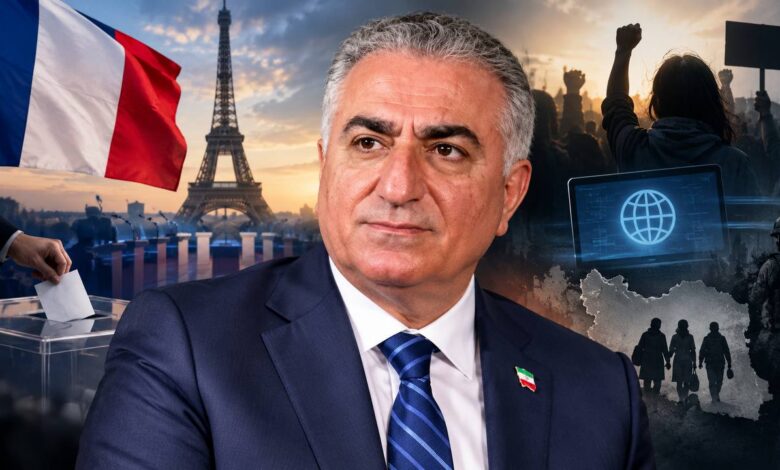
In an article published in the French newspaper “Le Figaro,” Reza Pahlavi called on French presidential election candidates to commit to supporting the Iranian people’s struggle for freedom, condemning the suppression of protesters, ensuring free access to the internet, and guaranteeing the security of Iranians abroad against threats. By linking the 1983 attack on French forces in Beirut to what he described as threats posed by the Islamic Republic in Europe, he called for a change in Paris’s approach toward Tehran.
In an article published in the French newspaper “Le Figaro” on Friday, October 23, according to reports released the same day, Reza Pahlavi called on French presidential election candidates to make support for the Iranian people and countering actions attributed to the Islamic Republic part of their political commitments.
The publication of this article coincided with the anniversary of the deadly attack on the Drakkar building in Beirut on October 23, 1983. In that attack, 58 French soldiers serving as part of a multinational force stationed in Lebanon were killed. The French Ministry of Defense has stated in its historical documents that French and American intelligence agencies held the Iranian government responsible for the attack. At the time of the attack, responsibility was attributed to a group called “Islamic Jihad.”
Pahlavi, while paying tribute to the victims of this attack, described the Islamic Republic not only as a threat to the Iranian people but also as a dangerous factor for the security of Western countries. In his argument, he referenced a series of historical and security events to demonstrate that threats attributed to the Iranian government have extended beyond Iran’s borders.
The main focus of Reza Pahlavi’s article is a call to French presidential election candidates to accept four specific commitments:
First, support for the Iranian people’s struggle to achieve freedom; second, explicit condemnation of the suppression of protesters in Iran; third, efforts to ensure free access to the internet for Iranians; and fourth, protection of Iranians living abroad from threats, intimidation, and actions attributed to the Islamic Republic.
These demands elevate the Iran issue beyond the level of diplomatic relations between Tehran and Paris and emphasize the responsibility of European governments in matters of human rights, freedom of communication, and the security of political opponents in exile.
Pahlavi also argued, by reference to terrorist attacks in France in recent decades, military support by the Islamic Republic for Russia, and security concerns in Europe, that Western countries’ policy toward Tehran should be based on a more serious assessment of security threats and support for Iranian civil society.
In another section of this article, Reza Pahlavi referred to the assassination of Shahryar Shafiq in Paris in 1979 and bombings in France in 1985 and 1986. He also included the killing of Shapour Bakhtiar, the last prime minister during Iran’s monarchy, as an example of threats posed by the Islamic Republic to its opponents abroad. Bakhtiar was killed in August 1991 at his home in Suresnes, a suburb of Paris.
These events have been subject to historical discussions regarding operations attributed to the Islamic Republic outside of Iran; however, responsibility in each case should be examined based on evidence and judicial findings specific to that case.
Pahlavi further referenced the security case involving RAF Fairford airbase in Britain; a case that began in September 2024 with the arrest of several individuals near the base. British authorities have mentioned the possibility of Iranian involvement, and on October 21, Britain’s counter-terrorism police announced that two other individuals had been arrested in connection with the investigation, with the possible involvement of the Iranian government still under review. Iranian officials have denied Tehran’s involvement, and at the time of reporting, no formal charges against the suspects had been announced.
Therefore, this case is still at the investigation stage, and claims made about the Islamic Republic’s role cannot be equated with judicial proof of its responsibility.
In his article, Reza Pahlavi described negotiations with the Islamic Republic as fruitless and stated that Western countries should, instead of relying on talks with the government, focus on a force that, in his view, has the potential to bring about political change: the Iranian people.
At the end, he linked his demands to principles such as the rule of law, gender equality, and the separation of religion from government; values that, within the framework of his political viewpoint, hold central importance for Iran’s future.
This position has been raised on the eve of France’s presidential election scheduled for 2027. According to the official French government calendar, the first round of elections will be held on April 18, 2027, and the second round on May 2, 2027.
Reza Pahlavi’s article can be seen as an attempt to bring the issues of human rights in Iran, internet freedom, and the security of government opponents into French election debates. However, the extent to which these proposals resonate among candidates and French political parties and their possible conversion into formal commitments will depend on political responses in the coming months.