Varoujan Arakelyan, the Architect Who Saved Iran’s Historical Heritage, Passes Away
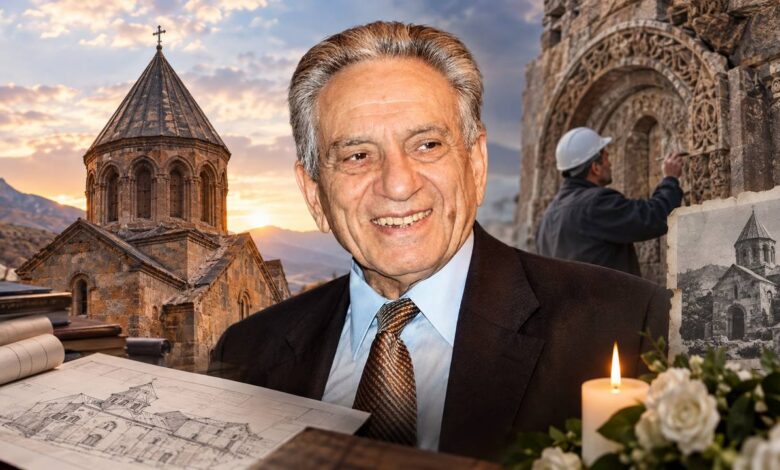
He did not merely restore historical buildings; he was a guardian of memory, identity, and the heritage of generations whose lives are etched in the stones of Iran’s ancient churches. Varoujan Arakelyan, a prominent architect and influential figure in Iran’s Armenian community, passed away in Mehr 1405 (September-October 2026), and his body was laid to rest last week. Yet the legacy he strived to preserve endures.
Varoujan Arakelyan was an Armenian-descent architect and social activist who dedicated his professional and social life to protecting Iran’s historical and religious heritage. Born in Tabriz and having completed his architectural studies at the Faculty of Fine Arts of Tehran University, he devoted a significant portion of his activities to the maintenance and restoration of Armenian churches and historical structures, particularly in Azerbaijan.
News of his death on October 9, 2026, corresponding to Mehr 17, 1405, was published in the Armenian-language media outlet “Ouragrerk.” His body was laid to rest on Mehr 20, corresponding to October 12, in Tehran, following a ceremony at the Church of St. Sergius. Following his passing, Ali Darabi, the Deputy Minister and Vice President of Cultural Heritage, issued a statement expressing gratitude for Arakelyan’s services in preserving and restoring Iran’s historical heritage and historic churches.
One of the most significant chapters in Arakelyan’s career concerns the preservation and restoration of Armenian historical sites in northwestern Iran. He played a role in the restoration of the “Church of St. Thaddeus,” known as “Qara Kelisa,” and subsequently worked to preserve various sections of this historical complex, including the dome, walls, and bell tower.
His activities were not limited to Qara Kelisa. The “Church of St. Stephen,” the “Dré Sham Church,” and other Armenian historical structures were among the monuments in which Arakelyan played a role in their preservation and restoration. His efforts to improve access to these sites were also part of his broader vision of protecting cultural heritage—a heritage that, without accessibility and public familiarity, risks fading from collective memory.
The name Varoujan Arakelyan is most closely associated with the “Church of St. Mary Zor Zor” in the Maku region, a historical structure that faced danger due to the construction of the Baron Dam.
To save this church, the building’s components were carefully dismantled and its stones catalogued to enable reconstruction at another location. This relocation and reconstruction was carried out with the participation of cultural heritage specialists and using Arakelyan’s architectural plans, and the church was successfully rebuilt in its new location.
This project exemplifies the challenges of preserving historical heritage against development projects, where the protection of a valuable structure requires specialized knowledge, careful planning, and cooperation among experts. Arakelyan’s role in this endeavor linked his name to one of Iran’s most important examples of saving a historical monument.
Arakelyan’s activities extended beyond architecture and restoration. He was among the founders and head of the Tabriz branch of the Ararat Club, served on the Armenian Church’s diocesan council, and chaired the Board for the Protection of Armenian Cultural Monuments in Iran.
His knowledge of Armenian history and architecture made him a consulted figure in the field of historical building preservation. He also devoted personal time and resources to preserving cultural monuments—a commitment demonstrating that for him, heritage protection was not merely a professional responsibility, but a social and cultural obligation.
The passing of Varoujan Arakelyan is not merely the loss of an architect for Iran’s Armenian community; it is a reminder of the importance of those who work to preserve our shared cultural heritage. Iran’s historical churches are part of the history of Christians in this land and simultaneously reflect aspects of Iran’s architectural, artistic, and social history.
Preserving such monuments means honoring cultural diversity and acknowledging the contribution of various communities in shaping Iran’s history. While historical buildings are preserved through restoration, their meaning endures through knowledge, respect, and transmission of this heritage to future generations.
Varoujan Arakelyan was among those who worked toward this goal. Though he is no longer with us, the structures he labored to preserve remain testimonies to his dedication and commitment—a legacy that will endure not only in the stone and walls of these buildings, but in Iran’s cultural memory.
May the memory and name of Varoujan Arakelyan, architect and guardian of Iran’s historical heritage, be honored.