Suppression of Journalists: From Professional Disqualification in Kermanshah to Mahdi Mahmodiyan’s Arrest in Tehran
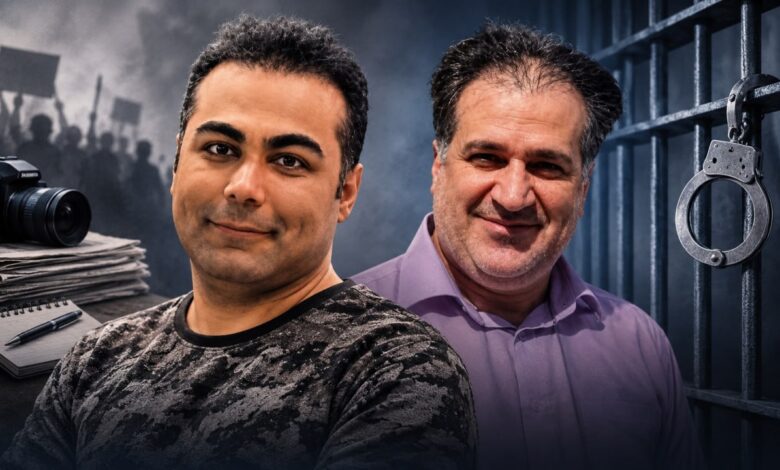
Concurrent with the conviction of Ali Pourdorab, a journalist based in Kermanshah, to one year imprisonment and two years of professional media activity ban, Mahdi Mahmodiyan, a journalist and human rights activist, was arrested in Tehran and transferred to an unknown location. These two cases exemplify the judicial and security pressures exerted on those who cover protest news, monitor prisoners’ conditions, and amplify the demands of families seeking justice.
Within a short span, two reports emerged from Kermanshah and Tehran, once again placing the state of media freedom and professional security of journalists in Iran under scrutiny: Ali Pourdorab faced a prison sentence and professional disqualification, while Mahdi Mahmodiyan, a human rights activist and former political prisoner, was arrested during a security force raid on his residence.
These two cases differ in their judicial proceedings, yet both demonstrate that media and human rights activities can entail severe judicial and security consequences, particularly when reporting addresses nationwide protests, prisoners’ conditions, and bereaved families’ grievances.
Ali Pourdorab, a journalist residing in Kermanshah, was sentenced by the Kermanshah Revolutionary Court to one year of punitive imprisonment on charges of “propaganda against the system.” According to reports published by HRANA and other outlets, the court, in addition to the prison sentence, imposed two supplementary penalties: a two-year travel ban and a two-year professional disqualification in journalism and media.
Pourdorab’s legal case was initiated in Mordad 1405 (August 2026). He was summoned to Branch 16 of the investigation department on the 10th of Mordad following notification from the general and revolutionary prosecutor’s office of Kermanshah Province.
The significance of this case extends beyond the one-year sentence. The two-year professional disqualification directly targets this journalist’s ability to work and continue media activities. The travel ban represents an additional restriction imposed alongside the prison sentence.
According to reports, Pourdorab covered news related to casualties of nationwide protests and the conditions of families seeking justice over recent years, amplifying their demands. Consequently, his conviction cannot be examined separately from the pressure environment affecting journalists who report on the consequences of protests and related legal proceedings.
The charge of “propaganda against the system” is among titles frequently used in legal cases against journalists and civil activists. The fundamental issue in such cases involves the necessity of clarity regarding the specifics of charges, the accused’s access to fair trial procedures, and the proportionality of punishment to the alleged conduct. Disqualifying a journalist from their profession, beyond personal punishment, also impacts the free flow of information in society.
On the morning of Wednesday, Azar 4, 1405 (November 25, 2026), security forces raided Mahdi Mahmodiyan’s residence in Tehran, arresting the journalist, human rights activist, and former political prisoner. After entering the residence, officers conducted a search, confiscated his electronic devices, and transferred him to an unknown location.
At the time of initial reports, Mahmodiyan had no contact with his family, and no information had been released regarding the detaining authority, place of detention, reason for arrest, or potential charges against him.
Mahmodiyan’s arrest occurred as he had been reporting on the danger of executing death sentences against Milad Armand and Navid Najaran, two defendants in the Ekbatan case. He had published an image of the execution order and warned of its imminent implementation. One day later, news of his arrest was reported.
This timing is not, in itself, definitive proof of the arrest’s motivation; however, the timing of the event and Mahmodiyan’s history of media activities highlight the necessity of clarifying the reason for arrest and ensuring his access to legal counsel and family.
The Committee to Protect Journalists also issued a statement on Thursday, November 26, 2026, calling for Mahmodiyan’s immediate release. The organization further stated that claims of his assault during arrest must be investigated and demanded the reversal of Ali Pourdorab’s prison and professional disqualification sentences.
This recent arrest is not Mahmodiyan’s first judicial confrontation. He has been repeatedly arrested and imprisoned in previous years due to his media and human rights activities.
In 1403 (2024), he was convicted on charges of “propaganda against the system” to eight months imprisonment and supplementary penalties. After serving his sentence, he was released from Evin Prison on Shahrivar 24, 1404 (September 15, 2025). Mahmodiyan was arrested again on Bahman 11, 1404 (January 31, 2026) for signing a statement. After 17 days, on Bahman 28 of the same year (February 17, 2026), he was temporarily released on a substantial bail of six billion and 500 million tomans.
Nevertheless, judicial pressures against him continued. Branch 23 of Tehran’s Revolutionary Court, presided over by Judge Taghi-zade, sentenced him in absentia in another case to eight months of punitive imprisonment on charges of “propaganda against the system.” Reports have also indicated the formation of another case in Branch 26 of Tehran’s Revolutionary Court, presided over by Judge Iman Afshari.
In this case, the specific charge against Mahmodiyan involves the writing and publication of notes from inside prison—a matter that raises questions about the limits of prisoners’ freedom of expression and the possibility of continuing media activities during incarceration.
Ali Pourdorab’s conviction and Mahdi Mahmodiyan’s arrest have occurred at a time when Iranian society requires the activities of journalists and independent media to learn about the fate of detainees, the status of those sentenced to execution, and the demands of families seeking justice.
In Pourdorab’s case, the punishment extends beyond imprisonment; professional disqualification has also stripped him of his ability to continue media work. In Mahmodiyan’s case, arrest without public announcement of charges or place of detention has left his family and the public uninformed.
These two incidents further remind us that pressure on media does not occur solely through newspaper seizures or website blockades; prison sentences, professional disqualifications, multiple legal cases, and arrests without transparent notification can also constrain independent media work.
The right to report on public matters, including protests, trials, executions, and the conditions of bereaved families, constitutes part of freedom of expression and the public’s right to information. Judicial proceedings against journalists and human rights activists, when accompanied by ambiguity in charges and lack of transparency in investigation procedures, also raise serious questions about public confidence in judicial justice.
At the time of initial reports, neither the location of Mahdi Mahmodiyan’s detention had been clarified, nor were more details about the process of appealing Ali Pourdorab’s sentence available. What is clear is the continuation of pressure on two figures in media and human rights work: one stripped of liberty and profession, and the other arrested with his family left in the dark about his fate.