Islamic Republic and the Continuation of a Policy of Death: “Milad Armoon” and “Navid Najaran” on the Brink of Execution
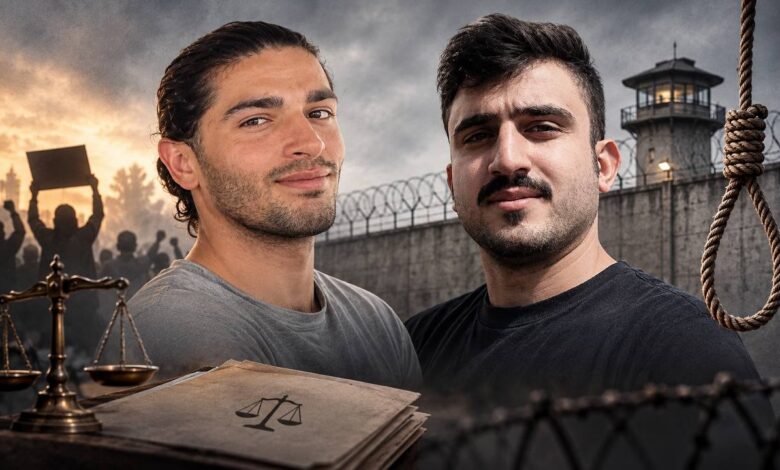
Milad Armoon and Navid Najaran, two detainees from the “Woman, Life, Freedom” protests, are scheduled to be executed at dawn on Wednesday, December 25, 2024, at Qarchak Prison; this despite a trial process marked by acquittal on murder charges, a change in the grounds for conviction, reports of torture, and serious judicial ambiguities. A retrial petition filed by the lawyers of these two prisoners has not resulted in a stay of execution up until the time of this report’s publication.
According to a report published on Tuesday, December 24, 2024, by the Emtedad channel, the lawyers of Milad Armoon and Navid Najaran have been notified that the execution order for their clients will be carried out at dawn on Wednesday, December 25, 2024, at Qarchak Prison. These two young men are among those detained during the nationwide protests of 2022 and are defendants in a case known as the “Ekbatan District” file.
Branch 15 of the Tehran Revolutionary Court, presided over by Abolqasim Salvati, has sentenced these two prisoners to death on charges of “spreading corruption on earth” (Efsad fi-l-Arz). This verdict, after confirmation by Branch 9 of the Supreme Court, has reached the execution stage. Now, their lawyers, by filing a retrial petition in Branch 39 of the Supreme Court, have requested a review of the case and a stay of execution; however, as of the time of this report’s publication, no order to halt the execution has been issued.
One of the most significant ambiguities in this case is the stark discrepancy between the proceedings regarding the murder charge and the verdict that is now set to end the lives of the two defendants.
In November 2024, six defendants in the Ekbatan case were sentenced to death by qisas (retributive justice) on charges of murdering Armaan Aliverdi. However, the Supreme Court overturned these verdicts, and the case was returned for review. Ultimately, based on the ruling of the Criminal Court One in May 2026, Navid Najaran was acquitted of the charge of complicity in murder. Milad Armoon, instead of a qisas sentence, was sentenced to five years in prison and payment of diyah (blood money) for participation in causing non-fatal injuries.
Nevertheless, the Revolutionary Court in a separate case sentenced Armoon and Najaran to death on the security charge of “spreading corruption on earth.” As a result, despite the criminal court reaching different conclusions regarding their role in the murder compared to the original charges, a death sentence was issued against them through another channel.
The lawyers of Navid Najaran have stated that their client was previously acquitted of the charge of inflicting knife wounds, and the criminal court did not establish that murder occurred by knife. Milad Armoon’s lawyers have also emphasized that he did not carry a cold weapon, and witnesses who had previously testified against him formally recanted their statements in an official letter.
Iran Human Rights Organization has also reported that these two prisoners were subjected to torture and ill-treatment during detention and interrogation to extract forced confessions; confessions that, according to the organization, were also broadcast on state television. The organization has further reported limitations on defense lawyers’ access to court sessions, the withholding of written verdict texts, and obstacles created in the legal process to challenge the verdict.
These matters, coupled with the change in the nature of the charges and the issuance of an execution order, raise serious questions about the observance of the right to defense, judicial independence, and the credibility of due process. In a case where the outcome determines whether human lives will be taken, even a single serious ambiguity should prevent hasty execution of the sentence; let alone a constellation of legal defects and allegations of torture and forced confession.
The Ekbatan case cannot be examined separately from the broader context of executions in Iran. Over the past four decades, the Islamic Republic has applied capital punishment not only in murder cases and serious crimes but also in security and political cases; cases in which protesters, opponents, and arrested citizens face execution on charges such as moharebeh (enmity against God) and spreading corruption on earth.
The Iran Human Rights Organization’s report on November 24, 2026, warned that Milad Armoon and Navid Najaran, following their transfer to special solitary cells designated for execution, are on the brink of execution. Pointing to reports of torture, forced confessions, and unjust trial proceedings, the organization called for immediate intervention by international bodies to save their lives.
Meanwhile, the “No to Execution on Tuesdays” campaign announced on November 24 that prisoners in 67 prisons across the country are on a hunger strike. According to the campaign’s statement, more than 81 people were executed in November, with at least 29 executions occurring in the week leading up to November 24. This figure presents a chilling picture of the widespread use of capital punishment in Iran.
However, killing and endangering the lives of citizens in the Islamic Republic is not limited to the gallows. Direct gunfire at protesters, the bloody suppression of demonstrations, suspicious deaths in detention centers, and denying prisoners fundamental rights—each of these is documented in human rights reports as forms of violence and violations of the right to life. Under such circumstances, the execution of two more protesters could mean the continuation of a cycle in which, instead of accountability for people’s demands and transparent investigation of cases, human lives are subjected to irreversible punishment.
Mahdi Mahmoudian, a “human rights activist,” warning of the imminent execution, described Tuesday, December 3, as the last opportunity to save the lives of these two prisoners and called for the mobilization of legal, civil, media, and international capacities.
Now the essential question is: why has the judicial apparatus of the Islamic Republic placed the execution order on its agenda before the outcome of the retrial petition becomes clear and before the objections raised by defense lawyers are addressed?
Execution is an irreversible punishment. If the judicial apparatus has erred in determining guilt, evaluating testimony, or respecting the right to defense, there will be no opportunity for remedy after the execution is carried out. No judicial justification and no security claim can negate the necessity of a fair trial and the protection of the right to life.
Milad Armoon and Navid Najaran now face an immediate danger of execution. A stay of execution and an independent and transparent review of their case is a humanitarian and legal necessity before it is too late. The Ekbatan case once again demonstrates that in the Islamic Republic, the distance between a security charge and a death sentence can be so short that even the opportunity to address fundamental questions about justice is denied to the accused.