Execution of “Ayoub Mohammad Nabil” Carried Out in Silence
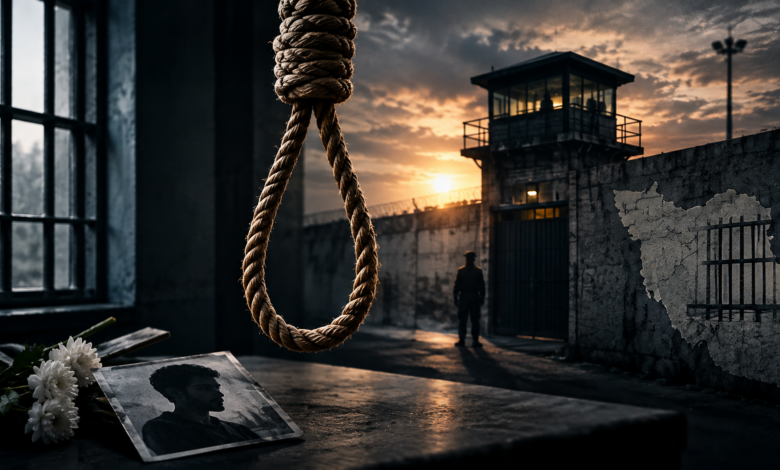
The death sentence of Ayoub Mohammad Nabil, a 28-year-old Iraqi citizen, was carried out in news silence and without public announcement by the judicial authorities of the Islamic Republic at Lakan Prison in Rasht. This case, alongside multiple reports of secret executions in Iran, raises serious questions once again about government concealment, the deprivation of families of timely notification, and the lack of transparency regarding the fate of prisoners sentenced to death.
The execution of a human being behind prison walls, without public notification and in the absence of transparency about the process of carrying out the sentence, is not merely the end of a prisoner’s life; it can plunge a family into mourning and ignorance and deprive society of the right to know the truth. A recent report by the human rights organization Hengaw regarding the secret execution of Ayoub Mohammad Nabil at Lakan Prison in Rasht has highlighted this concern once more: that executions in Iran may be carried out before the public is informed of the fate of the condemned.
According to the report, Ayoub Mohammad Nabil, a 28-year-old Arab citizen from Hadithah, Iraq, was executed on the morning of Sunday, October 19, 2026 (October 11, 2026 in the Gregorian calendar) at Rasht Central Prison. The organization states that his sentence was carried out following conviction on the charge of “enmity against God through espionage for proxy groups supported by Saudi Arabia”—a charge that Nabil had rejected, according to previous reports.
Nabil was arrested on September 25, 2025 in Foman and was held for approximately five months at the detention center of the Rasht Intelligence Department. He was transferred to solitary confinement one week before his execution, a period accompanied by physical and psychological torture.
Hengaw claims that Nabil’s security file was related to his religious identity as a Sunni Muslim, his appearance, and teaching Quranic lessons to local children. While these claims have not been independently verified publicly, they underscore the importance of transparent investigation into the case and publication of judicial documents—especially when the result of the investigation is the taking of a human life.
It should be noted that the judicial authorities and government media had not publicly announced the execution of Nabil’s sentence at the time of publication of this report. This very silence raises a fundamental question: why should news of the taking of a prisoner’s life first be published through a human rights organization rather than through transparent and official channels of public information?
Secret executions, especially when the family and lawyer have not been informed of the time of execution, limit the opportunity to pursue final requests of the prisoner, a final visit, and independent review of the conditions under which the sentence was carried out. This practice can also subject families to shock, ignorance, and anxiety, and deny them the opportunity to demand accountability for the judicial process.
This concern is not limited to Nabil’s case. Human Rights Watch reported in September 2026 on executions of protesters in Iran, stating that authorities in some cases carried out death sentences without prior notification to the families or lawyers of the condemned. The organization, referring to several specific cases, warned about the deprivation of prisoners of final visits and the severe psychological consequences of this practice for families.
A Guardian report in May 2026 also addressed the increase in reports related to secret executions in Iran, noting that human rights organizations have reported the carrying out of sentences without notification to families. These reports show that Nabil’s case was not raised in a vacuum, and concerns about the secret execution of death sentences have a broader history.
Charges of espionage or cooperation with foreign groups are among the most serious charges that can be brought in the judicial system; however, the seriousness of the charge does not replace the necessity of proving it in an independent and fair court. In cases where death sentences are issued, effective access to a lawyer, the ability to examine evidence, the right to appeal, and transparent notification are of vital importance.
When a prisoner has rejected the charges brought against him and human rights organizations also raise questions about his detention conditions and case investigation, the correct response is not silence and concealment, but rather the publication of documents, explanation of the judicial process, and provision of the opportunity for independent review.
The judicial authorities of the Islamic Republic should clarify when Nabil’s family and lawyer were informed of the execution, whether there was an opportunity for a final visit, and what evidence the investigation of the case was based on. Until such information is published, serious questions remain about transparency and the protection of the condemned’s rights.
A government that holds the authority to take human lives must be accountable to the public. Carrying out death sentences in news silence, if accompanied by depriving families of prior notification and the absence of independent oversight, not only weakens judicial transparency but also makes it more difficult to investigate fundamental rights violations.
In such circumstances, human rights organizations and independent media become one of the few channels for disseminating information about prisoners whose executions may not be announced through official channels. However, the responsibility for documentation should not rest solely on the shoulders of bereaved families and civil organizations; the government is obligated to make information related to death sentences and their execution transparent, verifiable, and accessible to the public.
The case of Ayoub Mohammad Nabil underscores once again the necessity of ending secret executions, ensuring prior notification to families and lawyers, guaranteeing fair trials, and establishing independent oversight of the execution of death sentences.
A human life cannot be taken in silence and then escape accountability in silence. Every secret execution raises new questions about justice, transparency, and the right of families to know the truth—questions that the authorities of the Islamic Republic cannot evade forever.