St. Prkich Church (Vank) on Path to World Heritage Listing; Restoration of Damaged Sections Underway with Isfahan Armenian Community Participation
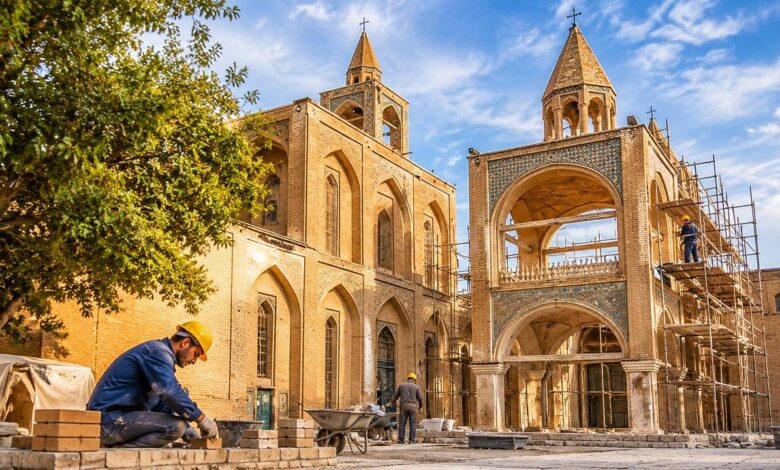
Restoration operations on the eastern and southern facades of Isfahan’s historic St. Prkich Church (Vank) continue with the allocation of 100 billion rials in national funding for the eastern section and participation from the Armenian Prelacy Council and the Ministry of Cultural Heritage. This initiative aims to strengthen protection of this 350-year-old structure and prepare the groundwork for its nomination to UNESCO’s World Heritage List.
Hadi Allahyari, head of the technical committee at the Isfahan Provincial Directorate of Cultural Heritage, Tourism and Handicrafts, announced in a recent interview with IRNA that restoration projects on the eastern and southern sections of St. Prkich Church are being carried out in cooperation with the Armenian Prelacy Council and the Ministry of Cultural Heritage.
According to him, 100 billion rials in national funding has been allocated for restoration of the eastern facade of this historic structure. This section had previously faced issues including structural settlement and crack formation in walls. Since 2025, monitoring indicators have been installed to continuously track cracks and assess potential changes and the building’s stability status over different time intervals.
Technical assessments revealed that the structure and roof covering of this section of the church were not in good condition in terms of weight and quality, with portions of the materials and structure stemming from interventions carried out over the past three to four decades. After preparation and approval of the restoration plan by the Ministry of Cultural Heritage, implementation began under the supervision of specialists in this field and with participation from the Armenian Prelacy Council.
Allahyari reported the restoration of over one thousand square meters of the eastern facade’s roof covering and stated that restoration of the bishop’s hall, the first floor, and adjacent spaces is underway, with some body construction and reorganization work reaching final stages.
Alongside these efforts, the church’s heating and cooling systems, which have long exceeded their lifespan, are being modernized and reorganized. These operations are being carried out based on mechanical plans and with the aim of upgrading protective standards.
Restoration of the church’s southern facade had been on the agenda since 2025. This section, due to its proximity to urban thoroughfares and lack of maintenance over the past several decades, had suffered from damage including plaster deterioration and lime mortar erosion, gutter dysfunction, and exterior facade wear. During restoration, windows have been reorganized, deteriorated paint removed, and damaged sections repaired. The southern entrance has also been restored based on authentic patterns of its original architecture.
According to Isfahan’s cultural heritage technical committee head, efforts have been made during these operations to preserve the building’s historical features while reconstructing and reorganizing the water channels, gutters, and facade bodies using traditional methods and materials compatible with the church’s original structure. Additionally, in restoring various sections, expertise from architectural and restoration specialists and cooperation with the Armenian Prelacy Council have been utilized.
St. Prkich Church, also known by the names “Amenaprkitch,” meaning “Savior of All,” and “St. Sour,” is located in Isfahan’s Jolfa neighborhood and was built during the reign of Shah Abbas II. Its construction took approximately nine years to complete. Vank is one of the most important historical monuments of Iran’s Armenian community; a structure that, beyond its religious function, has served for centuries as an important center for the cultural, educational, and communications activities of Isfahan’s Armenians with the worldwide Armenian community.
The golden decorations of the ceiling and dome, historical and religious paintings, and the combination of Iranian and Armenian architectural features have made this church one of Isfahan’s most distinguished historical monuments. Preserving such a structure does not merely mean maintaining an old building, but rather honoring part of the history of cultural and religious coexistence in Iran and the living heritage of the country’s Armenian community.
Allahyari expressed hope that continued cooperation between the Ministry of Cultural Heritage and the Armenian Prelacy Council will provide the groundwork for international recognition of this structure and its inclusion in UNESCO’s World Heritage List. However, it should be noted that restoration and preparation for world heritage listing do not mean definitive registration of St. Prkich Church on UNESCO’s list; this goal still requires completion of formal evaluation procedures and acceptance within the framework of world heritage mechanisms.
Preservation of St. Prkich Church, alongside its architectural and historical value, holds significance that extends beyond the boundaries of a single religious community. This structure is part of Iran’s historical memory, and its protection means respect for cultural and religious diversity and preservation of a shared heritage that future generations must also have the opportunity to know and benefit from.