Unveiling “Thousand Years of Iran”: A Visual Narrative of Iran’s Historical Heritage by Herbert Kirmessian
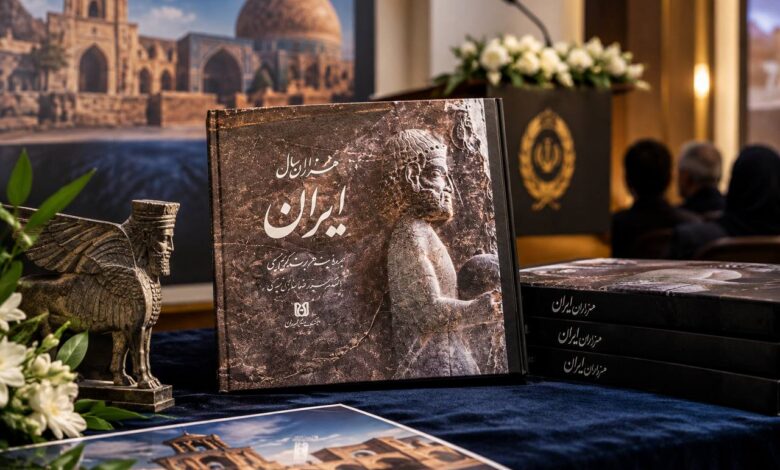
The illustrated book “Thousand Years of Iran” by Herbert Kirmessian, an Iranian-Armenian photographer and documentarian, was unveiled Tuesday evening, November 26, 2026, at the National Bank of Iran Museum in Tehran. Published with the support of the National Bank of Iran, this work showcases Iran’s history, civilization, architecture, and cultural heritage through photographs, presenting part of the historical memory of this land in visual form.
“Thousand Years of Iran,” as narrated by Herbert Kirmessian, is a visual collection of Iran’s historical monuments and structures spanning various periods from pre-Islamic times to the Safavid era. The book has been published with the support of the National Bank of Iran through its printing and publishing company, with an introduction written by Seyyed Reza Salehi-Amiri, Minister of Cultural Heritage, Tourism, and Handicrafts.
The unveiling ceremony took place Tuesday evening, November 26, at the National Bank of Iran Museum, attended by a number of government officials, researchers, and cultural and artistic figures. Among the attendees were Seyyed Reza Salehi-Amiri, Zhale Amuzegar, a researcher of ancient cultures and languages, and Mohsen Seifi, Chief Executive Officer of the National Bank of Iran.
Herbert Kirmessian is an Iranian-Armenian photographer and documentarian born in Tehran who has devoted a significant portion of his professional career to photographing historical monuments, archaeological sites, and Iranian architecture.
Among his documentary subjects are Persepolis, Susa, Chogha Zanbil, Bam Citadel, and Mount Khajeh. He has also served as a research photographer at Persepolis and, in a separate project, has investigated and documented signatures and marks left behind by architects and artisans from the Achaemenid period.
Kirmessian has described his working method, stating that to document certain structures and historical monuments, he has repeatedly returned to these sites during different seasons and has sometimes spent months or years photographing and documenting a single work. This approach demonstrates that his project was not merely limited to capturing beautiful images, but rather aimed to convey architectural details and the historical narrative of each monument to viewers.
In a statement regarding the publication of this book, Kirmessian noted that “Thousand Years of Iran” has lived with him for many years, and he has dedicated the first section of the book to Cyrus the Great.
The choice to dedicate this section to Cyrus the Great reflects his significance in Iranian history and the resonance of his name in historical and religious texts. Cyrus is described in the Book of Isaiah in the Old Testament, which is also part of the Christian Bible, as the “Lord’s anointed,” and in the Book of Ezra, his decree for the return of exiled Jews and the reconstruction of the Temple of Jerusalem is recorded.
This historical and biblical connection makes Cyrus’s name a notable figure for Christian audiences as well; however, “Thousand Years of Iran” is a visual work about the scope of Iran’s history and cultural heritage and should not be considered purely a religious work.
At the unveiling ceremony, Zhale Amuzegar, a researcher of ancient cultures and languages, emphasized the role of art and artists in preserving national identity and the continuity of cultural heritage. Referencing the transience of human life and the permanence of cultural works, she stressed the importance of documenting and transmitting this heritage to future generations.
Mohsen Seifi, Chief Executive Officer of the National Bank of Iran, characterized the publication of the book as part of the bank’s efforts to document and chronicle Iran’s history and achievements in connection with economic and cultural developments.
The publication of “Thousand Years of Iran” can be seen as an effort to visually document part of the nation’s historical heritage—a heritage that has survived through centuries in structures, archaeological sites, architecture, and artistic works.
For Iranian society, regardless of ethnic, religious, and cultural differences, preserving these monuments is part of safeguarding the historical memory and multifaceted identity of Iran. The presence of an artist with Armenian heritage in such a project is also a reminder of the contribution of Iranians with diverse beliefs and backgrounds in documenting and preserving the culture and history of this land.
Through the language of photography, “Thousand Years of Iran” offers viewers an opportunity to look once again at a past whose monuments still remain in various corners of Iran—a past whose understanding and preservation can serve as a bridge between present and future generations.