Revolutionary Guard Commander Admits to Infiltration at Highest Levels of Government
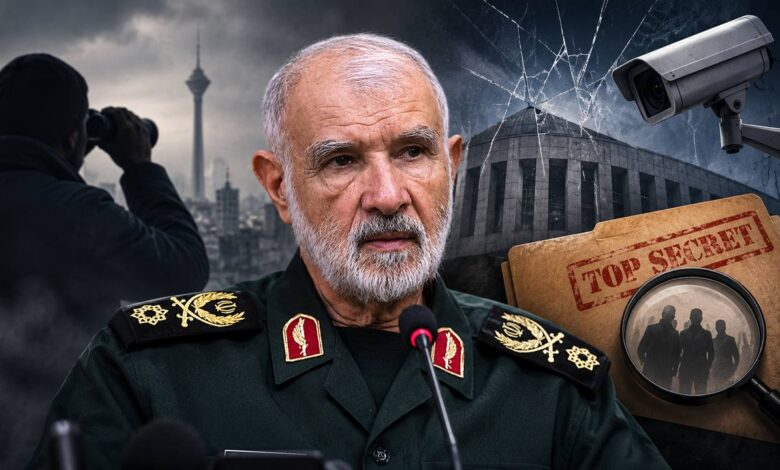
Mohammad Jafar Asadi, a commander of the Islamic Revolutionary Guard Corps and former deputy of the inspection office at the central headquarters of Khatam al-Anbiya, acknowledged intelligence infiltration within the Revolutionary Guards, the Ministry of Intelligence, state radio and television, and other government institutions, stating there is no longer any place to hide. These remarks, combined with Abbas Araghchi’s previous admission of a security breach at the highest levels of government and reports about Israel’s use of Tehran’s surveillance cameras, paint a picture of structural vulnerability in the Islamic Republic’s security apparatus.
Asadi told the Defapress news agency: “Enemy infiltration has occurred at higher levels. There is infiltration even within the Revolutionary Guards, the Ministry of Intelligence, state media, and various government agencies across the country. This infiltration is sometimes direct and sometimes indirect.” An apparatus that has monitored citizens for years is now, according to Revolutionary Guard officials, unable to even protect information and security within its own power structure.
He also claimed that Israel can use its infiltration networks within European countries to obtain passports and identity documents for its agents so they can enter Iran under the cover of tourists or traders.
These statements are far more than a routine security warning. When someone with a commanding background in the Revolutionary Guards speaks of infiltration within institutions that form a significant part of the Islamic Republic’s military, intelligence, and propaganda structure, the fundamental question becomes: how has an apparatus with this level of budget, personnel, equipment, and security claims become so vulnerable to infiltration? If this infiltration exists at the highest levels, who bears responsibility for it, and who should be held accountable for these security failures?
Asadi’s remarks came as Abbas Araghchi, Iran’s Foreign Minister, stated on July 19, 2026, during a discussion about the recent 40-day conflict, that there had been a security breach within the Pasteur complex. Araghchi, referring to the United States and Israel’s awareness of important meetings on March 1, 2026—the first day of the conflict—said this indicates there was a security breach that probably still has not been resolved. He even suggested that the scope of this infiltration extended beyond access to information and may have affected decision-making and the psychological environment of the government.
Earlier, the New York Times had reported that the operation resulting in the death of Ayatollah Ali Khamenei and several senior Islamic Republic officials was the result of months of intelligence surveillance and close cooperation between the U.S. Central Intelligence Agency, the CIA, and Mossad. According to this report, information about Khamenei’s whereabouts and the meeting of senior officials was provided to Israel and played a determining role in planning the operation.
The totality of these reports raises serious questions about the Islamic Republic’s intelligence protection structure: how was the location of the highest-ranking government official and sensitive military and security meetings so easily traceable? Was the problem only the infiltration of human agents, or did weaknesses in communication systems, digital infrastructure, and surveillance networks also play a role in this failure?
One notable aspect of Asadi’s remarks was his reference to mobile phones, cameras installed on streets, in shops, and even in homes, as well as information recorded in various systems. He said images from cameras are analyzed using artificial intelligence, and information about refueling, receiving services, and purchasing airline tickets provides the ability to track individuals. Asadi concluded: “We ourselves are providing services and information, and it can no longer be said that there is a place to hide.”
However, this confession has another dimension: the Islamic Republic has spent years developing these same tools to monitor citizens, identify opponents, control women, and suppress protests. Now, the same infrastructure that was supposed to be the government’s eye on people’s lives may, according to published reports, have become a security weakness for the government itself.
The Financial Times reported on June 9, 2026, that the Islamic Republic had installed new cameras during December 2024 protests to increase surveillance of protesters. According to an informed source, Israel was able to gain access to these camera feeds during the recent conflict and used them to identify Basij forces stationed at checkpoints. Other reports have also indicated that Israel accessed Iran’s traffic camera network and used data analysis to track senior officials and their bodyguards.
This contradiction cannot be ignored: a government that installs cameras and surveillance systems to control citizens and collects information about people’s movements and daily lives apparently has not been able to keep the same infrastructure secure from external infiltration and access. Citizens must bear the cost of constant surveillance by giving up their privacy, but the government cannot even guarantee who has access to the collected information and how it is being used.
In another part of the interview, Asadi claimed that one Revolutionary Guard member was abducted with his head covered and taken to a house from where direct contact was established with Tel Aviv. According to his account, this person was later blindfolded and taken to the deserts around Varamin and threatened that if he moved within two hours, he would be shot. Asadi said the Revolutionary Guard member began screaming after about 10 to 15 minutes and eventually managed to escape.
However, Asadi provided no name of the individual, the time of the incident, the identity of the abductors, or any independent evidence to verify this account. Therefore, this part of his remarks should be considered the narrative of a former Revolutionary Guard official, not an event whose details have been independently verified.
That said, previous reports have been published about the interrogation of individuals associated with the Revolutionary Guards within Iran. In May 2022, Israeli media reported on the interrogation of Mansour Rasouli in Iran; Iran International identified him as being connected to a network affiliated with the Revolutionary Guards that, according to the outlet, was tasked with assassinating individuals in Turkey, Germany, and France. The narrative of this case was accompanied by different reactions and accounts from Rasouli himself, and details were inconsistent across media outlets.
That same July, Iran International reported on the interrogation of Yedollah Khodmati, a member of the Revolutionary Guards’ Amadid and Support Unit, claiming he provided information during interrogation about weapons transfers to Syria, Iraq, Lebanon, and Yemen. News of Khodmati’s interrogation was later confirmed by official Islamic Republic media, though officials presented a different narrative about the identity and nature of the abductors.
Asadi’s admissions are not only about Israeli intelligence infiltration; these statements lift the veil on a deep rift between the government’s security claims and the actual performance of its apparatus. In recent years, the Islamic Republic has further restricted citizens’ privacy through the expansion of cameras, identification systems, communication control, and citizen data collection. But now, a former Revolutionary Guard official is saying that information from these same systems may fall into others’ hands and that there is no longer any safe place to hide.
Under such circumstances, rather than citizens bearing responsibility for the government’s security weaknesses or facing further restrictions in their daily lives, officials should explain the heavy costs of this structure, the intelligence failures, and the fate of people’s private data. National security cannot be used as a pretext for unlimited surveillance of society, while the same government faces repeated failures in protecting its most sensitive centers and information.
When the government expects citizens to register all their information and personal details in systems under its control, it has the responsibility to answer for the security of this data; but above all, the government itself must answer this question: how has an apparatus that claims to control everything failed to prevent infiltration into the most sensitive layers of power?