16-Year Prison Sentence for Kurdish Couple for Religious Activities: Belief Treated as Security Threat
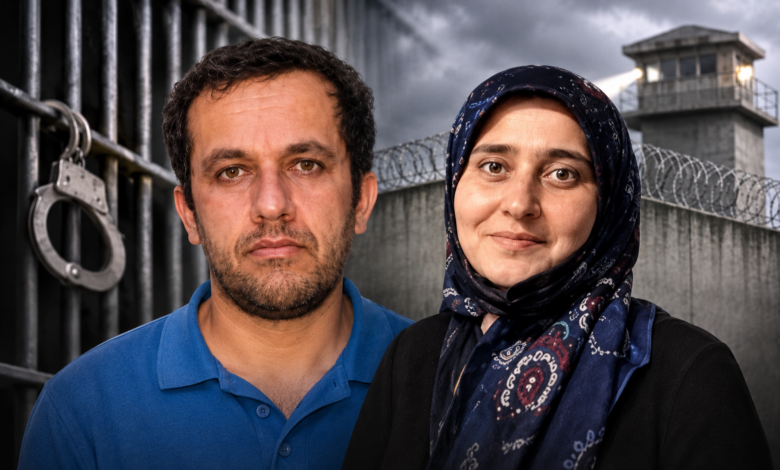
Saedat Taskeh and her husband Moloud Atashbar, two Kurdish citizens from Mahabad, have each been sentenced to eight years in prison; a ruling that, according to reports, was issued in connection with their religious activities. The couple has been in detention since June 2023 and are now serving a combined 16 years in Urmia Central Prison—another case demonstrating that in the Islamic Republic, peaceful religious activity can be met with serious security charges.
According to human rights organizations, Saedat Taskeh and her husband Moloud Atashbar, both 43 years old and from Mahabad, have each been sentenced to eight years in prison by one of the branches of Urmia’s Revolutionary Court on the charge of “forming or managing an association with the intent to undermine national security,” in connection with their religious activities.
The couple was arrested on June 5, 2023, while working on a farm on the outskirts of Mahabad by Ministry of Intelligence forces. After being transferred to the Urmia Intelligence Directorate detention facility, they were held for more than two months in solitary confinement and under interrogation; a period marked by deprivation of phone contact and family visits.
Following the completion of interrogations, the couple was transferred to Urmia Central Prison and subsequently sentenced to eight-year prison terms. According to Hengaw reports, Saedat Taskeh is held in the women’s ward while Moloud Atashbar is held in the special section for political and ideological prisoners.
Saedat Taskeh suffers from a nervous system disorder. Approximately seven years ago, the couple migrated first to Turkey and then to the Kurdistan Region of Iraq to pursue her medical treatment, but due to failure in completing the treatment process, they returned to Iran and began working on a farm near Mahabad.
The arrest of this couple at their workplace and their continued imprisonment raises serious questions about Saedat Taskeh’s health condition and her access to proper medical care. Published reports have not provided fresh details about her medical situation in prison or the extent of her access to medical services. Given her reported illness, it is the responsibility of prison authorities and the judicial system to ensure effective and continuous treatment for her.
One of the key concerns in this case is the use of security charges to deal with religious activities. The accusation against this couple, rather than pointing directly to specific criminal conduct, focuses on forming or managing an association with the aim of undermining national security; while Hengaw’s report identifies the basis of the case as their religious activities.
If the activities in question were solely worship, gathering, or peaceful participation in a religious community, converting this into a security case and issuing a long-term prison sentence would be a serious violation of freedom of religion and conscience. The judicial authorities must present specific evidence of criminal conduct; merely having a different belief or participating in religious activity should not replace proof of guilt.
Another important point is Article 23 of the Islamic Republic’s Constitution, which prohibits investigation of beliefs and stipulates that no one can be subjected to abuse or prosecution solely because of holding an opinion. Article 13 also only recognizes Zoroastrians, Jews, and Christians as defined religious minorities; a limitation that, from the perspective of equal citizenship rights, makes the situation of other religious and belief communities more vulnerable.
The case of Saedat Taskeh and Moloud Atashbar cannot be considered merely a local or isolated case. Reports from international human rights organizations indicate pressure on a broad spectrum of religious and belief groups in Iran.
The United States Commission on International Religious Freedom stated in its October 2026 report that authorities of the Islamic Republic continue to arrest and imprison individuals for freely exercising their right to religion and belief; including religious leaders, members of religious communities, and advocates of freedom of conscience. The report also refers to arrests and imprisonment of Bahá’í and Christian citizens and mistreatment of some prisoners.
United Nations experts also expressed concern in July 2026 about arbitrary arrests, enforced disappearances, torture, and mistreatment of members of the Bahá’í community, and reported the detention or imprisonment of at least 57 members of this community.
Regarding Christians, particularly converted Christian citizens, religious freedom defense organizations have reported arrests, interrogations, closure of house churches, and issuance of lengthy sentences with charges such as actions against national security. Sunnis also face restrictions including discrimination in access to certain employment opportunities and limitations on mosque construction in several major cities. Yarsan followers and Ghanabad dervishes have also been affected by discrimination and security dealings according to human rights reports.
These cases demonstrate that the issue is not merely about dealing with one religion or one specific group; a structure that does not recognize freedom of belief can target followers of different religions, Islamic schools of thought, and even individuals with non-religious beliefs. Of course, the type of pressure, severity of treatment, and degree of legal protection for these groups are not uniform; but the common thread in many of these cases is the securitization of peaceful activities and the restriction of the right to choose and express opinion.
The arrest and conviction of a couple for religious activities, especially with security charges and lengthy imprisonment, once again raises the necessity for accountability of the Islamic Republic’s judicial system. If the charge against these two citizens is based on peaceful religious activities, issuing such sentences not only violates freedom of religion and conscience but also sends a threatening message to other citizens who adhere to a different faith or religion.
The state is obligated to protect the right of all citizens to hold, change, or express religious and non-religious beliefs; not to use difference in belief as a pretext for arrest, deprivation, and imprisonment.
No citizen should be deprived of freedom and security for being Muslim, Sunni, Bahá’í, Christian, Yarsan, Jewish, Zoroastrian, or non-religious. The right to belief, worship, and choice of opinion is not a government privilege but a human right that must be guaranteed for all without discrimination.