Trump: I Have No Hesitation About Attacking Iran Again
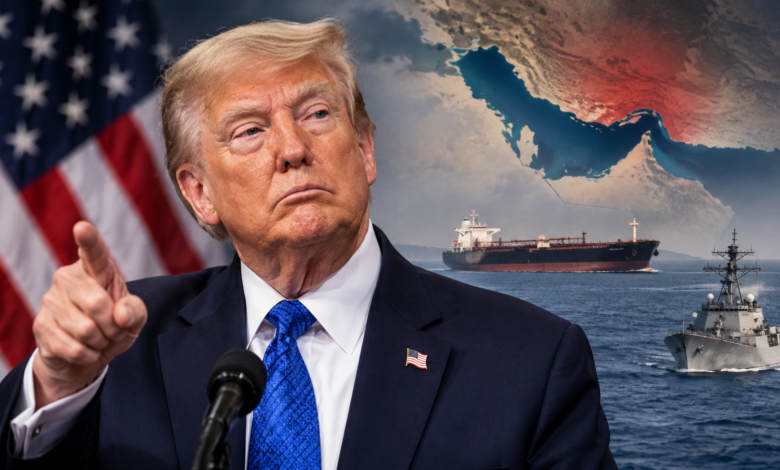
Donald Trump, the President of the United States, threatened in a recent interview with Hugh Hewitt, a conservative American broadcaster, that if he deems it necessary, he may resort to military force against the Islamic Republic again. He simultaneously claimed that America has complete control of the Strait of Hormuz, Iran’s economy is on the brink of collapse, and there is no longer any need for an agreement with Tehran. However, examination of economic data and independent reports on the maritime situation in the Persian Gulf show that some of these statements diverge from verifiable realities.
In his conversation with Hugh Hewitt about the possibility of using military force again against the Islamic Republic, Trump said: “No, I have no hesitation whatsoever.” Responding to the question of whether he would resort to military action to stop Iran’s threats against U.S. allies and ships, he added: “If I see things going in a different direction, I will do it. I might even do it right now.”
These remarks come at a time when war and maritime blockade have severely affected shipping security in the region, and recent reports indicate continued attacks on commercial vessels.
The American president, in another part of the interview, referring to military operations against Iran, said that the intense confrontation lasted only three weeks, and in the past five months, no American soldiers have been killed. He also compared the casualty situation of the Russia-Ukraine war with American military losses, claiming that the Russian and Ukrainian sides combined have 25,000 casualties per month.
These figures are Trump’s statements in the interview and should not be accepted as definitive casualty statistics of the war without independent verification. Moreover, continued attacks on ships and regional infrastructure show that reducing the intensity of broader military operations does not necessarily mean the end of hostilities or the return of security to the region. Recent maritime reports continue to indicate attacks and serious dangers to ship crews.
Trump emphasized several times in this interview that America completely controls the Strait of Hormuz and Iran has lost this strategic waterway. However, Reuters reports present a more complex picture.
According to reports published on November 12, Iran’s Revolutionary Guard Navy claimed that four tankers were targeted in explosions in the Strait of Hormuz over two days. Iranian officials said these ships ignored warnings and entered prohibited routes; however, Reuters was unable to independently verify Iran’s account of the cause and details of these explosions. At the same time, Britain’s Maritime Trade Operations Authority reported that an unidentified projectile struck a ship northwest of Ras al-Khaimah.
A Reuters report on November 11 also cited data from the Washington Institute for Near East Policy, stating that in October, 37 ships in the Strait of Hormuz area came under attack—a figure described as the highest monthly rate since the war began in late February. In the first ten days of November alone, at least 10 ships came under attack.
Therefore, Trump’s claim of complete control of the Strait of Hormuz, in light of the continued attacks and maritime insecurity, requires further explanation. Military control or the imposition of a blockade on parts of sea routes does not necessarily mean ensuring the complete safety of commercial vessels’ passage.
One of Trump’s notable claims was a 301 percent inflation rate in Iran. He said the country’s economy has collapsed, the government cannot afford to pay its military personnel, and Iran’s army, navy, air force, and air defense have been destroyed.
However, the figure of 301 percent does not align with statistics published by Iran’s Statistical Center for Mehr 1405 (September 2026). According to figures reported by this center, the annual inflation rate in that month was 76.8 percent and point-to-point inflation was 88.7 percent. An independent review published on October 30 also did not confirm the 301 percent figure for conventional inflation indices.
This discrepancy does not mean denying Iran’s economic crisis or the severe impact of inflation on people’s lives; rather, it shows that the figure presented by the American president significantly differs from available official statistics and requires clearer documentation to be accepted.
In another part of the interview, Hugh Hewitt asked Trump what Washington’s reaction would be if Islamic Republic forces killed a senior American official. Trump responded: “They won’t be around much longer.”
This remark is a direct threat against the Islamic Republic in the event of the death of a senior American official and indicates that the military option remains part of the White House’s stated calculations.
Hewitt also asked whether Trump is willing to continue a maritime blockade of Iran for even 26 months until the government collapses. Trump did not say he would definitely continue the blockade for such a period; instead, he said: “No, no. The government is collapsing.” He then reiterated his claims about Iran’s economic and military situation.
Trump also posted a message on Truth Social saying: “We no longer need an agreement with Iran. Those days are long gone. We have hundreds of billions of dollars of their money in our possession, and their strait is also under our control.”
This message was released at a time when reports had emerged about the possibility of resuming diplomatic contacts and the role of J.D. Vance, the U.S. Vice President, in efforts related to Iran-U.S. negotiations. In the same post, Trump announced that he has asked Vance to focus his attention on what Trump calls corruption and crimes in cities and states managed by Democrats.
However, Reuters reporting shows that Trump’s change in tone does not necessarily mean the definitive end of all negotiation channels; American officials have not completely ruled out the possibility of continuing diplomatic efforts.
Trump’s recent statements cannot be examined separately from the consequences of war, maritime blockade, and Iran’s economic crisis. On one hand, the Islamic Republic faces military and economic pressures and increasingly severe restrictions on trade and exports; on the other hand, continued insecurity in the Strait of Hormuz and threats of further attacks could impose heavy costs on the region’s economy and the lives of civilians.
In such circumstances, claims of complete victory or the imminent collapse of either government, whether from Washington or Tehran, are no substitute for accurate and verifiable information. The claim of complete control of the Strait of Hormuz in the face of continued attacks on ships requires scrutiny; just as the claim of 301 percent inflation is inconsistent with available official statistics.
Ultimately, the main issue for the Iranian people is not which side has the upper hand in the war, but whether military and economic pressures will lead to a reduction in threats and political opening, or will usher in a new round of confrontation, infrastructure destruction, and harm to citizens. Iran’s security and future should not become a battlefield for competing propaganda narratives and endless threats; the Iranian people need, above all, security, freedom, and the ability to determine their own destiny.