New Account of Forced Confessions and Execution of “Ali-Sina Mostafavi” in Kerman
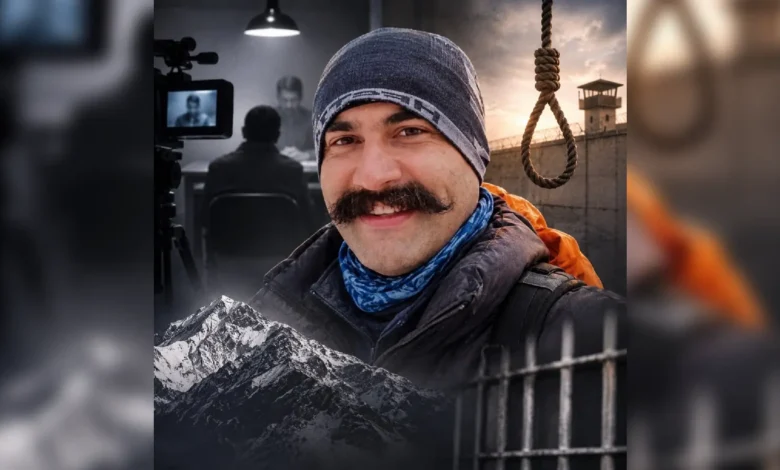
New reports have revealed details of the case and final days of Ali-Sina Mostafavi, a mountaineer and political prisoner with monarchist affiliations, who was executed in Kerman prison on October 13. According to informed sources, just two days before his execution, he was subjected to hours of pressure at an intelligence agency to make confessions against himself on camera, portions of which were broadcast on state television.
According to Iran Wire’s report, on October 11, just two days before his execution was carried out, Ali-Sina Mostafavi was transferred to an intelligence center where he was pressured from morning until around 7 p.m. to confess against himself. Sources for this report also indicated severe beatings during arrest, pressure on his wife and sister, multiple ambiguities in the case file, and defendants’ deprivation of access to written judicial documents.
An informed source stated that the confessions broadcast on the television program “Price of Crime” from Islamic Republic state media, including statements attributed to Mostafavi about being attracted to “Reza Pahlavi’s empty promises,” were extracted from him on the same day under severe pressure.
According to this source, after returning to prison, Mostafavi contacted his family and, while crying, spoke of the pressures he endured to write, sign, and repeat word-for-word the interrogators’ desired statements.
This source further told Iran Wire: “He was under such pressure that he was crying bitterly on the phone. He said they put a piece of paper in front of me, they wanted me to both write and sign it, and also recite it, and they filmed it. They said unless you recite it word-for-word, we won’t let you go.”
One of the most striking parts of this report is the account of the final message Ali-Sina Mostafavi sent to the judge of his case before his execution. According to released information, he had asked prison officials to tell the judge: “I did not wage war with God or commit moharebeh that you charged me with moharebeh for; my war was with you.”
This statement was conveyed at a time when the Islamic Republic’s judiciary had sentenced him to death on the charge of “moharebeh” (enmity against God) and conducting armed activities in Kerman.
The “Mizan” news agency, the official media of the judiciary, had claimed that Mostafavi opened fire in Kerman’s Azadi Square on April 24, 2026, wounding a citizen and a young girl. The agency also claimed that on May 11, he fired at soldiers on duty and passing vehicles, and that searches of his residence revealed several firearms, 246 rounds of ammunition, and 30 Molotov cocktails.
Judicial authorities also accused him of contact with foreign media, sending images of projectile impacts during the war, and announcing readiness to conduct operations at Kerman airport. The judiciary announced that the death sentence was carried out after confirmation by the Supreme Court.
In contrast, an informed source stated that Mostafavi had no associates, no operational equipment, and no plan to attack Kerman airport. According to this source, what was presented in his confession video was an expression of his thoughts and statements, not a description of conducted operations or operational planning.
Iran Wire, referring to a three-minute-eight-second video released by Tabnaka, noted that Mostafavi’s statements in this video were repeatedly cut off and connected together from different sections. In parts of the video, while his voice is being broadcast, images of several weapons and a distant view of Kerman airport are shown; however, it is unclear to whom the displayed weapons belonged.
Mizan news agency had claimed that these weapons were discovered at Mostafavi’s residence and that the released video demonstrated his readiness for operations at Kerman airport.
“Mahshid Nazemi,” a human rights activist from Kerman, stated that the entrance area of Kerman airport is heavily secured and an attack by an ordinary individual alone, without resources and support, would not seem possible.
The confession video was recorded on October 11, just two days before the execution, and Mostafavi was under pressure to repeat the interrogators’ desired statements.
Based on information disclosed by Mahshid Nazemi, Ali-Sina Mostafavi was arrested at approximately 3 a.m. on May 5, 2026, at his home in Kerman. Simultaneously, security personnel raided his mother’s house and the residence of his sister’s fiancé.
According to Nazemi, approximately 50 to 60 security forces participated in this operation. Mostafavi was severely beaten before the eyes of his wife and his eight-year-old daughter; the severity of injuries was such that the family was concerned about serious damage to his vision.
This human rights activist stated that at the first visit, the whites of Mostafavi’s eyes were bloodshot and half his face was bruised.
“Mahboubeh Rahimi,” his wife, “Sima Mostafavi,” his sister, and “Mojtaba Pourmanamin,” his sister’s fiancé, were also arrested that same night. According to Iran Wire’s source account, the arrest of family members was used to coerce Mostafavi into confessing and signing the statements desired by officers.
According to this source, Mostafavi believed that if he wrote and signed what was requested of him, his wife and sister would be released. However, when he was confronted with them after approximately ten days, he was shocked by their continued detention.
Based on the same report, Mahboubeh Rahimi and Sima Mostafavi were each sentenced to seven months and six days in prison on the charge of “anti-system propaganda activities” in connection with their Instagram stories. Mojtaba Pourmanamin was also sentenced to 12 years in prison on charges of cooperating with Mostafavi.
One of the important aspects of this report is the existence of contradictions in official narratives regarding incidents attributed to Mostafavi. Voice of America had previously pointed out differences between initial police reports about the April 24 shooting and later accounts by security agencies. In initial reports, the incident was described as “non-terrorist”; however, later security authorities spoke of arresting individuals on terrorist charges. Additionally, discrepancies have been noted regarding the composition of male and female defendants in reports from different agencies.
Iran Wire also wrote, citing Mahshid Nazemi, that the defendants in this case did not even have access to ordinary judicial documents and summons. According to her, the defendants’ signatures were obtained on blank sheets, and the sheets later shown to them in prison lacked details of charges and judicial provisions.
The report states that the First Branch of the Kerman Revolutionary Court, headed by “Hadi Aqai’i,” issued the death sentence against Mostafavi. Based on released information, the judicial review process was accompanied by allegations of torture, pressure during detention and solitary confinement, and lack of effective access to case documents.
The judiciary announced that the case was reviewed with the presence of a lawyer and the sentence was carried out after confirmation by the Supreme Court; however, this official announcement alone does not address questions about defendants’ actual access to lawyers, the ability to examine evidence, and the credibility of confessions attributed to them.
Mahshid Nazemi, citing sources she described as trustworthy, stated that at the moment of execution, Mostafavi himself placed the noose around his neck and did not allow officers to do so. She also stated that a clergyman named Shams, who was responsible for religious procedures before execution, told prison staff after the sentence was carried out that he had never seen anyone so fearless, and that Mostafavi climbed the steps of the execution site firmly.
These details are also based on accounts from sources who spoke with Iran Wire and Mahshid Nazemi and cannot be independently verified.
Ali-Sina Mostafavi, born on November 28, 1987, was from Bam and resided in Kerman. He was the father of an eight-year-old daughter, a professional mountaineer, and enthusiast of traditional Iranian music who played the tar. According to his public Instagram page, Mostafavi posted content about environmental protection, tree planting, preventing littering in nature, and preserving biodiversity. He had also posted content supporting the Pahlavi family, particularly Mohammad Reza Shah Pahlavi.
An informed source, in describing his character, stated that Mostafavi left his work in real estate because he could not accept lying and provided financial assistance to needy families. The same source stated that after the December protests, he was no longer his former self and was deeply affected by the suffering of the Iranian people.
The execution of Ali-Sina Mostafavi on October 22, 2026, concluded a case whose official narrative was based on serious armed and security charges; however, Iran Wire’s new report raises serious questions about the timing and circumstances of obtaining confessions, the possibility of pressure on the defendant and his family, the credibility of the television video, contradictions in official accounts, and defendants’ access to judicial documents.
In a case whose punishment was the taking of a human life, clear answers to these questions are of fundamental importance: Were the confessions attributed to the defendant obtained freely and without pressure? Were the alleged evidence regarding shooting and plans to attack the airport independently examined? And did the defendant and his family have actual opportunity to defend themselves and access to the judicial process?
The execution of the sentence has forever prevented the defendant from answering these questions. What remains is the necessity of an independent review of the case and clarification of the truth about the process that led to the execution of a father, a mountaineer, and an Iranian citizen.