Writers’ Association Strongly Protests Six-Year Prison Sentences for Three Writers
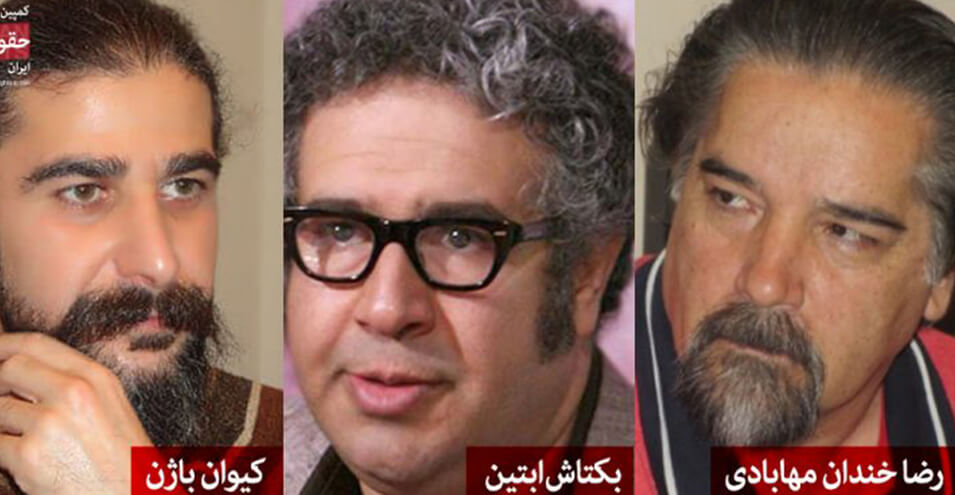
The Iranian Writers’ Association issued a statement on April 16 protesting heavy sentences imposed on three Iranian writers and its members named Baktash Abtin, Reza Khandan Mahabadi, and Keyvan Bazen. According to the ruling by Branch 26 of the Revolutionary Court presided over by Judge Mohammad Moghisseh, each of these three writers has been sentenced to six years in prison.
The trial of these three writers and members of the Writers’ Association took place in early April, and the verdict was delivered to their lawyers on April 15. One day later, the Writers’ Association stated in its declaration that these sentences constitute a condemnation of all Iranian writers who wish to exercise their right to freedom of expression in Iran.
Among the charges against them is participation in commemoration ceremonies for Jafar Pouyandeh and Mohammad Mokhtari, two members of the Writers’ Association who were killed during the serial murders. Another charge against them is the publication of the fifty-year history book of the Writers’ Association. However, Baktash Abtin stated in an interview with the Human Rights Campaign following his court session that he had no participation in preparing this book and was not in Tehran at the time, and that all the printed copies of the book were stolen and never even reached the members of the Association themselves. The book after printing
The Writers’ Association stated in its declaration: “This is not merely a trial and conviction of three writers, nor is it only the trial of the Iranian Writers’ Association. It is the conviction of all writers and those who wish to exercise their right to freedom of expression.”
Reza Khandan Mahabadi, Keyvan Bazen, and Baktash Abtin, who have been repeatedly summoned for interrogation in recent years, arrested, and faced political charges, have been charged in the recent court hearing with two charges of “propaganda against the system” and “gathering and conspiracy against national security.” Baktash Abtin was tried on April 27 on these two charges in Branch 28 of the Revolutionary Court, and Reza Khandan Mahabadi and Keyvan Bazen were tried on April 28 in the same branch. During these two days, some members of the Writers’ Association gathered in front of the court building in protest of their trials and the pressure being applied.
The publication of the four-volume book “Fifty Years of the Iranian Writers’ Association,” which became one of the charges against these writers, was published in limited quantities by the editorial board of the fifty-year commission of the Iranian Writers’ Association on the occasion of the fiftieth anniversary of this non-governmental institution, but was never even distributed among the Association’s own members because copies of the printed book were stolen after leaving the printing house.
The Iranian Writers’ Association stated in its protest declaration: “These three writers have been sentenced to a combined eighteen years in prison for the reason that: why did you become members of the Iranian Writers’ Association; why did you publish an internal publication of a cultural organization; why did you compile the documents and records of the fifty-year activities of the Association in a book; why did you visit the graves of Ahmad Shamloo, Mohammad Mokhtari, and Jafar Pouyandeh; why did you sign statements defending freedom of expression for writers and artists and opposing executions and censorship.”
The statement continued: “What kind of ‘national security’ is it that considers the publication of a newsletter and protest statement as an act against it? Whose security is endangered by membership in the Association and visiting the graves of poets and writers? Any court that carries even a modicum of justice and independence, and respects even a trace of human rights, would not regard these types of ‘evidence’ as proof of crime but rather as pretexts for case fabrication. In reality, what has formed the basis of the charges and verdict in the case of the three members of the Association is nothing but taking steps toward freedom of expression and opposing censorship.”
The Iranian Writers’ Association characterized the charges against its members as case fabrication in its declaration and called for “unconditional cancellation of these sentences and closure of the cases of” its members.
And finally, it called for an end to “repressive” sentences against writers. The statement said that these repressions and sentences “have been occurring in waves in recent decades to spread fear and terror and suppress freedom of expression.”
The Iranian Writers’ Association is a non-governmental institution consisting of writers, translators, editors, and part of the international PEN organization. It formally announced its existence in 1968 with the goal of organizing writers as a profession and fighting censorship. The Association and its members have faced varying degrees of repression since its formation, and especially during the 1980s and 1990s, ranging from censorship and legal prosecution to assassination. Mohammad Jafar Pouyandeh and Mohammad Mokhtari were among the members of the Writers’ Association who were killed during the serial murders.
Source: Iran Human Rights Campaign