Prince Reza Pahlavi Receives “Solomon” Award in Poland
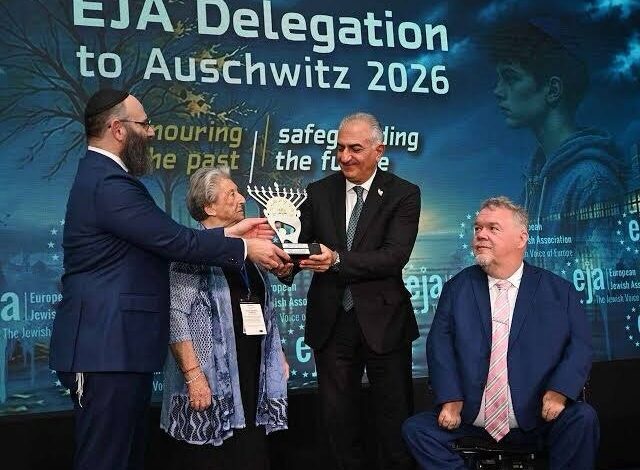
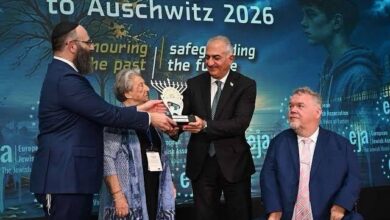
Prince Reza Pahlavi received the “Solomon” award from the Association of Jews in Europe during his visit to Poland, in the city of Krakow. The association presented this award in recognition of his enduring friendship and support for the Jewish community. At the award ceremony, he described the Islamic Republic as a threat to the Iranian people, the Jewish community, and the security of the free world, and called for more serious action by European countries against the Tehran government.
Prince Reza Pahlavi received the “Solomon” award from the Association of Jews in Europe on Monday, November 9, during a ceremony in Krakow. This honorary distinction, also known as the “King Solomon Award,” was presented by the association in recognition of his support and friendship with the Jewish community and his stance against antisemitism. The ceremony took place on the eve of the anniversary of “Kristallnacht,” the night in November 1938 when organized Nazi attacks on Jews in Germany and Austria resulted in massacres, arrests, and the destruction of synagogues and Jewish businesses. On Tuesday, November 10, he and his wife, Yasmin Pahlavi, visited the Auschwitz-Birkenau concentration camp and paid tribute to the victims of the Holocaust.
During his acceptance speech, Pahlavi described the Islamic Republic as a transnational, revolutionary, and jihadist movement that has transformed Iran into a center for global terrorism. Referring to the suppression and killing of protesters in Iran, he said: “The people of this country are the first victims and hostages of the Islamic Republic, and their struggle for freedom extends far beyond Iran’s future.”
In another part of his speech, he stated: “The Islamic Republic is a transnational, revolutionary, and jihadist movement that has occupied Iran’s soil and transformed it into a command center for global terrorism. The people of Iran are the regime’s first hostages, and today they stand shoulder to shoulder with the free world against the same fascists who have targeted Jews.”
Prince Reza Pahlavi emphasized that European countries should not wait for another terrorist attack on European soil to respond to the threats posed by the Islamic Republic. He characterized support for the Iranian people not merely as a moral responsibility but as a necessity for European and global security.
Recalling the historical bond between Iranians and Jews, he stated that the position of the Iranian people against antisemitism is clear, and that descendants of Cyrus and children of Iranians who sheltered Polish refugees during World War II now stand alongside the Jewish community.
Prince Pahlavi also called on European countries, drawing on their historical experience in confronting totalitarian regimes, to abandon appeasement policies toward the Islamic Republic and take more concrete steps to support the Iranian people. In his remarks, he emphasized freedom, human rights, and the Iranian people’s right to determine their country’s political future.
A day after receiving the award, Prince Reza Pahlavi and his wife, Yasmin Pahlavi, visited the Auschwitz-Birkenau concentration camp complex in Poland. The visit was intended to commemorate the victims of the Holocaust and pay tribute to the millions of people who lost their lives during Nazi Germany’s crimes.
Auschwitz was located near the city of Oświęcim in Poland and became the largest complex of forced labor and extermination camps during the Nazi occupation of the country. According to the Auschwitz-Birkenau State Museum, the Nazis deported approximately 1.3 million people to this complex, and at least 1.1 million were murdered there. Around one million of the victims were Jewish, while tens of thousands of Poles, Roma, Soviet prisoners of war, and people of various other nationalities also perished.
The entrance gate of the main Auschwitz I camp was inscribed with the German phrase “Arbeit macht frei” – meaning “work sets you free” – which in reality became a symbol of the Nazi regime’s deception and brutality in the face of imprisonment, torture, starvation, and murder of prisoners.
Following the implementation of the policy known as the “Final Solution” for the extermination of European Jews, Auschwitz-Birkenau became one of the primary centers of mass murder. Large numbers of Jews deported from various European countries, especially through the gas chambers of this complex, were murdered.
On January 27, 1945, forces of the Soviet Red Army liberated the Auschwitz camp. Thousands of remaining prisoners were found in severely dire conditions. Many other prisoners had been forced westward on death marches before the arrival of Soviet forces.
Prince Reza Pahlavi’s emphasis on the historical connection between Iranians and Jews refers to a relationship spanning many centuries. In Jewish historical tradition and collective memory, the name of Cyrus the Great is linked to the end of Babylonian exile and his permission for the return of Jews to their homeland and the reconstruction of the Temple in Jerusalem.
During World War II, Iran also hosted a number of Polish refugees who arrived through the Soviet Union. Among them were Jewish children, who later became known as the “Children of Tehran.” This historical experience was one of the important themes in Pahlavi’s remarks at the Krakow ceremony.
The visit to Auschwitz likewise carries symbolic significance within this framework: a reminder of the catastrophe that befell European Jews and other victims of Nazism, and an emphasis on the necessity of confronting antisemitism, hate-mongering, and organized crimes against humanity.
Receiving the Solomon Award and his presence at Auschwitz formed the two main components of Prince Reza Pahlavi’s visit to Poland, a journey in which his remarks linked the freedom of the Iranian people, global security, and the necessity of standing firm against antisemitism.