Reza Pahlavi in Brussels Seeking European Support for the Iranian People
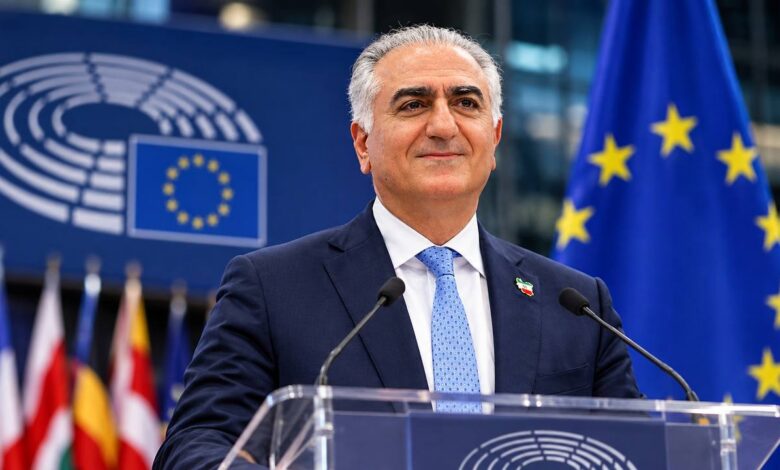
Reza Pahlavi announced his trip to Brussels through a message posted on his official social media pages, stating his efforts to convey the demands of the Iranian people to European leaders and lawmakers. He also claimed that the Telegram campaign “Barkhiz Iran” (Rise Up Iran) received hundreds of thousands of messages from within the country in a short period.
In this message, Reza Pahlavi described his Brussels trip as an effort to secure European political support for opponents of the Islamic Republic, saying his goal is to amplify the voice of Iranians who, according to him, are standing against the repression and violence of Iran’s government.
In a significant section of his message, he defended the launch of the “Barkhiz Iran” Telegram bot and claimed that the Islamic Republic, by spreading false information, attempted to prevent people from joining this campaign; however, this attempt failed. According to Pahlavi, the bot received hundreds of thousands of messages in a short time from various segments of society, including students, teachers, doctors, workers, soldiers, and police officers.
Nevertheless, the number of messages received, the actual participation rate of citizens within Iran, and how duplicate or automated messages are distinguished from independent messages have not yet been verified by an independent institution. Therefore, the figure announced should currently be considered a statistic presented by Reza Pahlavi’s team, not a statistic independently verified.
This message was released following Reza Pahlavi’s trip to Belgium, which began on Tuesday, November 3 (Aban 12), during which he met with several members of the European Parliament. According to Iran International’s report, Pahlavi met on Wednesday with David McAllister, Chairman of the European Parliament’s Foreign Affairs Committee, to discuss the possibility of imposing further sanctions against the Islamic Republic and supporting free internet access for Iranians.
He also called for a change in European policy toward the Islamic Republic in an article in the Brussels Times, and outlined five pillars for European lawmakers to act upon: identifying and freezing hidden assets of officials and networks affiliated with the government, expelling agents and networks linked to the Islamic Republic, providing financial support for free internet access tools, offering political support to political prisoners and protesters sentenced to death, and creating opportunities for officials who break away from the government to join the people.
However, his trip to Belgium was not without controversy. Belgian news network BX1 reported that the Belgian Foreign Ministry took a cautious stance regarding a formal invitation to Pahlavi at Parliament and emphasized the necessity of hearing other voices of Islamic Republic opponents. According to the same report, the Belgian government announced it does not show preferential support for any particular person or group among Iran’s opponents. Ultimately, the meeting with Pahlavi was held as part of a session of the liberal party MR’s parliamentary group, not as an official meeting in the name of the entire Parliament.
These disagreements show that even among European politicians opposed to the Islamic Republic, there is no complete consensus on how to engage with opposition figures and the extent of their political representation.
One of the main themes of Reza Pahlavi’s latest message is an invitation for citizens to communicate directly with his team through the “Barkhiz Iran” Telegram bot. He has emphasized that protecting user security is the primary priority of this campaign.
Given the security situation and the government’s extensive surveillance of citizen communications in Iran, the issue of protecting user information is of particular importance. However, in independent sources reviewed for this report, sufficient technical details about how messages are stored, team members’ access to user information, data retention periods, and practical mechanisms for protecting participants’ identities have not been published. Consequently, the campaign organizers’ emphasis on user security alone cannot replace the publication of transparent and verifiable information about privacy and digital security.
Reza Pahlavi’s message, beyond inviting participation in a communication campaign, carries an important political claim: he presents himself as committed to leading efforts for Iran’s freedom and asks people to join a campaign that he says aims at overthrowing the Islamic Republic and building a free and prosperous future.
At the same time, in his article for Brussels Times, he spoke of a coalition that, according to him, can include republicans and monarchists, leftist and rightist movements, and citizens of various languages, religions, and backgrounds. He outlined four principles for this coalition: preserving Iran’s territorial integrity, separating religion from government, individual rights for all citizens, and the people’s right to choose the form of government through free and fair elections.
These principles, if developed into a clear and measurable program, could serve as a basis for dialogue about Iran’s political future; however, the degree of acceptance among various opposition groups and how equal participation of all groups is guaranteed are matters that require further clarification and accountability.
At a time when Iranian society faces political repression, economic crisis, restrictions on civil liberties, and concerns about the future, any political campaign seeking to gain citizens’ trust must provide clear answers not only about inviting participation, but also about decision-making methods, transparency, information security, and guarantees of the people’s free right to choose.
The full text of Crown Prince Reza Pahlavi’s message, published on his official pages, is as follows:
“My dear compatriots,
I have come to Brussels to convey your message and desires to the ears of Europe’s leaders, lawmakers, and public opinion—the voice of a nation that courageously and steadfastly stands against the repression and violence of the Islamic Republic and has not surrendered to this criminal regime.
In its latest disinformation campaign, the Islamic Republic attempted to prevent you from joining the “Barkhiz Iran” Telegram bot by spreading false information, but this attempt also failed. In a short time after its introduction, we received hundreds of thousands of messages from across the country through this bot. From students, teachers, and doctors to workers, soldiers, police officers, and other segments of society.
We launched this campaign to create a direct and two-way connection with you, and its widespread reception carries a clear message: the will of the Iranian nation is unbreakable.
Our nation, with all its diversity and variety, seeks liberation from the Islamic Republic and fights and pays for it. This nation does not fear the regime; on the contrary, it is the Islamic Republic that fears the power of a united Iran. It is the regime’s missing leader who hides in fear of the people and does not even dare to utter a sound.
You, my honored compatriots, have once again proven that contrary to the regime’s propaganda, not only have you not grown tired and discouraged, but your belief in victory is stronger than ever.
I am proud of your courage, steadfastness, and loyalty to Iran. You have stood by your covenant with the homeland in the most difficult days. I, too, stand by my covenant with you for Iran’s freedom and dignity.
Once again, I invite all you compatriots who believe in overthrowing the Islamic Republic and building a free and prosperous future to join the National Cooperation Campaign for the Salvation of Iran.
You can contact my team directly by scanning the QR code during the live broadcast of the Iranian National Revolution Television and Iran International network, or through the Telegram ID @BarkhiziranBot. Rest assured that protecting your security is my and my team’s foremost priority in this campaign.
We want for ourselves and future generations a free, advanced, and dignified Iran—an Iran that regains its rightful place in the world once again. I believe in this future because I believe in you and your unbreakable will. The light of Iran will triumph over the darkness of the Islamic Republic.
Long live Iran, Reza Pahlavi”