Reza Pahlavi in the Heart of Germany: “I Will Return the Freedom Prize to Tehran”
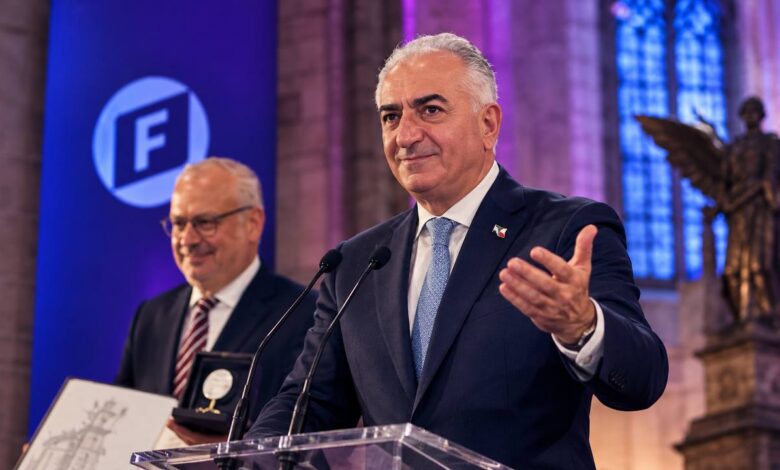
Reza Pahlavi, the exiled Iranian prince, at the ceremony to receive the 2026 Freedom Prize from the Friedrich Naumann Foundation at the historic St. Paul’s Church in Frankfurt, called for targeting the Islamic Republic, the Islamic Revolutionary Guard Corps, and the regime’s repressive apparatus; he emphasized that Iran’s people and civilian infrastructure must remain safe from military attacks. In explicit remarks, he attributed responsibility for dragging the war into Iran to the Islamic Republic and said that Iran’s future should only be determined by the Iranian people.
Reza Pahlavi stated at the ceremony: “The Iranian people want the Islamic Republic, the Islamic Revolutionary Guard Corps, the repressive apparatus, and the weapons used against the people themselves to be targeted. We seek to protect the Iranian people and the country’s civilian infrastructure.”
Rejecting the false binary of “war or appeasement,” he said he has advocated for years the policy of “maximum pressure on the Islamic Republic and maximum support for the Iranian people.” According to him, following the massacre of protesters and despite the pain and concern over the consequences of war, they have concluded that military pressure can weaken the regime and provide an opportunity for the Iranian people.
Pahlavi, referring to the deaths of civilians, said in part of his speech: “The killing of every innocent Iranian in this war is a great pain that I carry in my heart.”
He described the Islamic Republic as a government that, through suppression and killing of its own citizens and spending national wealth on foreign wars, has become the greatest threat to Iran’s national sovereignty. Pahlavi also emphasized that external pressure, even if it weakens the regime, should neither replace the people’s will nor decide Iran’s future.
One of the main themes of Reza Pahlavi’s speech was emphasizing the Iranian people’s right to freely choose the future political structure. He described the Islamic Republic as lacking legitimacy and his role not as determining the shape of future government, but as helping to facilitate a safe transition and establish and sustain democracy.
He also emphasized principles such as preserving Iran’s territorial integrity, equal rights for all citizens regardless of language, ethnicity, or religious belief, separation of religion from government, and the right to choose a political system through free popular vote. In explaining his views on a secular state, Pahlavi spoke of equal rights for Shias, Sunnis, Bahais, Christians, Jews, Zoroastrians, and non-religious citizens.
He described himself as a bridge to cross from the current situation toward a free future; a bridge that is not meant to be the final destination, and the decision about that destination should remain in the hands of the Iranian people.
The Friedrich Naumann Foundation in 2026 awarded its Freedom Prize not to an individual or party, but to the Iranian people; people who, according to the foundation, are struggling for freedom, civil rights, and democracy. Reza Pahlavi received this prize as a trustee and until it can be handed over to freely elected representatives of the Iranian people.
He stated at the ceremony that he is a trustee and owns nothing he possesses; his duty is to protect it and return it to its true owners. Pahlavi pledged to one day return the prize to the Iranian people: “Not in the soil of a foreign land, but in the capital of our own nation, Tehran.”
The ceremony took place at St. Paul’s Church in Frankfurt; a historic venue where the first nationwide elected parliament of Germany was formed in 1848. The choice of this location for awarding the prize to the Iranian people created a symbolic link between Iranians’ struggle for freedom and Germany’s historical experience on the path to democracy.
Concurrent with the ceremony, thousands gathered in Frankfurt. According to German media reports, police announced around midday that the number of gatherers across the city was approximately five thousand; most were supporters of Reza Pahlavi. For the rally and major gathering in “Oust” park, approximately 24,000 and 30,000 participants had registered or were announced respectively. Alongside the supporters’ gathering, opponents of the foundation’s decision to entrust receiving the prize to Reza Pahlavi also protested. Reports indicated the gatherings and marches took place in a largely peaceful atmosphere.
Marie-Agnes Strack-Zimmermann, chair of the European Parliament’s Security and Defense Committee, also emphasized at the ceremony the Iranian people’s right to freedom and self-determination. Recalling the suppression of protests and imprisonment of protesters, she said this prize carries a clear message for the Iranian people: “You are not alone.”
At the same time, the selection of Reza Pahlavi as the prize’s trustee recipient was not without criticism. Some Iranian groups and activists have protested this decision and have emphasized the need to reflect the ethnic and political diversity of Iranian society. German media have also pointed to disagreements over Reza Pahlavi’s political role and the legacy of his father’s rule. However, the Naumann Foundation has clarified that the prize belongs to the Iranian people and that receiving it as a trustee does not mean transferring the right to decide on the country’s future to an individual or political faction.
The ceremony took place at a time when suppression of protests, executions, and pressure on opponents continue in Iran. The main message of this prize, according to its organizers, is to honor people who are paying the price for their freedom and fundamental rights; people who are destined to decide Iran’s future one day not through government-appointed representatives, but through their own free choice.