Human Rights Lawyer Amirsalar Davoudi Suffers Heart Attack While in Solitary Confinement
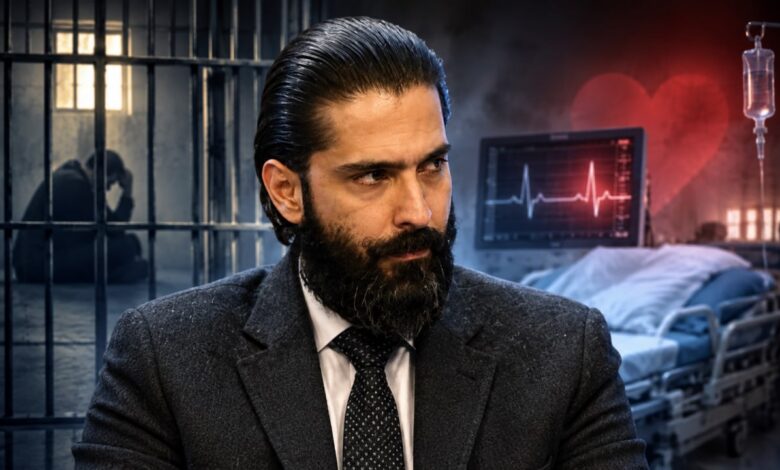
“Amirsalar Davoudi,” a lawyer and human rights defender, has suffered a heart attack following what reports describe as security pressure, prolonged solitary confinement, and deprivation of access to medication. He has been transferred to Alzahra Hospital in Isfahan. Despite his transfer to the hospital, no clear information has been released regarding his physical condition, whether he remains hospitalized, or whether he has been returned to prison.
According to a report by the human rights organization Hengaw, citing its sources, Amirsalar Davoudi suffered a heart attack in solitary confinement after enduring security pressure and deprivation of medication during his detention. Based on this report, he was transferred from his place of detention to Alzahra Hospital in Isfahan.
It should be noted that to date, no official or independent report has been released regarding the details of the heart attack, his current condition, or his place of detention following his transfer to the hospital.
Amirsalar Davoudi was arrested on Sunday, October 19, 2026 (Mehr 19, 1405), while appearing in court at the Isfahan Revolutionary Court to defend his client “Mehshad Kashani.” Reports indicate that officers transferred him from the courtroom to the office of the head of the judicial complex and subsequently arrested him.
“Asadollah Jafari,” the Chief Justice of Isfahan Province, confirmed Davoudi’s arrest two days later in a statement released by the Judiciary’s Public Relations Office. He cited the distribution of an audio file of the wedding ceremony of “Alireza Sepahi” and “Mehshad Kashani,” as well as materials published by this lawyer, as reasons for legal action against him.
Jafari raised charges against Davoudi including “publishing computer-based falsehoods with intent to disturb public opinion,” “inciting people to kill one another with intent to destabilize national security,” and “propaganda against the system.” These are charges announced by the judicial authority and do not constitute proof of guilt.
Prior to his arrest, Davoudi represented Alireza Sepahi, an executed political prisoner in Isfahan. He also published news of the marriage of Sepahi and Mehshad Kashani, two prisoners who were detained at the time of the ceremony, and posted an audio file of the recitation of their marriage vows on his personal page.
Alireza Sepahi was executed on the morning of October 13, 1405 (Mehr 13). The release of news about these two prisoners’ marriage and Davoudi’s objections to the legal proceedings and execution of the death sentence became a subject of media attention following his arrest.
The Chief Justice of Isfahan publicly cited the distribution of the audio file of the marriage as one of the reasons for Davoudi’s arrest. This matter highlights the connection between this lawyer’s professional activities and information dissemination and his new legal case.
Another concern raised regarding Davoudi’s case is the restriction on his chosen lawyer’s access to case information. According to published reports, even the lawyer appointed from among those approved under Note 48 of the Criminal Procedure Code has not been granted access to review the case contents.
Article 48 of the Criminal Procedure Code and its note impose certain limitations on lawyer selection during the preliminary investigation phase in some security-related cases. However, denying an approved lawyer access to the case file raises serious questions about the possibility of effective defense and respect for the defendant’s rights.
According to information released by the Human Rights Organization in Iran, Davoudi was transferred to Isfahan Central Prison, known as Dastgerd Prison, following his arrest. The organization also reported that he was deprived of contact and visits with his family, and that his family and lawyer were unaware of his place of detention.
Amirsalar Davoudi has previously faced legal proceedings and imprisonment due to his legal and civil activities. In a previous case, he was sentenced to a total of 30 years imprisonment and 111 lashes; according to reports by the Human Rights Organization in Iran, the execution of this sentence was halted following the acceptance of a retrial petition. Davoudi also received the Ludwig Travers International Human Rights Award in 2022.
The report of his heart attack and transfer to the hospital has now turned concerns about this lawyer’s health condition into an urgent matter. According to human rights standards, every person deprived of liberty must have access to necessary medical care, and the state is responsible for preserving the health and life of those held in its detention.
At the time of this report’s publication, Amirsalar Davoudi’s exact physical condition and his place of detention following his transfer to the hospital remain unclear. Transparent information about his medical condition, access by his family and lawyer to him, and assurance of appropriate medical care are urgent requirements in this case.