Why Are Iraqi Protesters Attacking Iran?
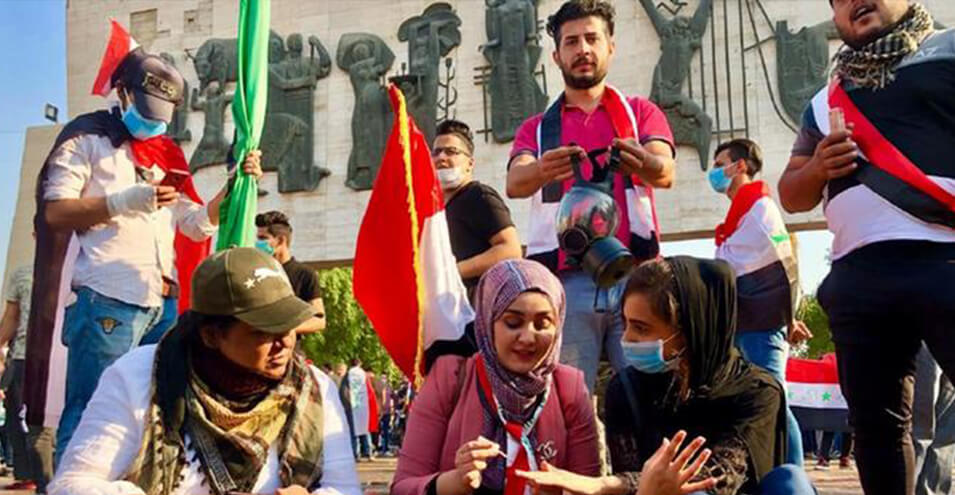
As protests continue in Iraq, the anti-Iranian tone of these demonstrations has intensified. Deutsche Welle Persian spoke with several Iraqi protesters to understand the reasons behind this negative and critical stance toward Iran.
“For Iraqis who dream of a democratic Iraq, the presence of Shiite militia forces close to Iran and their interference in politics is a nightmare that has unfortunately come true.” This is what Amin Ahmad, one of the Iraqi protesters currently demonstrating against his country’s situation at Tahrir Square in Baghdad, says.
Amin Ahmad, 25 years old, told Deutsche Welle Persian: “Many Iraqis feel that Iran has not been a good neighbor for them. They believe that Iran’s interference is holding Iraq back and preventing Iraqis from progressing and achieving the social freedoms they seek.”
The new wave of protests in Iraq began in early October this year, not September, in response to economic and livelihood conditions, widespread corruption in government, and the state’s failure to provide services. However, these protests gradually took on a more political character, and the scope of protesters’ demands and grievances expanded rapidly.
Amin Ahmad says: “The issue is not just Iran. Many of the young people present at Tahrir are in agreement with me that Iraq’s election law and political system need to be completely transformed.”
He says: “First, we need to dissolve the quota law based on sect and ethnicity and end this situation. We don’t trust any of the current parties and politicians. Even those who claim to support our movement.”
The current situation at Iraq’s Tahrir Square is reminiscent of the same square in Cairo at the height of the Arab Spring. Like those days, in Iraq too, demonstrators from various social backgrounds and political affiliations have remained in tents and public booths, continuing their protests with music, dancing, slogans, and sometimes stone-throwing. These gatherings are occasionally subjected to sporadic but violent and armed attacks.
On the western side of Tahrir Square, there is a 13-story commercial complex that had been left in semi-abandoned condition since Saddam Hussein’s fall in 2003.
Before the start of the second round of protests, Baghdad residents knew this building as a Turkish restaurant (Mataem al-Turki), but since October 25 (the fourth of Aban) when protesters took control of it and have been using it for rest, food and beverage distribution, and medical services, the building has been given a new name. The building is now known as “Uhud Mountain of Baghdad.” In the history of early Islamic wars, Mount Uhud was a strategic stronghold whose loss led to the defeat of Muslims. Protesters believe that in this building they are safe from the danger of snipers and evacuating it would be equivalent to accepting defeat.
We Don’t Trust Adel Abdul Mahdi
The entrance to the Turkish restaurant building is covered with large banners with slogans such as “No Iran, No Saudi Arabia, No America, No Baath, No Barzani, and No Israeli spies!”
Among them, large banners of Muqtada al-Sadr’s supporters are also visible. From the very beginning of the tensions, Muqtada al-Sadr expressed support for the protesters and shortly after called for a cabinet reshuffle.
Malath Laith Fouad, a 26-year-old female student, is convinced that “those who are part of the problem cannot provide a solution to it. Muqtada al-Sadr and others who pretend to support us know they lack the ability to confront the people.”
It seems the demonstrators have no intention of returning to their homes. Abbas Ali, a 32-year-old protester from Baghdad, has been present at Tahrir Square since Friday night, November 1. He told Deutsche Welle Persian that trust between people and government has completely vanished.
He says: “How can we trust their promises when more people are being shot at every day?”
He says: “Cabinet reshuffle will not deceive anyone. Adel Abdul Mahdi says that as soon as he finds a successor, he will hand over power, but what we want is different from what he has in mind. We want a revolution.”
In response to such demands, though Adel Abdul Mahdi has insisted on carrying out fundamental reforms to address the protesters’ demands, at least for now he has rejected stepping down from power.
Like many other young women, Malath is present in the square every day. She helps the protesters by filming and photographing events and posting them on social media.
She believes that the discontent across the country is much more widespread than what is seen in major cities: “The cameras may be focused only on Baghdad, Basra, and Karbala, but many residents of Anbar, Mosul, and other cities are still here alongside us.”
She refers to the severe security atmosphere prevailing in predominantly Sunni cities, especially those that were recently under ISIS control, and says that the slightest protest movement there is quickly suppressed. She wants “everyone to know that this is not a Shiite or Sunni issue; this is an Iraq issue.”
Unfulfilled Neighborly Duty
The volume of trade between Iran and Iraq reached 19 billion dollars by last summer. Bazaars across Iraq are full of Iranian goods. Even among food packages distributed to demonstrators, Iranian items are visible.
Nevertheless, social networks are filled with videos in which Iraqis call on their compatriots to boycott Iranian goods.
Anti-Iranian sentiments, slogans, and speeches against Iran have intensified in recent weeks. It has gone beyond slogans—for example, in Karbala, the building of the Islamic Republic’s consulate in that city was attacked.
In Malath’s view, “protesters are attacking the Iranian government, not the people of that country. Iraqis have always been good hosts to Iranian pilgrims. But if the Iranian government’s interference continues, who will guarantee that this hatred won’t spread?”
Many Iranian officials have taken positions against the protesters, and reports have been published about the direct presence of Qasem Soleimani, commander of the Quds Force of the Islamic Revolutionary Guard Corps in Iraq, to direct how to deal with the protests. Supreme Leader Khamenei compared the Iraqi protests to “the sedition of the ninth of Dey” and accused “the United States and some regional countries” of creating tensions in Iraq and Lebanon.
Abbas Ali, confirming the words of Amin and Malath, told Deutsche Welle Persian: “Beyond Baghdad, anti-Iranian sentiments take on different content and approach ethnic resentment.”
Over the past two years, due to a short-term contract with a telecommunications company, he has frequently traveled to Basra. According to his observations, people in cities like Basra have forgotten about ISIS and its allies and now hold Iran responsible for all shortages.
According to him, “in the suburbs of Basra, on the banks of the Shatt al-Arab, you can see Abadan and Khorramshahr on the Arvand Rud bank. Every time Basra goes dark due to electricity shortages, Abadan and Khorramshahr are seen bathed in light on the other side of the Arvand. The people of the region used to hold Saddam responsible for this situation, but now they think Iraq’s wealth is being plundered by people whose ties to Iran are increasingly obvious.”
As Iraq’s political crisis escalates, it remains unclear in what direction relations between the two countries will head in the coming months. The governor of Mehran declared on the eighth of Aban (October 30) a ban on the entry of trucks and transit vehicles into Iraqi territory due to “Iraq’s unstable situation.” Some border crossings have been closed, and Iranian pilgrims have been asked not to travel to Iraq for pilgrimage for now.
FIFA’s decision also shows what the state of relations between the two neighboring countries is these days. The football match between Iran and Iraq’s national teams is set to be held in a stadium in a third country instead of Basra. This situation is not a good sign for the friendly relationship between two countries that spent eight years in war three decades ago.
Source: DW