Security Document Reveals Plan to Restrict Christmas Celebrations in Iran; Christmas Tree Under Government Scrutiny
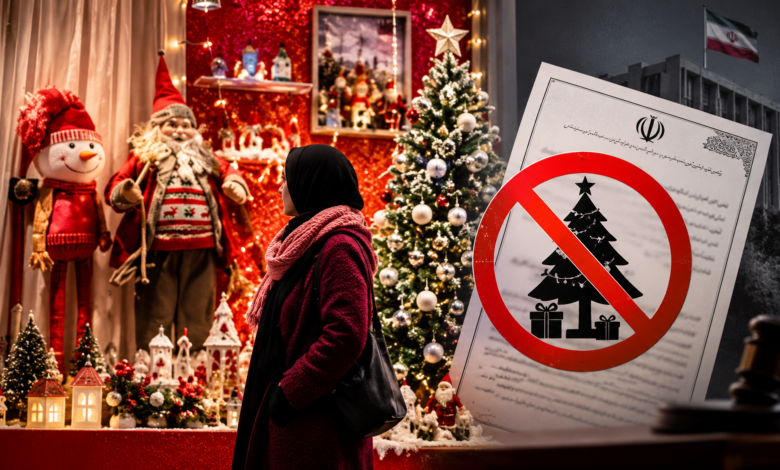
A document attributed to the secretariat of the Information Coordination Council reveals a program aimed at restricting Christmas celebrations, displaying New Year symbols, and selling products related to Christianity in Iran. The document requests that municipalities, schools, welfare organizations, hotels, shops, postal services, and judicial bodies monitor activities related to Christmas and in some cases prevent their organization or distribution.
According to information released by Article 18 Organization, the organization has viewed the original version of the document attributed to the secretariat of the Information Coordination Council; however, due to limited access to information and independent sources in Iran, it is not possible to fully verify the document’s authenticity and the extent of implementation of the orders contained within it. A version of this document with modifications has also been published on the social network X. Therefore, what is presented in this report regarding the details of the orders pertains to text attributed to security institutions and should not be considered as instructions whose authenticity and implementation have been formally confirmed.
In the published text, Christmas celebrations and the use of symbols such as Christmas trees and Santa Claus are framed within the context of activities described as “Crusader-Zionist Christian movements.” The document’s authors also identify house churches and Bible distribution networks as activities that allegedly target the Islamic beliefs of society. Although the authenticity and extent of implementation of this document’s provisions have not yet been independently verified, its content aligns in a concerning manner with the Islamic Republic’s long history of security-oriented treatment of Christians, particularly converted Christian citizens and house churches.
The aforementioned rhetoric, more than demonstrating concern for public security, reflects an ideological perspective that links the religious and cultural activities of a community to concepts such as infiltration, threat, and security conspiracy. In such a view, even a family gathering, a Bible, a cross symbol, or a Christmas tree can transform from a normal cultural and religious matter into a security issue.
This approach, of course, has precedent in media outlets close to the government. The “Rasa” news agency affiliated with the Qom seminary wrote approximately two years ago in an article titled “Pine Tree Worshippers of Cyrus” that a tendency toward celebrations such as Christmas represents a form of cultural aggression. This media outlet even linked Christmas celebration organizers to individuals who participate in ceremonies related to Cyrus. Such rhetoric demonstrates that opposition to Christmas is not limited to security circles and is rooted in part of the government’s ideological propaganda.
However, the reality of Iranian society differs from this security portrayal. Interest in Christmas trees, Santa Claus, lights, and New Year decorations is also seen among some non-Christian citizens. Some of these enthusiasts are Christians, some are interested in the culture and aesthetics of this celebration, and some simply view it as an opportunity for joy, family gatherings, and escape from daily pressures. None of these choices are inherently a threat to security or others’ beliefs.
Based on the text attributed to the secretariat of the Information Coordination Council, implementation of resolutions related to “managing New Year and Christmas celebrations” is to be pursued through security committees in provincial governorates and county offices.
In the section pertaining to municipalities, there is mention of preventing district mayors from attending churches, refraining from installing New Year greeting billboards, and prohibiting the issuance of permits for tourism tours to visit sites belonging to religious minorities.
In the education and welfare organization sections, there is discussion of preventing Christmas celebrations in schools and kindergartens, particularly in Tehran and other major cities. Cultural heritage departments have also been asked to prevent the installation of Christmas trees and symbols such as Santa Claus in hotels.
Another section of the document pertains to the Prosecutor’s Office for Culture and Media; an institution that, according to the published text, should combat the sale of Christian items in online stores and social networks. These measures could lead to the blocking of websites and Instagram pages. Postal offices have also been called upon to manage the sending of Christian religious promotional items.
In another section, emphasis is placed on gathering information about Instagram pages and shops that display or advertise Christian symbols and Christmas products. If these orders are implemented, the scope of action extends beyond churches and religious gatherings to include ordinary businesses, decoration sellers, hotels, and even families who install Christmas trees in their homes.
In other words, the problem is not merely how to hold religious ceremonies, but also the right of citizens to choose their method of celebration, decorate their homes, purchase a cultural commodity, and appear in public spaces comes under attack.
Concerns about the provisions of this document are being raised at a time when the treatment of Christian communities, particularly converted Christian citizens and members of house churches, has been repeatedly documented.
Article 18 Organization has reported the arrest of dozens of Christians around Christmas. For example, on December 27, 2024, more than 40 Christians were arrested in two separate gatherings to celebrate Christmas. These arrests occurred at a time when judicial authorities had announced the granting of five-day leave to some imprisoned Christians on the occasion of Christmas.
In another example, in November 2023, approximately 30 intelligence ministry operatives raided a Christian family gathering near Shahriar that had been organized to plan Christmas celebrations. Hossein Mohammadi and Hana Golami, two Christian citizens, were among those arrested in this case and were later summoned to serve their prison sentences.
Additionally, two brothers named Mahmoud and Mansour Mardani, who were arrested during a security forces raid on a house church in Fooladshahr, Isfahan, coinciding with the celebration of Christmas, were each sentenced to four years in prison and in December 2025 were transferred to prison to serve their sentences.
Article 18’s annual report on 2025 also reports increased pressure on Christians, arrests, and issuance of heavy prison sentences. The report states that in 2025, at least 73 Christians were convicted of various charges and at least 57 people faced penalties including imprisonment, exile, or forced labor. The report also refers to the cancellation of public Christmas services at Vank Church in Isfahan in November 2025; an action that occurred for the second time in four years.
Meanwhile, a distinction must be made between the status of historical and officially recognized Armenian and Assyrian churches and the status of converted Christian citizens and Persian-speaking communities. The constitution of the Islamic Republic recognizes Christians as among officially recognized religious minorities, but this recognition does not mean that all Christians enjoy equal freedom to worship, teach, and hold ceremonies.
According to the British Foreign Office’s political report on Christians in Iran, updated in October 2026, Armenian and Assyrian Christians have limited ability to hold services in their churches, but this freedom comes with restrictions; including that official churches are subject to oversight and are not allowed to accept converted Christian citizens in their services or engage in evangelical and religious activities in the Persian language. In contrast, these converted citizens are often denied access to official churches and resort to house gatherings for worship and Bible study; gatherings that have repeatedly been targets of security force raids.
The report also mentions the arrest and prosecution of Christians on vague charges such as “propaganda against the system,” “promotion of Zionist Christianity,” and security crimes. Even activities such as prayer, baptism, communion, and Christmas celebrations have been presented as evidence of charges against Christians in some cases.
Article 18 of the International Covenant on Civil and Political Rights, to which Iran is also a party, recognizes the right to freedom of thought, conscience, and religion. This right includes the freedom to have or adopt a religion or belief and to express it individually or collectively, in private or in public, through worship, performance of rituals, religious practices, and teaching.
Even if a government disagrees with a celebration or cultural symbol, that disagreement cannot serve as justification for suppressing or depriving citizens of their fundamental rights. A Christmas tree, Santa Claus, a Bible, or a family gathering are not inherently security threats. Converting these symbols into subjects of case-making and security monitoring is nothing but government interference in the most private choices of citizens.
If the published document is authentic and its provisions are implemented, the Islamic Republic will not only restrict Christians’ religious freedom but also limit non-Christian citizens’ right to participate in a cultural celebration and choose their own way of life. A government that feels threatened by a decorated tree or a family celebration actually demonstrates how alienated it is from cultural diversity and citizens’ freedom of choice.
The people of Iran do not need security permits for joy, faith, and coexistence. No institution has the right to tell families what symbols to place in their homes, what books to read, what celebrations to hold, or which religious community to join. Christmas is not a crime, Christian faith is not a crime, and citizens’ happiness should not become a security file.