National Registration of Armenian Music Museum and Historic Cemeteries in Isfahan
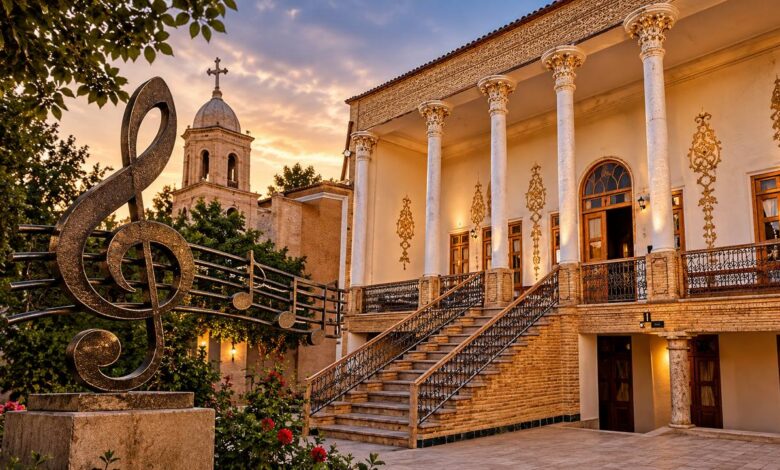
The Armenian Music Museum in New Julfa and a collection of historic Armenian cemeteries in Isfahan Province have been registered in the list of Iran’s national monuments; a step to preserve part of the centuries-old history of Christians in Iran that, at the same time, raises serious questions about the Islamic Republic’s performance in protecting churches and properties belonging to this community.
“Rouhollah Seydalassegari,” deputy of cultural heritage at the Isfahan Province’s cultural heritage directorate, announced that at a meeting of the National Monument Registration Council, files of several buildings and historical sites belonging to religious minorities were reviewed, and qualified works were registered as national monuments.
The most important building registered in this collection is the “Abrahamyan House”; a structure that was previously used as an Armenian orphanage and now houses the Isfahan Armenian Music Museum. This building is located in New Julfa; a neighborhood that has been one of the most important centers of Armenian presence and life in Iran for centuries.
Alongside this museum, historic Armenian cemeteries in Fereydunshahr, including the Hovanes One and Two cemeteries as well as the cemeteries of Saint Mary, Saint Nersès, Snowhouse, and several villages in the province, including Khalilabad, Khang, Sarushjan, Bijgerd, and Milagard, have been placed on the list of national monuments. These cemeteries are not merely burial grounds; their tombstones, inscriptions, and historical markers represent part of the collective memory and enduring evidence of centuries of Armenian presence in this region.
Seydalassegari described the registration of these works as a step toward recognizing the lesser-known heritage of religious minorities and emphasized that these monuments are not limited to a specific community, but are considered part of Isfahan’s historical and cultural identity.
However, the national registration of these monuments is taking place under circumstances where the Islamic Republic’s historical treatment of part of Christian heritage presents a different and concerning picture.
In June 2026, the historic Evangelical Church of Mashhad, a building from the Qajar and early Pahlavi periods that had previously been registered on the national monuments list, was demolished in a nighttime operation. After public reactions, provincial officials spoke of halting the demolition and the necessity of protecting the building’s remains, and the Governor of Khorasan Razavi mentioned the promise of its reconstruction; however, in November of the same year, the remaining sections of the church were also demolished at night. The identity of the direct perpetrators of this demolition has not been independently clarified, but this event raised serious questions about the oversight and responsibility of relevant institutions.
Another example is the complex of St. Peter’s Evangelical Church in Tehran. United Nations human rights experts condemned in a statement on July 15, 2026, the confiscation of this complex and the expulsion of 27 Armenian and Assyrian citizens residing there. This complex, in addition to the church building, included residential houses, two schools, and offices of Christian institutions. According to UN experts, the ruling transferring the ownership of this complex was issued in 1998 by the Revolutionary Court and became the basis for subsequent actions.
In Tabriz, the Assyrian Evangelical Church was also closed in 2019 with the involvement of security personnel; the cross atop its tower was removed and the building’s locks were changed. A report by Iran’s Human Rights Documentation Center also reported the confiscation, change of use, or destruction of several church properties in various cities of the country over the past decades.
These cases show that the problem is not merely the natural deterioration of historic buildings; in some cases, judicial and administrative decisions, confiscation of property, closure of churches, and restrictions on the activities of Christian communities have also played a role in the fate of this heritage.
Of course, a distinction must be made between the status of historical Armenian and Assyrian communities, which are recognized in the constitution as religious minorities, and the status of converted Christian citizens; the restrictions and pressures on these groups are not identical. However, the protection of property rights, worship, and maintenance of historical sites is a right that should not depend on the type of church or the ethnic and religious background of its followers.
The national registration of the Armenian Music Museum and the historic cemeteries of Isfahan is a positive and noteworthy step; but the true value of such a decision becomes apparent when the protection of Christian heritage becomes a continuous and practical measure: from the restoration and maintenance of buildings to the prevention of their confiscation, destruction, and non-transparent change of use.
One cannot speak of the historical coexistence of religions and Iran’s cultural diversity while remaining silent in the face of church demolitions, closure of places of worship, and loss of Christian communities’ property. The heritage of Armenians and other Christians in Iran is part of the history of this land; protecting it is not a privilege for a minority, but a public and cultural responsibility.