Girls protesting against compulsory hijab welcome the protester's action in Enghelab Square
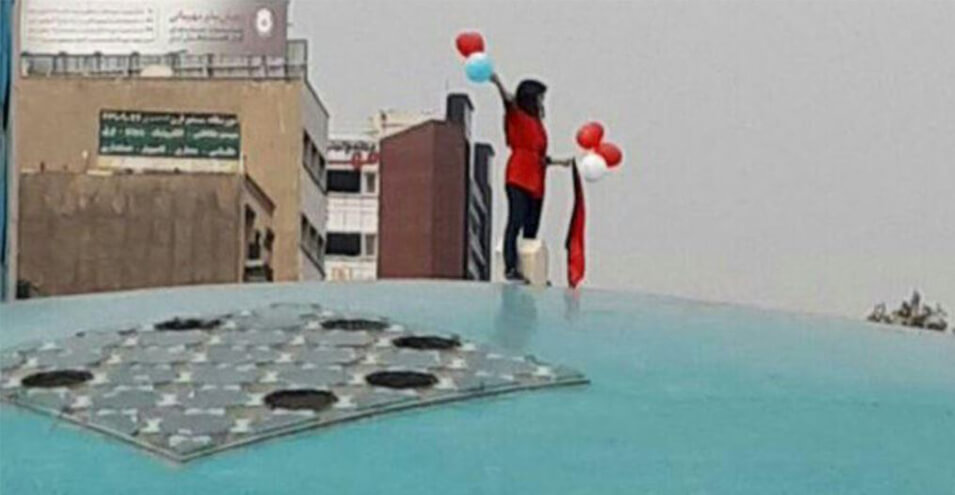
The girls who protested against the mandatory hijab six months ago and were met with repression by the government welcomed the action of another girl who protested against the mandatory hijab by removing her headscarf in Revolution Square on Monday.
A girl, whose identity is still unknown, climbed the green dome-shaped symbol of Revolution Square on Monday, November 29, to protest against the mandatory hijab. She was not wearing a hijab, but was waving a red scarf and red and white balloons in her hands.
After a few minutes, while people watched the girl's civil protest in silence, a police officer climbed the dome, arrested the girl, and brought her down.
People showed their protest against the arrest of the "Girl of Revolution Square" by whistling and clapping.
Her symbolic gesture showed that, contrary to the Islamic Republic's claims, public protests against the compulsory hijab in Iran have not ended.
Official Iranian media did not publish any news about the civil protest of the Revolution Square girl, and the Islamic Republic's authorities have not yet reacted to the issue.
Public protests by women against the "compulsory hijab" in Iran began last year. The protests, which began on January 27, 2017, when "Vida Movahed" climbed an electricity box on Enghelab Street and tied her white scarf to a pole, drew other women to the streets in various cities in Iran to demonstrate civil protest.
The protesting women, who held their scarves in their hands and protested silently in various parts of the city, became known as the "Girls of Revolution Street."
Girls from Enghelab Street, such as Shaparak Shajarizadeh, Vida Movahed, Narges Hosseini, Shima Babaei, and Maryam Shariatmadari, were arrested by law enforcement and security officials in circumstances where the harsh treatment of law enforcement officers during their arrests sometimes made headlines. The Iranian government issued prison sentences for some of these women.
Mandatory hijab in Iran was raised as a violation of civil rights in March 2018. This is despite the fact that at the time of the revolution, religious leaders had not announced that hijab would be mandatory for women after the revolution.
At the same time as the issue of compulsory hijab was raised, thousands of people held a protest rally in Tehran, but these protests were fruitless and not only were women forced to wear the government-approved hijab, but security and law enforcement officers, in the form of "guidance patrols," took on the task of dealing with women who, according to them, were "badly wearing hijab" or "without a hijab."
Also, after campaigns were launched to remove the compulsory hijab, the issuance of judicial orders against this group of protesters intensified, to the point that even Nasrin Sotoudeh, the lawyer for the "Girls of Revolution Street", was arrested on charges including accepting representation from protesters against the compulsory hijab. Farhad Meysami, a physician and human rights activist, has also been in prison since August for supporting the women's campaign against the compulsory hijab.
Despite all the violent and coercive police actions and heavy prison sentences of several years for women who oppose compulsory hijab, and while the Iranian leader calls the protesting women "deceived," civil protests against compulsory hijab continue.
This girl's civil protest against the mandatory hijab took place just two days after a video of a female student being run over by an Ershad patrol car was released. The police intended to break the student's protest against the presence of these patrols on campus by showing off their power and running her over, but not only did the student's resistance not break, but this time this resistance took the form of another girl's civil protest against the mandatory hijab in Revolution Square.
The clashes between the Islamic Guidance Patrol and police officers with opponents of the mandatory hijab come at a time when the head of the judiciary, Sadegh Larijani, had claimed in a statement that the government would never deal with anyone who was simply against the hijab, but he went on to announce that he would deal with women who advertise and promote their opposition to the hijab.
Previous protesters' reaction to compulsory hijab
The arrests and legal actions against the "Girls of Revolution Street" are a clear indication of the statements made by the head of the Iranian judiciary to prevent further protests by women against the compulsory hijab. However, these actions failed to deter women's civil protests. So much so that the protesting girl protested on Monday after learning of her arrest.
The anonymous girl's protest against the mandatory hijab in Enqelab Square drew support from other "Girls of Enqelab Street" groups online. They wrote about the proliferation of "Girls of Enqelab Street."
Maryam Shariatmadari, another detainee of the "Girls of Enghelab Street," who was violently pulled down from an electrical box on Enghelab Street in Tehran, also supported the anonymous girl from Enghelab Square with this tweet.
Shaparak Shajarizadeh, who left Iran after a legal challenge, posted a video of a girl on "Revolution Square" on her Instagram page and wrote that "the voices of the girls on Revolution Street will not be silenced."
Social media users also expressed many reactions to this girl's protest in Revolution Square.
One of these reactions was related to Iranian actress Taraneh Alidoosti, who posted a video on her Twitter about the history of women's struggles with compulsory hijab from the Iranian Human Rights Campaign channel.
Previously, some prominent figures such as Iranian actresses Mehnaz Afshar and Anahita Hemmati had supported women's rights.
Protests against the mandatory hijab in Iran are not limited to the country's borders. In addition to protests from human rights organizations, some foreign figures, including an Indian chess player, decided to withdraw from a chess tournament in Iran due to the mandatory hijab for women.
The US State Department and human rights organizations have repeatedly protested the harsh treatment of protesters against the compulsory hijab in Iran in recent years.
Previously, US Secretary of State Mike Pompeo, protesting the arrest of 30 women who opposed the mandatory hijab, had stated that "the Iranian people deserve the rights
"Their humanity should be respected."
Source: Voice of America