Protests in Ahvaz are becoming more widespread and arrests are increasing every day.
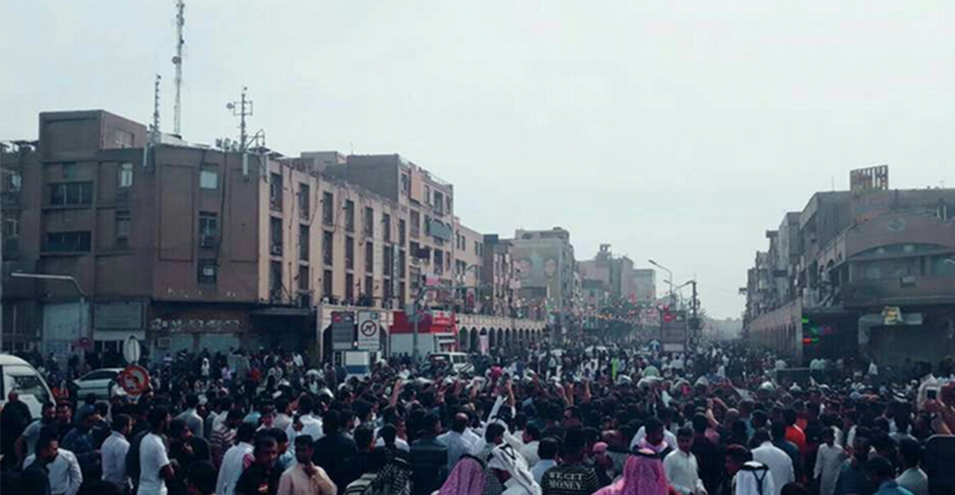
As popular demonstrations in Ahvaz and other Arab cities enter their second week and the scope of the protests expands, the number of arrests of activists and ordinary people in these cities of Khuzestan has also increased. The number of arrests is between 100 and 160 people.
Human rights organizations have so far recorded the arrest of 100 people in the second week of protests by the Arab people of Ahvaz. However, some local and international media outlets have reported the number of arrests as high as 160.
Arrest for the crime of Allahu Akbar
Sattar, a young man living in the Rafish area of Ahvaz, told DW about the arrests in recent days: "They arrested my brother in front of my eyes. No matter what my father did, the officers did not let my brother go. We have nothing to do with anyone. We are also careful that no one destroys anything so as not to give them an excuse. All we do is chant slogans. They disrespected us on television and we want an apology. Now that they are not apologizing, we are chanting Allahu Akbar, but it seems they have a problem with Allahu Akbar too."
He further explains: "Believe me, asking someone who insulted you to apologize is not asking too much. They put all the ethnic groups on the map except the Arabs. This is while we have been born here and died here for generations. No matter what happens, our future generations will be born here and will die here."
Regarding insults to Arab people, Mina Daris, an Arab artist and singer, had previously said at the ceremony of donating Ahwazi dolls to the Iranian Puppet and Culture Museum: "Sometimes I think to myself that if I were an Arab horse, I would be better than a human. Because at one time in the south, Arabs were insulted so much, and that's why if I were a horse, I would be happier in life; at least I have been for the past 20 years."
The Iranian Broadcasting Corporation (IRCC) takes a step back, the police take a step forward.
Despite repeated requests from the people, representatives of Khuzestan in the Assembly of Experts, representatives of Ahvaz in the Iranian Parliament, and the Friday prayer leader of Ahvaz regarding the need for an official apology to the Arab people of Ahvaz, none of the IRIB officials have responded to these requests so far, and only Mohammad Zarean, the producer of the program "See and Create," has apologized on social media.
In the "See and Create" program on April 2, 2018, dolls wearing the costumes of different ethnic groups in Iran were pasted on a map, but instead of the Arab doll, another doll was pasted on southwestern Iran.
On the other hand, despite claims by Hossein Ashtari, the commander of the Iranian police force, that the unrest was controlled “with the support of the people and the management of the scene by the police,” human rights organizations have so far published the identities of 100 people arrested. Some media outlets report the number of detainees at 160. There is no information on the charges, conditions and location of detention, or the manner of trial of the arrested individuals.
In addition to arrests, there have been reports of security forces firing tear gas and plastic bullets at people. Images posted on social media show that security forces fired tear gas and plastic bullets at people in the cities of Ahvaz, Mahshahr, and Kot-Abdullah, as well as in the areas of Ain 2, Alavi Alley, and Naderi Street in Ahvaz.
New demand
Following the fire that broke out at the Navars Coffee House in the Alavi neighborhood of Ahvaz on the evening of April 2, 2018, and killed 11 people, the mourning ceremony for these people turned into a gathering place for protesters. On the evening of Wednesday, April 4, 2018, hundreds of protesters gathered in front of the Navars Coffee House and the streets leading to it, chanting slogans demanding the release and clarification of the fate of those arrested in recent days.
Some of the family members of these individuals also joined the protesters and demanded the release of their children. Some Ahwazi activists also issued calls, inviting people to gather in front of prisons and judicial centers to demand the fate of these individuals.