Nazanin Zaghari's husband's hunger strike; "It's time for Britain to change its approach"
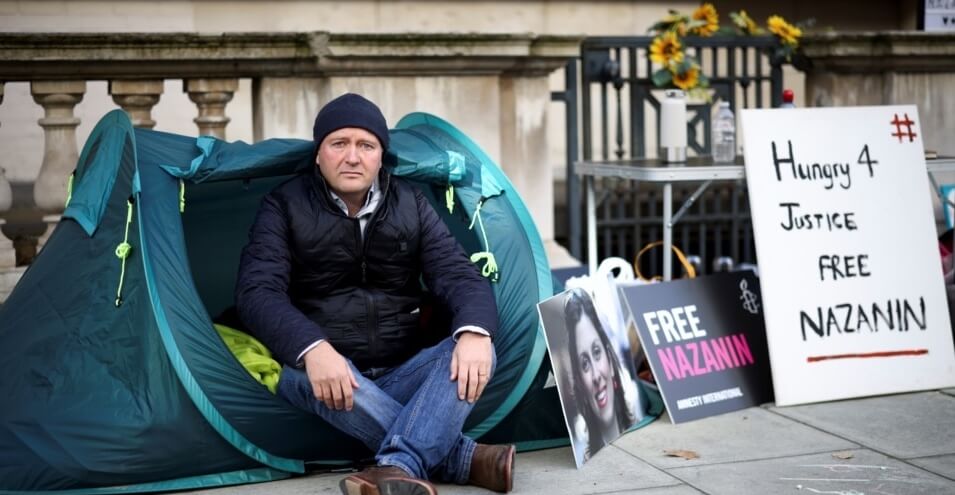
Nazanin Zaghari was arrested at Tehran airport more than five years ago after completing a trip to visit her family. She was in prison for about four years, and now that her five-year prison sentence has ended, she is once again in danger of being returned to prison on a new charge.
Her husband in London has long been trying to bring Ms. Zaghari home, complaining both about the Iranian government’s “hostage-taking” and the British government’s failure to release her. Mr. Ratcliffe has repeatedly called on the British government to pay its debt to Tehran under a pre-1979 military contract, so that Nazanin Zaghari and other imprisoned British citizens can return to their families.
At the end of the ninth day of his protest, Richard Ratcliffe spoke to Radio Farda about his physical condition, his experiences these days, and the approach of his wife and child.
First, I wanted to ask how you are doing after 9 days?
It's really cold. November is cold in London, and when you don't eat, you feel the cold faster. So I'm wearing three layers of coats and clothes and everything, but I'm not warm. I'm not very hungry, but I'm much more tired. I'm slower to move and even slower to talk and think. But I'm moving. Last time we were in front of the Iranian embassy for 15 days. And I remember the last few days were really hard. So now every day is a little harder than the day before.
The first night you pitched your tent in front of the Foreign Ministry, the police came to you after midnight. How is the situation now? How is your presence on that sidewalk tolerated?
That's right. The police had been called and they rudely woke me up at 3:45 in the morning. Of course, after I explained what was going on, they said, "Okay, go to sleep and we'll talk to higher-ups tomorrow." The next day, someone from the police came and said we could continue our protest, but they said to be careful.
Since then, the police have not bothered us, but the security guards have come and filmed us with their cameras and kept an eye on us; but that's not much more. And so, these days, British politicians have come here, members of parliament, the mayor of London, and so that makes us safer and keeps an eye on us.
What are these people telling you? What is the message of these politicians?
The messages are varied but generally it is support for Nazanin and me, sympathy for what has happened and hope that [this situation] will end soon. Some people spend more time and get more involved. For example, Jeremy Hunt, the former foreign secretary, has been here a few times; once he cycled in the morning to bring drinks. He went into more detail, asking what the foreign secretary had just said and generally trying to understand where the problem is that this story is still going on two years after he left office. But generally everyone comes here to show their support.
Usually, when someone goes on a hunger strike, one of the efforts of supporters is to persuade the person to end the hunger strike. Did these people make such requests?
The MPs who came did not ask for that. And in our meeting with Foreign Secretary Liz Truss, she did not make that request. She talked about Nazanin's case and that they were working hard, but she did not say please end the hunger strike.
I'm sure the State Department is not happy with this, and you're right. This is a short-term strategy because if it continues any longer it could end up putting me in the hospital. But I think the government is waiting for this to pass and for me to stop the strike myself. But I still say that their approach to Iran is wrong, and their approach to the debt issue needs to change.
Mr. Ratcliffe, you have been spending your days and nights on a sidewalk for over a week. Your daughter Gabriella was photographed with you last week in this protest. How does she see this situation?
That's right. Last week was school holidays and he was here with me for a few hours some days. We did different activities together. For example, the other day, we carved out and prepared pumpkins for Halloween. We decorated the area around my tent together, did a lot of painting and stuff like that.
As a result, he has fun with these activities with the other children, but he doesn't think too deeply about the issue. For example, he says that dad is camping here and he won't be able to eat for a few days. The first few nights when I wasn't there, he wasn't comfortable and he had nightmares and would wake up, but now he's better and my sister and her children are with him.
Of course, Nazanin is concerned about the impact this situation will have on Gabriella, and of course, the longer this hunger strike lasts, the harder it will become.
You are doing all these things and moves because you want your wife to be able to return to the UK. What does she think of this latest move of yours?
Well, she's probably very worried. Worried that her husband is on a hunger strike in the cold street, worried about how this will affect her daughter, and worried about when that call to go to prison will be made?
The most important reason I went on hunger strike was because the Iranian authorities said they would not accept the appeal, and that they might call at any moment to send her back to prison. We pressured the British government to do something, and they said they would do nothing to prevent Nazanin from being sent to prison, so we had to do something.
As a result, as many Iranian listeners know, this way the Iranian prison system operates creates great anxiety.
When will you decide to end the hunger strike?
I am still waiting for a better response from the British government. It is time for the British government to change its approach in condemning Iran's behavior in taking hostages and protecting Nazanin. So we will continue a little longer to see what their response is.
Source: Radio Farda