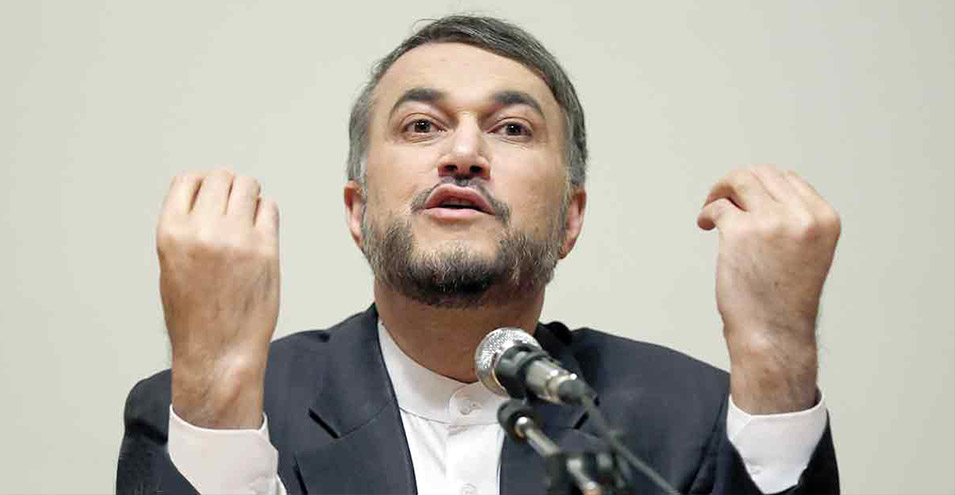
Iran's deputy foreign minister says that ISIS forces were once within 50 kilometers of Iran's borders and that the Islamic Republic's timely action prevented damage. He added that without Iran's "advisory" assistance, Syria would have been lost.
Hossein Amir-Abdollahian, Deputy Director of the Arab and African Affairs Department of the Iranian Foreign Ministry, provided explanations about Iran's support for Assad, the Syrian crisis, ISIS movements in Iraq, and domestic security at the "Syrian Developments and Upcoming Scenarios" meeting.
According to ISNA, Amir Abdollahian said: "If it weren't for the vigilance of the military and law enforcement security services, perhaps today we would have to talk about terrorist groups exploding in our metro stations in Tehran, but all of this was stopped fifty kilometers away from our borders and they were not allowed to enter the country."
In explaining the importance of the Syrian crisis for the Islamic Republic, Amir Abdollahian pointed to the connection between developments in Iraq and Syria and said that the regime's timely action against terrorist groups prevented it from reaching a "vulnerability point": "Our military and security departments concluded that during the developments inside Syria and the movements of ISIS and the support of regional and trans-regional players, some insecurity would enter Iraq from Syria. This increasing capacity that was created in Iraq with the presence of ISIS from Syria also threatened our national security."
This is not the first time that Islamic Republic officials have spoken about eliminating the threat of ISIS entering Iran's borders. Ahmad Reza Pourdastan, commander of the ground forces, admitted in the fall of 2015: "Last year, ISIS approached Iran's western borders from Iraq's Diyala province, and we warned that if they crossed our 40-kilometer red line, they would face a decisive response."
The Ministry of Intelligence has also announced several times the arrest of ISIS-related teams on Iran's western and eastern borders, but this is the first time that an official from the Foreign Ministry has drawn the dimensions of the threat of ISIS influence to possible explosions in the Tehran Metro.
The Green Helmets and the “Advisory Mission”
The meeting on “Syrian Developments and Upcoming Scenarios” was held on Wednesday, May 28, at Allameh Tabatabaei University. Amir Abdollahian reiterated that Iran is not sending military forces to Syria: “At this point, no combatants or fighters have entered Syria, but the same advisors who were going to Syria from the IRGC have now entered Syria as part of the elite advisory forces of the army, and at times, due to their proximity to the scene of operations, we sometimes encounter their martyrdom.”
This explanation refers to the deployment of Iranian army commandos, known as the Green Berets, to Syria. It was first announced in mid-April by Ali Arasteh, deputy coordinator of the army's ground forces, that a group of Green Berets from the 65th Nohed Commando Brigade had been deployed to Syria as advisors.
Kamal Pimberi, deputy head of training for the Iranian Army's ground forces, announced on Sunday, May 25: "The army, based on the advice and orders of the Supreme Commander-in-Chief, has also participated in advisory missions to play a role alongside the Revolutionary Guards."
"We did not allow terrorists to overthrow the Syrian regime"
In response to a question about the reason for sending army forces to Syria, Hossein Amir-Abdollahian said that they were sent to Syria at the official request of the country's government and "solely to fight terrorism" "to prevent the overthrow of Bashar al-Assad by terrorists and not to endanger the region and our national security any further."
He considered the increase in the number of "Iranian advisory forces" in Syria to be a function of the increasing developments and needs in the region, and emphasized that the Islamic Republic "did not allow terrorists to overthrow the Syrian political and legal system."
In another part of his speech about the future of Syria and the fate of Assad, the Deputy Foreign Minister addressed the ignorance of many countries about the developments in Damascus: "In contrast, Iran, Russia, China, Lebanon, and even countries like Egypt and Algeria believe that decisions about Syria should not be made in New York, Munich, and Vienna, but rather the Syrian people should do this."
Amir-Abdollahian added that Iran does not support the idea of Bashar al-Assad being the president of Syria for life, but first the fate of the terrorists in Syria must be clarified: "Perhaps it is not very rational for us to make a deal on Bashar al-Assad when no suitable replacement has been found for him."
Ali Akbar Velayati, the Supreme Advisor to the Leader of the Islamic Republic on International Affairs, had said in a meeting with the Syrian ambassador in Tehran a few days ago that Iranian forces are present in the country at the request of the Syrian government and that the Islamic Republic will only accept the outcome of the Geneva talks if it does not contradict the "interests of the Syrian nation."
Velayati has previously emphasized that Bashar al-Assad is the Islamic Republic's red line. In December 2015, after returning from Syria, he stated on the Islamic Republic's Radio and Television that the Syrian crisis is a "small international war," adding that Iran has no intention of leaving Assad behind on the "battlefield or in the political arena."
Source: Deutsche Welle