New photos released against Iran and the deployment of American troops to the region
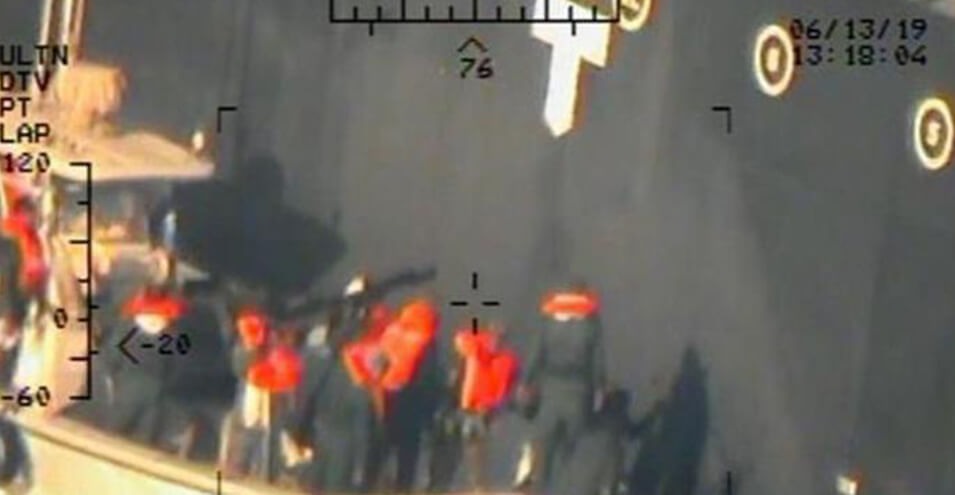
The US is sending another 1,000 troops to the Middle East for “defensive purposes.” The US Department of Defense previously released new photos against the Islamic Republic in connection with the recent attack on oil tankers in the Gulf of Oman.
Tensions between the United States and Iran continue to rise. Acting US Defense Secretary Patrick Shanahan issued a statement on Monday, June 17, announcing the deployment of 1,000 additional troops to the Middle East.
He clarified: "This action is being taken to ensure the safety and well-being of our military personnel who are present throughout the region, as well as to protect American interests." Shanahan also emphasized that "the United States is not seeking war with Iran."
This is the second time in a short period of time that the United States has deployed new troops to the Middle East.
The United States sent an additional 1,500 troops to the Middle East in late May to bolster its military presence in the region. The US defense secretary said at the time that the deployment was in response to “continued threats from Iranian forces, including the Revolutionary Guard Corps and its affiliates.”
New images
On Monday, June 17, the US Department of Defense also released new photos that, according to the Pentagon, show that the Revolutionary Guard Navy was responsible for the recent attack on two foreign oil tankers in the Sea of Oman.
In a statement, the Pentagon said that one of the new photos "shows the remains of an unexploded mine's magnetic attachment device."
According to the US Department of Defense, these new photos were taken by a US Army helicopter.
In another of the 11 new photos released, the Pentagon says it can be seen how IRGC forces are trying to remove an unexploded mine from the hull of the Kokuka Courageous tanker, thus eliminating their footprints.
In another image, the damage caused by the attack on the tanker can be seen, according to the US Department of Defense.
The US Central Command (CENTCOM) also released a video a day after the attack on two oil tankers in the Sea of Oman on Thursday, June 13, which it said showed an IRGC patrol boat trying to remove an unexploded mine from the hull of the tanker.
Washington accuses the Islamic Republic of involvement in the June 13 attacks on two oil tankers in the Gulf of Oman. Iran has denied any involvement in the attacks, calling the incidents “suspicious.”
“Ridiculous actions”
On Monday, June 17, IRGC Chief of Staff Major General Mohammad Baqeri called the explosive operations against oil tankers in the Sea of Oman and the Indian Ocean "ridiculous and worthless actions" by the enemies of the Islamic Republic.
He said, rejecting US accusations about the attacks on oil tankers, “We have the courage to take responsibility for our actions.” Mohammad Bagheri stated that if “Iran wants, it can close the Strait of Hormuz and prevent any vessel or tanker from passing through this waterway.”
Abbas Mousavi, spokesman for the Iranian Ministry of Foreign Affairs, also compared the US accusations to a joke in an interview with the "Young Journalists' Club" and emphasized that the recent attack on two oil tankers in the Sea of Oman "could be the work of Team B."
The "B" team refers to Israeli Prime Minister Benjamin Netanyahu, US National Security Advisor John Bolton, Saudi Crown Prince Mohammed bin Salman, and Abu Dhabi Crown Prince Mohammed bin Zayed, who, according to the Islamic Republic, are trying to incite tension between Iran and the United States.
The divide in the European Union
The European Union currently does not have a unified position on the US claims. Britain, like the US, holds Iran responsible for the attacks on the tankers.
A number of European countries, however, have refused to support the US position on the cause of the recent attack on two tankers in the Sea of Oman.
On Monday, June 17, the foreign ministers of Germany, Luxembourg, the Netherlands, and Austria announced on the sidelines of a meeting of European Union foreign ministers that they are still uncertain about the perpetrator of the attack and are comparing their information and data with that of the US government.
German Foreign Minister Heiko Maas said that although his country had received information from the US and Britain, it had not yet reached a definitive conclusion about the perpetrator of the attack. He stressed the need for "high precision and sensitivity" in investigating the incident and called for "no haste."
The danger, said Austrian Foreign Minister Alexander Schallenberg, is that “it will be a game of chance and everyone will end up losing,” adding: “No one benefits from a hasty, unexamined statement of position.”
Luxembourg Foreign Minister Jean Asselborn also recalled the US's erroneous documents and evidence regarding Iraq's access to weapons of mass destruction, which served as the basis for the 2003 invasion of Iraq, and called on the UN Secretary-General to appoint an independent investigation team to investigate the incident and identify the perpetrators of the attack.
Source: DW