Iran: A Society in Transition or on the Brink of Explosion?
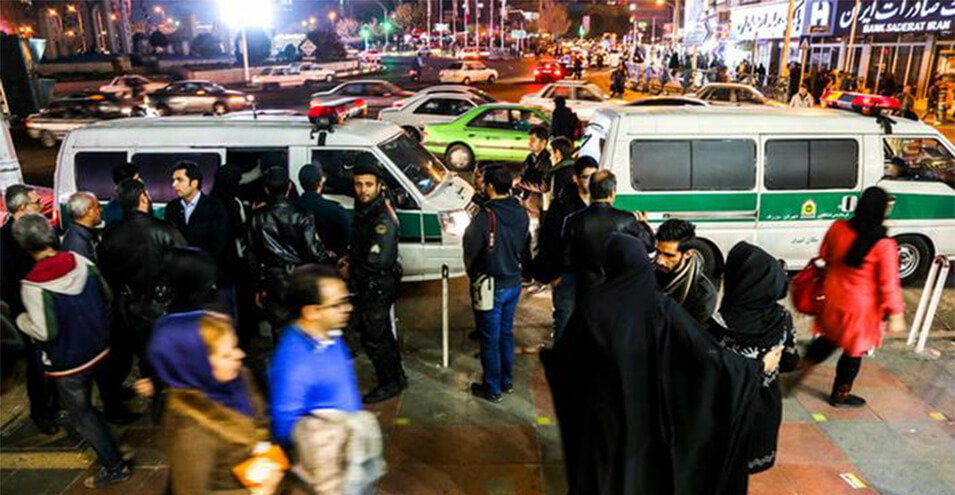
Forensic medicine statistics from Tehran Province indicate that one conflict occurs in this city every minute. This only concerns disputes that are referred to forensic medicine. Is Iranian society an angry society on the brink of explosion?
Severe beating of a girl by female police for the type of clothing she wore, throwing a girl protesting mandatory hijab off a platform by a law enforcement officer, bloody beating of Gonabadi Dervishes, armed individuals entering a law enforcement officer’s home and shooting family members, and examples of this kind—are these just a handful of samples of the barrel of violence in Iranian society, or should we see a different picture of Iran: people who, on the occasion of any holiday, even on mourning days, head to entertainment centers, dance to music playing from their cars in the exhausting traffic of roads, record videos of this dancing among the rows of parked cars on the road, and share them on social media, people who chant and dance in parks and entertainment centers to any song, and…?
A European traveler who lived in Iran for six months, mostly in Tehran, said of the people of this city that it seems two groups of people live in Tehran; the first group are people who drive with anger and rage all day, unwilling under any circumstances to give way to each other, pushing each other aggressively in bank lines and taxi queues and public transportation, coming to blows over taxi fares or their turn in line.
The second group are happy and cheerful people who come to the streets at night, park their cars in front of every food vendor and eat and drink on the sidewalk and listen to loud music in their cars. As if these are not the same people who just hours before tore each other’s shirts over a few tomans of extra or less taxi fare.
“A Society Full of Rage and on the Brink of Explosion”
Phrases like “a society on the brink of explosion,” “a society full of rage,” “naked violence flowing through society” are these days phrases frequently used by some analysts and experts to describe Iranian society.
This group of experts are clearly concerned, frightened, afraid that this society on the brink of explosion will be dragged into ruin. They believe Iranian society is full of suppressed rage.
Nasrin Sotoudeh, a lawyer and legal expert, attributes this suppressed rage in Iranian society to two things: political closure and judicial corruption. She tells Deutsche Welle that when there is no room for any political protest, these protests accumulate and emerge as suppressed rage.
However, she prefers to analyze this more in her own field of work, namely the legal sphere. Sotoudeh says that the most important source of peace in a society can be that society’s judicial system, which is the last resort for a person whose rights have been violated to turn to for justice and seek fair and equal treatment.
According to this legal expert, however, the judiciary in Iran has experienced a pervasive crisis, a crisis that is not limited to political cases. She says: “Cases that have been dealt with in completely unjust ways and inappropriate verdicts have been issued for them, causing society’s request for justice, fairness, and equality to remain unanswered for years. These accumulated grievances manifest themselves in the form of anger and violence.”
Hamid Reza Jalaeipour, a reformist political activist, however, has a different view on this matter. Last year, Amoli Larijani, head of the judiciary, announced that 15 million legal cases were reviewed in courts in just one year. This statistic even caused protests from some government officials. However, Jalaeipour believes that this level of recourse to the judicial system indicates public trust in part of the judiciary.
In his conversation with Deutsche Welle, he emphasizes that this trust does not extend to the political branch of the judiciary and the part that, according to him, imprisoned environmental activists.
Jalaeipour says he personally visited courts and spoke with 40 people who had legal cases. He says all these individuals were satisfied with the process of reviewing their complaints and their only criticism was the length of this process.
This sociologist concludes that people trust this branch of the judiciary and prefer to submit their lawsuits to the judicial system rather than using the old method of “arbitration,” despite paying lawyer fees and spending considerable time.
“Iranian Society is not a Violent Society”
Hamid Reza Jalaeipour disagrees with the premise that Iranian society is a society full of suppressed rage. He even attributes the way law enforcement officers treat women protesting mandatory hijab to the great patience and tolerance of the Iranian government toward an issue that, according to him, has become part of this government’s identity; the issue of mandatory hijab.
This reformist political activist says: “These [Revolution Street girls] have a demand that has an identity dimension for the Iranian government. For four decades, some have tied the identity of the revolution and the Islamic Republic solely to the hijab. Revolution Street girls have challenged this, and in my view, this shows that both the government and the people have become more patient. Now they have even pulled one girl’s foot—this doesn’t mean it has become violent. Actually, see the subsequent reactions: the police say we will pursue and follow up. Or a female police officer beats another woman—you should see how sensitive our society has become and how it reacts to it. This doesn’t mean Iranians have become violent at all.”
Nasrin Sotoudeh, who is the lawyer for several of the Revolution Street girls, however, looks at this matter from a different perspective and says: “So much closure has been created in society that half the population is deprived of the right to choose their clothing, and those protesting mandatory hijab suddenly face government propaganda claiming that what they do is a kind of encouragement to corruption, when it is not at all like that—they were protesting mandatory hijab and faced heavy sentences. This is a kind of display of political power by the government in the form of judicial authority, which could be one of a government’s greatest mistakes.”
What is circulating in cyberspace these days is an image of different and sometimes contradictory faces of Iranian society; both people dancing among the crowd of vehicles stopped in road traffic and a woman screaming her forty years of rage at not having the natural right to choose her clothing in front of the camera. Both images belong to this same society; a society in transition or on the brink of explosion.
Source: DW