Holding a ceremony commemorating Khomeini in Tehran's Sarkis Church: Loyalty to the regime or systematic pressure?
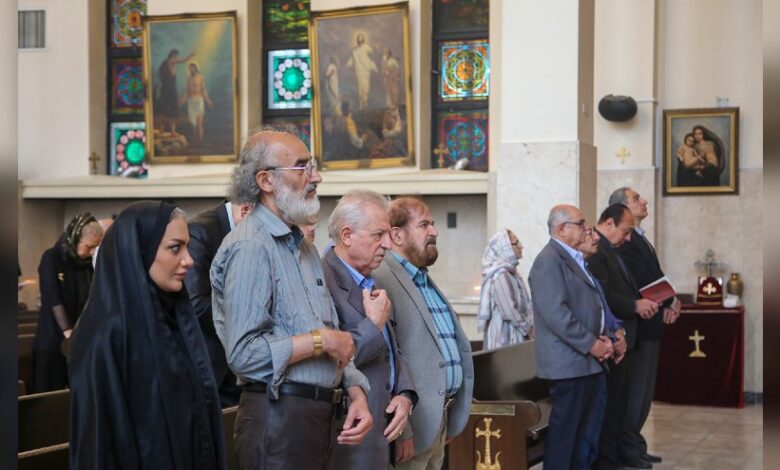
Tehran's Sarkis Church held a ceremony to commemorate Khomeini, but was this ceremony a manifestation of loyalty to the regime or systematic pressure from the regime?
Yesterday, Friday, June 6, the Sarkis Church in Tehran held a ceremony to commemorate Ruhollah Khomeini on the occasion of the 36th anniversary of his passing. The ceremony was also attended by General Mohammad Reza Movahdian, head of the Religious Minorities and Armed Forces Committee of the Khomeini Commemoration Headquarters, and a group of Armenians from Tehran.
In addition to reciting prayers, the Armenians of Tehran emphasized their commitment to the revolution and the Islamic Republic system and honored the memory of Ruhollah Khomeini, the founder of the Islamic Republic. "Arakel Gadechian," the representative of Archbishop Sivo Sarkisian, also emphasized Khomeini's freethinking and praised him.
Sardar Movahedian also delivered a speech at the ceremony, thanking and appreciating the Armenian Caliphate Council and the Armenian community, and referring to the activities of the Religious Minorities Committee, he said: "We had two programs in the Religions and Religious Minorities Committee of the late Imam's Headquarters: one was a tribute to different segments of the divine religions, which was held on June 7th, and the other was programs that the segments themselves held independently to commemorate Imam Khomeini. A similar program was also held on June 14th, where the Supreme Leader of the Revolution was the speaker, and leaders of religions and religious minorities were also present."
According to Sardar Movahedian, the Jews in the Yousefabad Synagogue, the Zoroastrians in the Aryan Fire Temple, and the Armenians in the Holy Sarkis Church in Tehran held ceremonies to honor Ruhollah Khomeini. He also added: "The unity between the Committee of Divine Religions is derived from Islam and the teachings of the Quran. The late Imam said in a gathering of the leaders of divine religions that monotheism is the religion of all."
Sardar Movahedian's statements regarding unity among religions were made at a time when the Islamic Republic regime, after the victory of the 1979 revolution, attempted to kill Christian leaders and citizens, as well as confiscate their property for the benefit of the state. Pastor Sayah, Pastor Hospian, Bahram Dehghani, brother of Goli Dehghani, Bishop of the Church of England, and many other Christian citizens who fell victim to the extremism of the revolutionaries are all examples of the Islamic Republic's crimes against Christians and other religious minorities.
Now, 46 years after the victory of the Islamic Revolution, not only have these pressures, attacks, repression, and arrests against religious minorities not decreased, but have also increased. Some citizens, who are even recognized in the Constitution of the Islamic Republic, continue to be attacked and repressed by the government under the name of spies, infidels, and deviants, many examples of whom, such as Hakob Gochoumian, are currently in prisons of the Islamic Republic.
The regime's claims of religious unity in Iran are contrary to what is being shown. Evidence suggests that the Armenian population, as one of the largest Christian communities in Iran, is declining day by day, indicating increasing pressure on them and ultimately forced migration.
The Armenian population in Iran before the 1978 revolution was about 250,000, but now, according to statistics, their number has dropped to fifty to sixty thousand. This decrease indicates that eighty percent of Armenians have emigrated from Iran, which has been caused by discrimination and individual, religious, and social restrictions.
But now the question is: is holding a ceremony to commemorate Ruhollah Khomeini in the Armenian Church a demonstration of national unity between religions by the government, or is it systematic pressure and a cover-up of bitter realities such as discrimination, repression, arrest, exile, and other issues against minorities in Iran?
It should be noted that the aforementioned ceremony was held in the Sarkis Church in Tehran, with a very limited and small number of Armenians in attendance, which not only does not reflect loyalty to the system, unity, and empathy between religions, but also evidence of systematic restrictions and pressures against religious minorities in Iran.