New tension over Hezbollah with the controversial presence of Nasrallah's son at Khamenei's home:
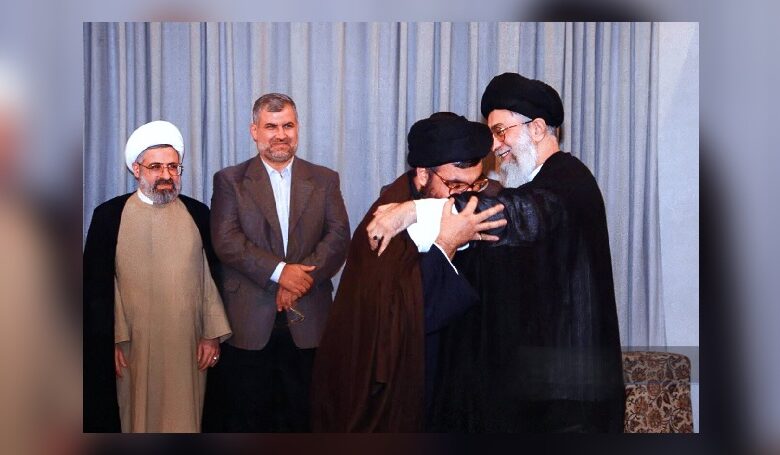
Today's tension between Beirut and Tehran over Hezbollah entered a new phase with the publication of a picture of Nasrallah's son at Khamenei's residence, sparking sharp diplomatic reactions.
While relations between Lebanon and the Islamic Republic have reached a peak of tension in recent weeks over the issue of Hezbollah's disarmament, the publication of a picture of "Mohammad Mahdi Nasrallah," the son of the slain Hezbollah Secretary General, at an official ceremony in Ali Khamenei's office, has once again fueled debate about the depth and nature of Tehran's influence in the Lebanese power structure.
The image, first published by the Israeli Foreign Ministry on X-Net, sparked widespread reactions. Referring to the presence of Hassan Nasrallah's son at the "birthday celebration" of the Prophet's daughter at the Imam Khomeini Husseiniyeh in Tehran, the ministry wrote on its Persian account: "As long as the Islamic Republic exists, these leeches will not give up on Iran."
Some Iranian domestic media outlets also introduced this young figure as Ali Khamenei's "special guest." He had previously expressed his loyalty to the leader of the Islamic Republic in a message, writing: "I swear to God, if we know that we will be killed and burned, and come back to life a thousand times, and be torn to pieces again, we will still not abandon you."
The re-release of this message, along with the intensification of political differences between Beirut and Tehran, has added new dimensions to this diplomatic dispute.
As the new Lebanese government attempts to redefine its relationship with Hezbollah, the exchange of critical messages between the two countries continues. The latest reaction was also published by the Islamic Republic's Foreign Minister, Abbas Araqchi. While welcoming Beirut's invitation to visit Lebanon, he described his Lebanese counterpart, Youssef Raji,'s decision to reject the trip to Tehran as "surprising," and wrote that countries with "friendly relations" do not need to choose a "neutral venue" for talks.
Araqchi also referred to the "Israeli occupation and violation of the ceasefire" and said: "I understand why the Lebanese Foreign Minister is reluctant to travel to Iran."
A day earlier, the Lebanese Foreign Ministry had officially announced that Raji had rejected Iran's invitation, writing: "There is no suitable atmosphere for dialogue between the two countries."
In the same letter, Raji emphasized: "Building a strong state is only possible when the government and the national army have a monopoly on weapons and when decisions about war and peace are completely in the hands of the government." Beirut then repeated the offer of a meeting in a neutral country.
The Lebanese government, with US support, is pursuing a plan that would allow only the army to carry weapons by the end of 2025, a plan that Hezbollah and Tehran see as an attempt to weaken the "axis of resistance."
International pressure has also influenced Lebanon's decision. In October, a high-level delegation of US officials in Beirut declared that the Islamic Republic was the "main obstacle" to Hezbollah's disarmament. At the same time, a Gallup poll showed that 79 percent of Lebanese people want the army to have a monopoly on weapons, a figure that reflects a shift in public opinion.
Political figures such as Walid Jumblatt have also warned that Lebanon should not become a messaging tool for Iran in regional negotiations and should establish the army's position as the only legal armed force.
In Iran, the majority of state-run and government media outlets have preferred to downplay the diplomatic tension. Some observers see this silence as a result of an order from the Supreme National Security Council to “play down” the dispute with Beirut. However, there were also examples of news distortion, for example headlines such as: “Lebanese Foreign Minister Apologizes to Araqchi” or “Lebanon Calls for a New Chapter in Relations.”
Sharq newspaper was the only major media outlet to publish an independent analysis of the dispute, writing: "The Lebanese Foreign Minister's insistence on the government's monopoly on weapons is a sign of Beirut's attempt to maintain a managed distance from Iran, without engaging in direct confrontation."
The combination of two parallel events (diplomatic tension over Hezbollah’s disarmament and the presence of Nasrallah’s son at Khamenei’s official ceremony) provides a clearer picture of the path ahead for Lebanon. Beirut seeks to restore its sovereignty and limit the role of non-state armed groups, while the Islamic Republic continues to view Hezbollah as an integral part of its regional strategy.
The symbolic presence of a figure close to Hezbollah in Khamenei's office shows that Tehran has no intention of retreating from its influence in Lebanon; a matter that many Iranian officials, including Ali Larijani, Araqchi, Pezzekian, and Khamenei himself, have explicitly emphasized in recent weeks.