The 84th Session of Hamid Nouri's Trial; "They Promised Us Forty Days of Paradise for Killing You"
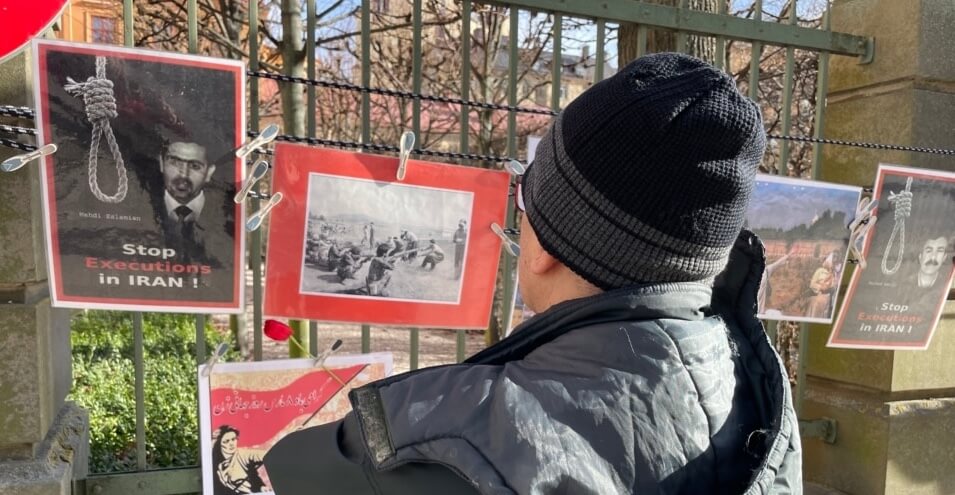
The 84th trial session of Hamid Nouri, accused of participating in the execution of political prisoners in the summer of 2018 in Gohardasht Prison, was held in Stockholm on April 7, 2022, with the testimony of Abdolreza Shahab Shokohi.
Abdolreza Shahab Shokohi was first arrested at the age of fifteen during the reign of Mohammad Reza Shah. He was arrested a second time after the revolution in 1988 in Qom and sentenced to death, but escaped in 1983 while on leave.
Abdolreza Shahab Shokohi was a member of the Workers' Path Organization and in June 1983, while transferring some documents within the organization, he was surrounded and wounded by a bullet and arrested for the third time. A month and a half later, Shahed was transferred to Evin Prison by the Joint Committee and was kept handcuffed for eleven nights upon arrival. Two years later, he was sentenced to death for the second time in a court presided over by Nayri in Evin Prison. It was in the same court that he was also informed of his brother's execution. Shahed's death sentence was later changed to fifteen years in prison.
Abdolreza Shahab Shokohi was transferred to Gohardasht Prison in 1987, while on a mass hunger strike, along with two or three hundred other prisoners, and was immediately severely beaten. He was later transferred to Ward Fourteen, a ward located between Wards Five and Six, where it was possible to communicate with these wards and observe the prison grounds from the windows.
Abdolreza Shahab Shokohi testified that [their cell] learned about the presence of the death squad in the prison on August 28, 1988, by Morse code. He confirmed hearing sermons by Rafsanjani and later by Mousavi Ardebili in two separate Friday prayers and slogans against the Mujahedin through the prison loudspeakers. He said that the television was removed from the cell and the newspaper broadcast was stopped. He also confirmed the cessation of visits in August 1988 in Gohardasht prison.
On September 29 or 30, Abdolreza Shahab Shokohi was blindfolded and questioned religiously by a soldier in the presence of Nasserian, along with a number of his comrades, all of whom were Marxists. The witness was then taken to death row with a group of his comrades. He testified that while he was on death row, he heard [the officers] say, "Take this one to the left, take that one to the right."
After a few hours, he stood before the death squad, including Nayri and Ishraqi, without a blindfold, and said that he did not pray and was not a Muslim.
After leaving the death squad room, Abdolreza Shahab Shokohi was given fifty lashes and taken to a dark hall, which he later learned was an amphitheater. There, through his blindfold, he saw some slippers and clothes on the floor of the hall and six ropes hanging from the ceiling. The witness was taken to a closed room that same day. Hearing people talking, he drove his truck to the window. He saw people wearing white clothes that looked like spray-paint suits and throwing bags wrapped in blankets into the truck.
Abdolreza Shahab Shokohi was brought before the death squad again the next day. The witness explained how he had escaped execution by agreeing to abide by the laws of society if he were released on the one hand and by Ishraqi’s mediation with Nayri on the other. After leaving the cell, he and several other prisoners were beaten so hard that his ribs broke. He recalled a prisoner named Tafreshi who was beaten so severely that he probably died. The witness said that another prisoner’s head exploded from being hit on a radiator. One of the guards told them, “They promised us forty days of paradise for killing you.”
Abdolreza Shahab Shokohi testified that after this severe beating, he was transferred to a cell and heard the voices of two guards from inside the corridor. He recognized Guard Adel, the head of the prison store, from the voice, who sometimes visited their ward.
Adel asks another guard: "I have a religious question. These girls, who we lower from the rope [of the gallows], turn blue and it is clear that they are suffocating, and according to Islamic law, they should be married and executed. Do you think this is right? I have a question for you."
The guard replied to Adel: "Haj Agha himself knows all these things, and they gave the order. If necessary, you should ask them yourself. But they definitely have an answer to this [question]."
Abdolreza Shahab Shokohi later testified in response to a question from Kenneth Lewis, one of the plaintiffs' lawyers, that he believed that these women prisoners were women prisoners of the Mujahideen and that he had not heard anything like this about leftist women.
Abdolreza Shahab Shokohi said that in the following days, a young cleric tried to teach the prisoners who had escaped execution how to pray. Naserian, Lashkari, and a "person in plain clothes" along with several IRGC guards would raid their cell in the following days and force the prisoners to pray by threatening and intimidating them.
Two or three weeks later, Abdolreza Shahab Shokohi was taken by the guards to the prison prosecutor's office and to "Hajj Agha Abbasi." Hajj Agha Abbasi was the same "person in civilian clothes" whom the witness had previously encountered several times without a blindfold - for example, once when removing a locked television - but no one had ever introduced him to him. Abbasi informed him that he would be transferred to Evin Prison. The witness said that Abbasi's smile that day remained in his mind. The witness said that a person immediately entered the room and Abbasi stood up respectfully at his feet. The witness said that the person was Amin Vaziri, the head of the task force, whom the witness had seen during his arrest in 1983.
Abdolreza Shahab Shokohi was transferred to Evin Prison in a private car that same day and was released from prison in April 1989.
In today's hearing, Abdolreza Shahab Shokohi named Sadeq Riahi, Jafar Riahi, Mohammad Ali Pejman, Mustafa Farhadi, Hossein Haji Mohsen, and Majid Evani as "living witnesses" who he could confirm, either personally or through an intermediary, of their execution in Gohardasht Prison in 1988. In today's hearing, the defendant's lawyers also addressed the discrepancies between the witness's statements in today's court hearing and his interrogations at the Swedish police station over the past two years.
The next hearings of Hamid Nouri's trial, after a break of almost two weeks due to the Easter holidays, will resume on Wednesday, April 20, 2022. This hearing is dedicated to questioning the defendant Hamid Nouri at the request of his lawyers. In this regard, Judge Thomas Sander officially announced in today's court session that he has never had a defendant give him so much opportunity and time to defend himself.
Source: Voice of America