A black scandal in Iran's bloody trade chain
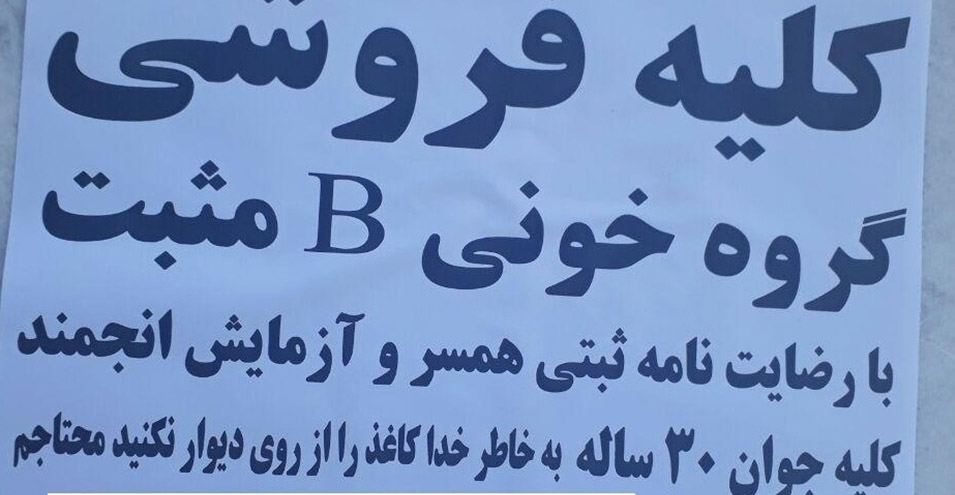
Suheila.S. FCNN: The placement of kidney sale advertisements on the doors and walls of the country's metropolises has become commonplace for several years. We are no longer surprised. It is as if we have allowed poverty to penetrate the depths of the bodies and souls of our compatriots. To the point where they give up a body part and plant bread in its place so that they do not fall below the poverty line. And hunger does not spare them.
Men also do not see a religious prohibition in the practice, to the extent that Naser Makarem Shirazi, a mujtahid who simply declares the forbidden as halal and the halal as haram, touches on its merits and says: "There is nothing wrong with selling organs that have been replaced, but the owner of the organ should demand money for permission to remove the organ, not the organ itself."
And this is where we all approved of the permissibility of a bloody trade in our country. To this day, these advertisements have gone beyond the kidneys and targeted other body organs, such as the eyes.
The bitter reality is that evidence indicates that these members are leaving the country, or rather, smuggling them to other countries, especially on the Persian Gulf coast.
An unfortunate phenomenon that is unfortunately growing, and its main victims are no longer poor adult vendors, but innocent children.
Children who are kidnapped and released after removing organs that can be trafficked. Of course, the number of children sold by drug addict families should also be attributed to them, which is unfortunately growing.
Even babies are sold. The latest prices in Tehran are as follows: a baby boy costs 7 million and a baby girl costs 8 million Tomans. The transaction starts with the care of addicted mothers in supervised homes, and the births take place in government hospitals. This is a piece of news that has been reflected in the domestic media despite severe censorship and has reached the attention of the public and officials.
The officials are indifferent.
In the meantime, however, no media outlet has approached the officials and criticized them. Officials who claim to uphold human rights in the country are indifferent to the growth of the bloody human trade and the killing of innocent children and infants for a small price.
Even the people's representative in the Islamic Consultative Assembly has not addressed the regime's officials, despite approving of these crimes and atrocities in the country.
According to the Khaneh Mellat news site, according to Yahya Kamalipour, deputy head of the Judicial and Legal Commission of the Islamic Consultative Assembly, taking hostages to steal body parts and including this crime among street children has doubled the severity of this violation. In such a way that it seems that due to the lack of a deterrent law, it is not possible to control this crime and unfortunately, we are facing the growth of this part of trafficking in the country.
Why the silence?
But why has everyone remained silent and not taken action to protect the lives of future generations of our country by addressing the officials, led by Khamenei as the leader of the Islamic Republic?
Amin Ghodsi, an Iranian living in Europe who was a prison guard in Adel Abad Prison in Shiraz for many years, believes that severe suffocation is a marginal factor in this media reluctance.
He considers the consequences of targeting the leader of human organ trafficking gangs in the country to be the main reason for this silence.
In an interview with FCNN, Qudsi said, "How is it that security officials are informed of the incident as soon as a Baha'i or Christian prayer meeting is held and immediately take action to arrest the perpetrators, but they remain unaware of illegal surgeries and deliveries of addicted women who do not taste motherhood, especially in a government hospital. This is just like the growth of drug trafficking in the country, which only ends with the punishment of low-level perpetrators. But the leaders of the trafficking gangs continue their work."
Organ trafficking is a simple matter that goes unnoticed by officials.
According to this citizen, it is naive to accept that the victimization of newborn babies or street children by traffickers remains hidden from the eyes of the leaders of the Islamic Republic.
Ghodsi Para goes further and continues by recalling his experiences from his time in prison in Iran: “I remember that drug traffickers with a history of drug trafficking were released from the death penalty by paying money in prison and court, and then their life sentences were reduced to less than ten years with successive pardons. But those who only carried drugs and had no money in their pockets were given the full punishment. Even manipulating the files was simple and practical with a payment of less than ten million tomans so that the smuggler’s drugs would be reduced in weight and his punishment would be minimal. All of this shows that the regime wants the drug trade to continue in Iran, because through this, huge profits flow into the pockets of the heads of state and the aghazadeh.”
He also mentioned the strict restrictions imposed at the border on the export of permitted goods accompanying travelers, saying: "People cannot allow a package of medicine or food to cross the border. How can a smuggler take human body parts, which require special equipment to transport, out of the country, away from the eyes of the officers?"
This compatriot's experiences indicate that the government colluded with some religious leaders in Shiraz to smuggle smuggled goods to neighboring countries, which sometimes involved drug trafficking. To the point where they simply imported heavy and second-hand foreign vehicles with special modifications into the country to be used for specific purposes. Therefore, he believes it is not unlikely that some of these individuals controlled or supported human organ trafficking gangs.
The news of identifying and arresting 12 organ trafficking gangs in recent months was, from the perspective of Qodsi, the most appropriate tool that could have led to the identification of the top people in this trade. However, nothing special happened, and not even the details of the cases of these criminals were made public.
Patients being deprived of donated organs
Elsewhere, the story of those in need being deprived of a transplanted organ from a fellow countryman is discussed. In a situation where it has been announced that about 25,000 people in Iran are waiting for an organ transplant and 10 people on the waiting list die every day, Iranian organs are being transplanted to foreign patients.
Most of these illegal operations were carried out in public and private hospitals in Tehran, without the security forces being informed.
According to statistics provided by the Kidney Patients Support Association, about 1,800 kidney transplants were performed in 2013, but only about 800 of them were coordinated by the association, and more than a thousand of these operations were illegal, including kidney transplants from Iranian citizens to Iranians or Iranians to foreigners, and were carried out with the violation of some hospitals and doctors.
More baby supply as sex workers grow
Media reports indicate that women who are unable to give birth in some hospitals in the south and center of Tehran sell their babies for 100,000 to 200,000 tomans. Of course, if the baby is an addict, the price is lower. Especially since the population of addicted women and sex workers in Iran has grown, the supply of babies has also grown, and brokers have gained more bargaining opportunities.
But the authorities are indifferent to controlling this process. In such a way that they do not use any effective means to ensure the safety of addicted women and prevent these heinous crimes. They even pretend that nothing has happened and that the country is safe and secure.
Recently, in response to news published in the media, Shahindokht Molaverdi, the Vice President for Women and Family Affairs, announced that the number of babies sold in their mothers' wombs is high, and to combat this trend, she has only issued warnings and dos and don'ts, which throws the ball into someone else's court.
While most of these children do not have a father and do not have identity documents. For this reason, hospital staff forcibly and regardless of the mother's refusal, hand over the child to her. Because the welfare department, as the guardian of the protection of such children, does not have the necessary ability to provide services to this group. These conditions determine a fate for this part of the Iranian population that is not pleasant or humane in any way.
Thus, the facts indicate that the growing trend of bloody trade in Iran is not a single-factor phenomenon, but a series of chain factors play a role in its occurrence. Cultural and economic poverty is one of these links. However, the authorities only target this link and ignore the origin and root of promoting this trade.
In this way, the easiest way is for everyone to talk about what should be done and to talk about solutions that are not clear from which institution or official they are going to implement. It is just a shoulder that is relieved of the burden of responsibility and the ball that is rolling around in the field of this and that. Without anyone being forced to answer or any official believing the consequences of this inhuman phenomenon in the country.