Long lines of dollar buyers in front of Tehran exchange offices as the value of the rial falls against the dollar
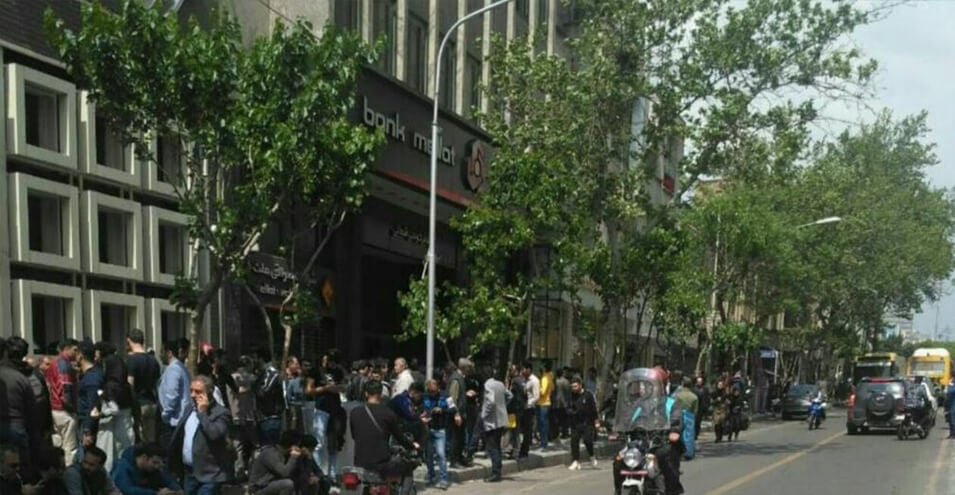
As the exchange rate continued its upward trend in the Iranian market, crossing the 5,600 toman mark, Tehran's exchange offices witnessed an influx of buyers to buy dollars and euros.
Domestic media reported on Sunday, April 9, citing exchange offices and currency dealers in Tehran, that each US dollar, which was selling for around 5,100 tomans on Saturday, exceeded 5,600 tomans on Sunday afternoon, and according to some reports, reached more than 5,700.
The selling rate of the euro also exceeded 6,600 tomans.
At the same time, images and news published on social media indicate the formation of long lines of people seeking to buy foreign currency in front of exchange offices in Tehran.
Witnesses also told ISNA that on Sunday, some exchange offices refused to sell dollars due to high demand and a shortage of dollars. Some exchange offices were also selling dollars to travelers with only their passports, facing long lines.
The increase in the dollar rate by several hundred tomans in one day comes at a time when the exchange rate in the Iranian market has been on an upward trend in recent months.
The exchange rate increase began late last summer, when each US dollar was selling for 3,500 tomans in the Iranian market, and increased in several stages until it exceeded 5,600 tomans.
The value of the national currency of the Islamic Republic of Iran against the dollar has fallen by 50 percent over the past seven months.
The depreciation of the dollar in recent months has thrown the Iranian market into turmoil and made citizens concerned about the future of their family finances. Since many of the goods used by Iranian citizens are imported or made from imported raw materials, an increase in the exchange rate quickly causes the prices of goods to increase.
Reasons for the increase in exchange rates
Two months ago, following a sudden increase in the value of the dollar, the government tried to stop the upward trend in the exchange rate by taking measures such as arresting currency speculators and injecting foreign exchange into some exchange offices at cheap rates, but this trend began again in April.
In recent months, some experts have cited concerns about the return of sanctions if the US withdraws from the JCPOA, the unrest in January, increased liquidity, and the Iranian government's difficulties in bringing money from oil sales into the country as reasons for the increase in the exchange rate.
Meanwhile, Siamak Shojaei, an economist and professor at William Paterson University in New Jersey, USA, believes that other causes are also involved.
Mr. Shojaei, who recently spoke to Voice of America after the exchange rate crossed 5,100 Tomans, considered another issue to be people's distrust of the country's economic and political situation, and said that large domestic capitalists are taking their capital out of the country in any way possible.
He pointed to the registration of more than 50,000 Iranian financial and economic institutions in the UAE, as well as the failure to realize the $41 billion in oil revenue promised by the Minister of Oil.
Referring to the $35 billion in imports, the economist said that all of these statistics should be placed alongside another factor in the increase in the exchange rate, namely the latest mistake by the Central Bank of Iran. He explained: “After the widespread arrest of illegal street money changers and brokers, the Central Bank injected a large volume of foreign exchange dollars into the market to keep the dollar below 4,500 tomans, while immediately after making such a mistake, which is even mentioned in textbooks, the country’s foreign exchange reserves are lost and the price of the currency rises again.”
Source: Voice of America