Zarif: Billions of Tomans Are Being Money-Laundered in the Country
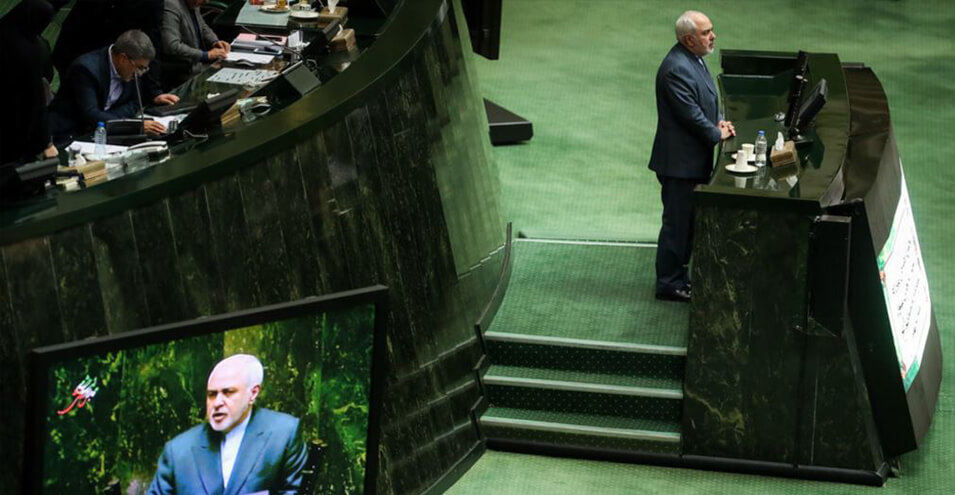
Iran’s Foreign Minister says that “the Islamic Republic’s skirts are clean of money laundering,” but at the same time announced that thousands of billions of tomans are being money-laundered in the country.
Mohammad Javad Zarif, speaking on Sunday, November 3, in an open session of the Islamic Consultative Assembly, in response to a question about “money laundering,” said that his previous remarks were not his alone and “various officials of the country” had raised these statements.
He simultaneously emphasized that “pressure groups” that have “personal interests” are reluctant for Iran to join conventions on “combating terrorism and money laundering.”
Iran’s Foreign Minister, referring to his statements from November 21 of last year that received widespread coverage, said: “I said in the Islamic Republic there are pressure groups that benefit from money laundering. They benefit thousands of billions of tomans from money laundering, and had it not been for the judiciary and the government, a 60-page regulation on money laundering would not have been approved.”
Mr. Zarif, however, only referred to the trial of Sultan Seke [coin] and said that “the Islamic Republic’s skirts are clean of money laundering.”
Iran’s Foreign Minister added: “Thousands of billions of tomans in money laundering are exchanged by currency and coin smuggling gangs, which are now being investigated in economic crime courts.”
He raised the question: “If there is no money laundering in Iran and corrupt groups are not laundering money, on what charge did you execute Sultan Seke.”
Mohammad Javad Zarif last November had considered the reason for “media campaigns” against bills related to money laundering in Iran to be “economic interests of tens of thousands of billions of tomans” of certain individuals.
He had accused cultural institutions related to “powerful bodies” of “creating a media campaign” regarding Iran’s accession to conventions against money laundering.
A number of members of the Resistance Front had responded to these remarks by raising a question with the Foreign Minister.
Two bills on Iran’s accession to the Convention on the Financing of Terrorism and Iran’s accession to the Convention Against Transnational Organized Crime, despite requests from Hassan Rouhani’s government officials, have not yet been approved by Iran’s Expediency Discernment Council.
Meanwhile, Gholamreza Ansari, Deputy for Economic Diplomacy at Iran’s Foreign Ministry, said that if the FATF bills are not approved, “the final blow” will be struck to Iran’s banking system.
The Financial Action Task Force, FATF, which is responsible for monitoring financial transparency in international banking transfers, preventing money laundering and financing of terrorism, gave Iran a four-month deadline for the sixth and final time in late October this year to approve bills related to money laundering and terrorism financing conventions.
Zarif’s Remarks about “Chief Extortioner”
Mr. Zarif said in another part of his remarks: “I am known in the world for defending the people and the system with my chest open. Look at the title that the American Secretary of State has attributed to me. Of course these things make me proud.”
The Persian Twitter account of the U.S. State Department, in translating a statement by Mike Pompeo, U.S. Secretary of State, used the term “chief extortioner” regarding Mr. Zarif.
According to the Assembly’s regulations, after the ministerial explanations from whom a question is asked, the questioning representatives also speak. However, Mr. Zarif said he had to leave the parliamentary session due to participation in the Supreme National Security Council meeting.
Masoud Pezeshkian, Deputy Speaker of Parliament, said: “What Mr. Zarif did was wrong. Staying eight more minutes would not cause him any problem and his action is not acceptable.”
Mohammad Reza Sabaghi’an, representative from Bafq, also said that “we should no longer allow Zarif into Parliament.”
Source: Radio Farda