Student activists targeted by the Islamic Republic's suppression machine
The Islamic Republic's machine of repression has been targeting students for decades, and now, coinciding with the 42nd anniversary of the 1979 revolution, news of the conviction of two more students is making the rounds in the media. A revolution whose slogan was the liberation of Iran and Iranians, but in practice imprisoned those who demanded freedom.
Students who are imprisoned for the slightest criticism or protest.
Like Parisa Rafiei, who even in prison has a new case filed against her and is sentenced to another term of imprisonment, 15 months in prison on charges of "propaganda against the system" because, after her temporary release, she wrote about the conditions in the detention center and what happens to female prisoners.
Parisa Rafiei is a student at the University of Tehran who was detained for three weeks in the winter of 2017.
In his first case, he was sentenced to seven years in prison and 74 lashes for participating in student protests. This sentence was eventually reduced to one year in prison through a reduction, and he has been serving this sentence in Evin Prison since July of this year.
But now, in his new case, another 15 months in prison have been added to that sentence.
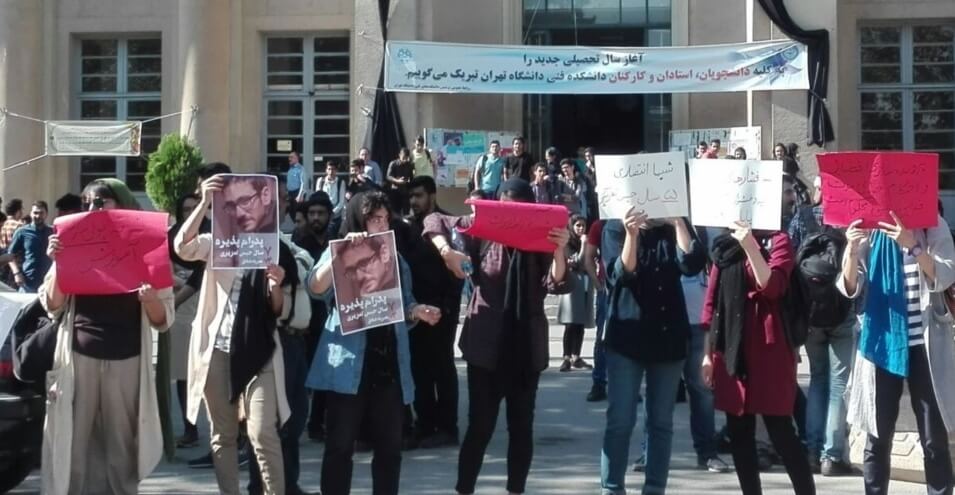
Soha Mortezaei is another student activist who has been sentenced to prison, simply because she had staged a sit-in on the campus of Tehran University, sitting on a table at her university and holding a placard on which she had written about "discrimination and injustice" against her, about her deprivation of education.
Soha Mortezaei, a graduate of political science and international relations, has been denied access to a doctoral degree.
For protesting this issue, he was charged with "gathering and colluding against national security" by Branch 15 of the Tehran Revolutionary Court, presided over by Judge Salavati, and sentenced to six years in prison.
And now this verdict has been confirmed by the Tehran Provincial Court of Appeal and notified to his lawyer.
It has been 10 months since the arrest of Ali Younesi and Amir Hossein Moradi, two elite students from Sharif University of Technology, and these two students are still in an uncertain situation in Evin Prison.
The Iranian judiciary has accused them of ties to the People's Mojahedin Organization and possession of explosives, charges the families deny.
Nazanin Mohammadnejad is another student activist who was detained for two months and was temporarily released last week, on a hefty bail of 1.2 billion tomans.
There are many names of students who have been arrested or sentenced to prison this year, on repeated charges, all of which were based on their student activities or civil protests.
Shahabuddin Nazari, Mohammad Khani, Kamyar Zoghi, Mohammad Sahedi, Roghieh Nafri, Mohammad Davari, Mostafa Hashemizadeh, Amirhossein Sharifi, and Abolfazl Nejadfateh are just a few of the students who have been arrested and sentenced to prison across Iran over the past year.
The reason for the arrest and conviction of these individuals was their student activities, or their cry for justice for the 176 victims whose plane was blown into thousands of pieces by the IRGC missiles in the sky of Tehran, as well as their support for the people who received their protests in bloody November 1998 with bullets and death.
The events that turned 2019 into a year full of breathtaking news, but in none of these cases have the perpetrators and commanders of those tragedies been identified and brought to trial.
Meanwhile, the Islamic Republic's security and judicial apparatuses did not hesitate to suppress the protesters of those events, and since the fall of 2019, they have arrested and imprisoned dozens of people simply for their calls for transparency and justice.
Source: Radio Farda