The opposite result of Rouhani's slogans: Who is responsible for filtering and the absence of a free media?
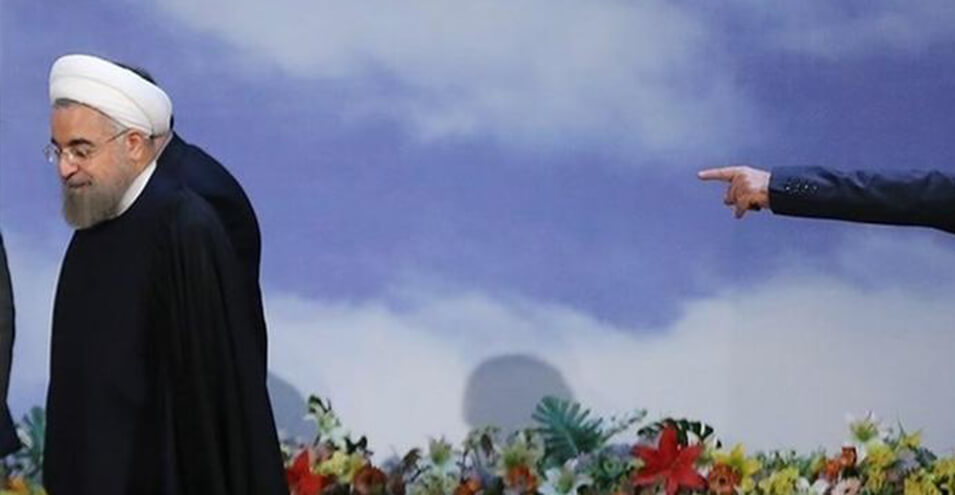
Rouhani's remarks criticizing filtering and the lack of a free media have been met with strong reactions. Conservatives accuse him of "filtering people's problems." Others ask what steps he himself has taken to free the media and combat filtering.
Yesterday's remarks by Iranian President Hassan Rouhani, criticizing filtering and the absence of a free media in the country, sparked a lot of reactions in the media and social networks and made the front pages of Iranian newspapers. However, it seems that his slogans during his speech to the directors of the Ministry of Communications, aside from the predictable attacks of "extremists", did not have the desired result for the 12th head of state, and have drawn widespread criticism towards him as the "responsible" official.
Meanwhile, media outlets affiliated with the so-called hardline fundamentalists have severely attacked Rouhani, accusing him of filtering and "censoring the people's problems" and promoting a secular government based on American demands.
Hossein Shariatmadari, the editor-in-chief of Kayhan, wrote in an editorial of this state-run newspaper on Tuesday, January 22, that the 12th head of state's remarks "indicate that His Excellency recommends a Vatican-like version for Islamic Iran and believes - and God willing, it will not be the case - that the government has no other duty or responsibility for the good and welfare of the people and their happiness and misery other than communicating religious principles verbally or in writing!"
The representative of Ali Khamenei, the Leader of the Islamic Republic, at the Kayhan Institute, referring to Rouhani's opposition to any kind of obstruction and the necessity of users' freedom to enter cyberspace and recognizing their free choice, added: "This view is far more dangerous than the Vatican version, and its meaning is precisely that we leave young people, teenagers, and all people alone in the dangerous valley of cyberspace and only introduce them to good and bad! Without having the slightest responsibility for preventing serious and dangerous harms in this space!"
“Promoting a government that suits America’s wishes”
Shariatmadari also wrote in an editorial in Kayhan under the title “Mr. Rouhani! This is not the Vatican!”: “Isn’t this view of Your Excellency – without you knowing it, of course – promoting the same secular government – normalism – that American officials and think tanks are constantly talking about their efforts to establish in Islamic Iran and ultimately not only dependence but also slavery of the nation to America?!”
The Supreme Leader's representative at the Kayhan Institute finally complained to "religious scholars" why they "don't make enough effort to counter these deviant opinions and views" so that people like him "don't need to enter this valley?!"
Kayhan also dedicated its first headline to Rouhani's speech, writing, among other things: "In his speech yesterday, the president made no reference to the real problems of the people and did not address the point that real filtering is censorship of the people's problems and forgetting promises, not playing with words and false dichotomies that do not solve any of the people's problems."
In this “analytical report,” the state-run newspaper also accused Rouhani of “creating false polarities” and “demagoguery,” writing: “The president interprets the public will of the people in such a way that the government and its actions are not harmed and no one questions it. The point here is, isn’t the livelihood and economy of the people, which are in danger today, part of the public will? Isn’t the government’s inaction in this regard illegitimate and illegal based on the interpretation that Rouhani is giving?!”
Kayhan also called Rouhani’s remarks about the lack of a free media in Iran “strange and surprising,” and said that his government “has a record of complaining about newspapers and media outlets.” According to the newspaper, “There is no critical media outlet that the government has not complained about or threatened.”
“Filtering people’s problems”
The Javan newspaper also dedicated the headline of one of its issues today, “People’s Problems Are Filtered!” to Rouhani’s remarks, writing, among other things, that since he “has nothing to say” in ministries such as Labor, Industry, or Health, he has moved to the Ministry of Communications, where he “can speak as much as he wants about Telegram, filtering, and cyberspace.”
The Javan newspaper adds: "Mr. President, you yourself have played the role of a filter. You talk about the wasted "freedom" in the media so that no one asks about the achievements of the JCPOA! You talk about the fantasy joys of the people in cyberspace so that no one talks about the real joys of having a decent income and a market without inflation. You automatically filter out housing, livelihood, employment, and independence and talk about poetry, songs, and ghazals."
This newspaper affiliated with the Revolutionary Guards ultimately wrote to Rouhani: "If filtering is bad, please get out of here. The main filtering is hiding the real problems of the people and fantasizing and telling stories from the radio and Reza Qoldar."
Statements that go against Rouhani's "practice and record"
The attack on Rouhani for his criticism of filtering was not limited to the interpretation of his words by hard-line fundamentalists, and some media outlets, including those affiliated with this movement, have also addressed his own role in the effort to block social networks and the free flow of information.
The Islamic Azad University News Agency (ANA) considered Rouhani’s remarks criticizing filtering to be contrary to his “practice” in the 1970s and wrote, “The law on entering people’s homes to collect satellites” was approved in one of the sessions of the Fourth Parliament chaired by Rouhani. According to the news agency, the law on “Prohibition of the Use of Satellite Equipment” approved on February 13, 1994 was approved after four sessions in the Fourth Parliament, when Ali Akbar Nateg Nouri, the then Speaker of the Parliament, had appointed Hassan Rouhani as his “plenipotentiary representative” in these sessions.
After referring to the "numerous security and military records" of the moderate head of the 12th government, the ANA news agency asked: "Has Rouhani deviated from his past positions or is he trying to attract the gray sector?"
Tasnim News Agency also considers Rouhani's criticism of filtering yesterday to be in contradiction with his own previous "directive" to "deal with filter breakers."
In his speech yesterday, the Iranian President, referring to “If you filter, what will you do with the filter breakers?” and “In this one year since Telegram was filtered, we all lost,” said: “The problem is that we thought this system was under our command, that we would order a filter, and it gets filtered? So, what do you do when it gets filtered? What do you do with the filter breaker? What do you do with the next filter breaker? What do you do when the filter breaker comes every day?”
Tasnim News Agency has published a picture of a circular dated January 15, 2017, stamped “Top Secret” and signed by Hassan Rouhani, in which the Iranian President addresses his Minister of Communications, calling for “effective action against filter breakers.” In this circular, which, according to Tasnim, was posted on social media on May 7, 2018 and the government has never denied, Rouhani, with an implicit reference to the nationwide protests of January 15, 2017, calls on Mohammad Javad Azari Jahromi to take “urgent” measures “in light of recent events and the impact of cyberspace on increasing social unrest.”
According to this news agency close to Iranian security institutions, "A short while later, Reza Taghipour, a member of the Supreme Cyberspace Council, reported Rouhani's emphasis on regulating VPNs, effectively dealing with filter breakers, and efficiently managing the legitimate use of these tools by cyberspace users and organizations, and said: We cannot sit back and watch the enemy instill whatever he wants in society. After these events, it became clear that Telegram is run with the direct support of the United States and Israel, and their goal is to spread prostitution and corruption in Iranian society."
“Dr. Rouhani, what have you done for media freedom?”
Criticism of Rouhani's remarks yesterday, including the contradiction between his statements and his government's actions in, for example, filtering Telegram, was not limited to "extremists." Some political figures and analysts who are generally considered supporters of the government have also joined the ranks of his critics, along with social media users.
Ali Mohammad Namazi, a member of the Central Council of the Construction Workers Party, wrote in today’s issue of the “Satare Sobh” newspaper: “What does it mean for the country’s chief executive to speak out against filtering, but social networks are filtered in his own government? Rouhani is talking about issues that the people themselves are aware of, but in practice they see no movement from the government. Telegram was filtered during Rouhani’s time […] In the author’s opinion, it is better for officials to talk less and act more.”
This former member of parliament then wrote, while asking the Iranian president to "guarantee citizens' rights," that from the people's perspective, Rouhani's election promises are not consistent with his government's performance.
Reformist analyst Sadegh Zibakalam also turned the edge of Rouhani's criticism of the lack of a free media in Iran back on himself, writing on Twitter: "Mr. Dr. Rouhani, the lack of freedom of the media in Iran and their monopoly on the government is not a new thing. The novel point is that as the second person in the system and responsible for implementing the constitution, with the support of 24 million votes, what steps have you taken to free the media?"
Criticism of filtering or “Farewell song to Instagram”
Hassan Rouhani’s statement that “we don’t have free media, we only have state media” was also met with a wave of criticism on social media. Iranian journalist Maziar Khosravi was among these critics, who wrote to Rouhani on Twitter: “Gentlemen! Why are you talking to us?! You are the president, not the leader of the opposition; so don’t filter, let the media be free. We are captive…”
Mehdi Mahdavi Azad, a political analyst based in Germany, looked at the issue from a different perspective, writing on Twitter that Rouhani’s “strong words” the other day were “probably a farewell ode to Instagram.” According to Mahdavi Azad, Rouhani: “He also gave a similar ‘warning’ two weeks before the Telegram filtering. On January 2, 2018, Javad Javidnia, the deputy for cyberspace at the Attorney General’s Office, said that a court order to filter Instagram had been issued, but they were waiting for an opportunity…”
Ali Afshari, a political analyst and human rights activist based in the United States, also wrote on Twitter: "Hassan Rouhani, continuing his false propaganda and sloganeering that has confused the presidency with a pulpit for preaching and lecturing, has done the people a favor by saying that they owe the easy use of cyberspace to the moderate government! While extensive filtering is in place, and where it is not, it is due to the lack of final closure by the dominant security sector."
Another Twitter user wrote: "Every time Hassan Rouhani talked about removing filters and freeing the media, we witnessed a new wave of arrests of journalists and the filtering of virtual networks."
Another user, in response to Rouhani's criticism of filtering and the lack of a free media in Iran, wrote sarcastically: "Mr. Rouhani. Hello. How many times have you said these slogans and words and we voted twice? We don't have any more votes to vote, can we just play cards?"
"National Media" Supports Filtering
In his speech yesterday, the Iranian President implicitly questioned the freedom and impartiality of the “national media” by declaring the absence of “free media” in Iran and the existence of “only state media” in the country. The state-run Kayhan newspaper also complained in its “analytical report” today, noting that “the State Radio and Television have been the most supportive of the government at critical junctures” and that the attack on the state-run Iranian Radio and Television has become “headline number one in most pro-government media.”
The Islamic Republic of Iran Broadcasting, whose chairman is a member of the Supreme Council for Cyberspace, is a supporter of filtering in Iran. In today’s issue of Shargh newspaper, journalist Ruhollah Sepandarand considers among the “numerous reasons” for the Iranian state-run radio and television’s approach to confronting social networks and supporting their filtering that “there is no doubt that the structure that has had a monopoly on producing multimedia content for all these years cannot withstand the presence of a serious competitor. Especially when this competitor is a good benchmark for the low quality of the IRIB’s programs.”
This journalist also points to the low quality of "national media" programs and the "significant gap" between the number of Iranian Broadcasting Corporation (IBC) audiences and the number of independent media productions in cyberspace, and reports an increase in the number of "prominent figures" who "prefer" to "connect with the people through social networks rather than through state-run radio and television."
The Sharq article also cited another reason for the Islamic Republic of Iran Broadcasting’s support for filtering: “Rather than being rooted in concerns raised by some currents, the IRIB’s support for filtering stems from macro-financial and economic calculations; because this organization, knowing its inefficiency in producing desirable media content, knows what huge profits the widespread availability of people’s access to media productions in cyberspace will steal from IRIB. This is while independent media sectors that operate in cyberspace are more productive with far lower costs than IRIB.”
Considering these cases, the author does not consider the IRIB's insistence on filtering in Iran "strange" because, according to him, "the emergence of social networks and the expansion of cyberspace" has reduced the "media power" of this institution.
The Internet and social networks in Iran face extensive filtering. International NGOs also call the Iranian government one of the “enemies of the Internet.” After the nationwide protests of January 2017, filtering of social networks entered a new round, which led, among other things, to the blocking of Telegram. At the same time, the government’s promotion of the use of domestic messengers has had no effect on social network users.
Despite this, Javad Javidnia, the head of the Iranian Attorney General’s Office’s Cyberspace Affairs Department, announced on January 2 that a “judicial order” had been issued to filter Instagram. The judicial official’s remarks were met with strong reactions, including from within the Rouhani government, and were denied by some representatives opposed to filtering.
Source: DW