End of the second round of the Aban Tribunal; Senior IRGC officer: The order to suppress was issued by the Leader of the Islamic Republic
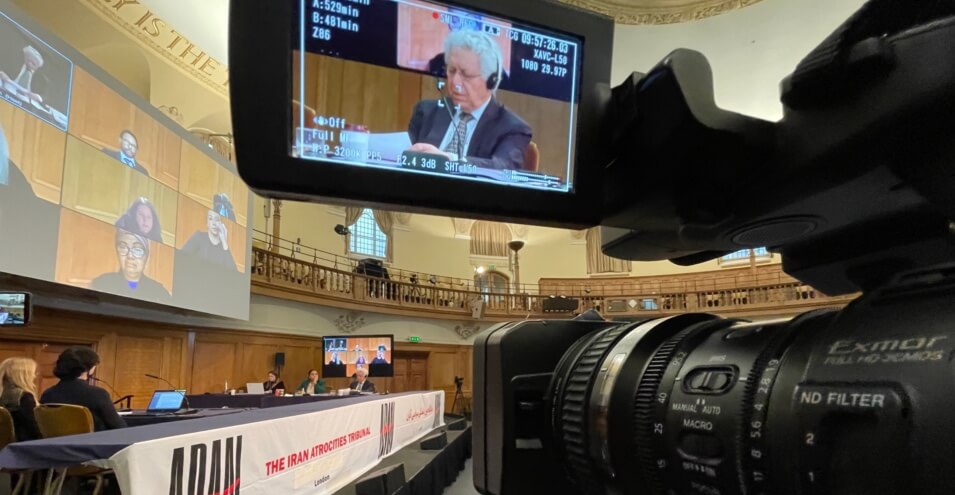
Three months after the first round of the International People's Court was held in London in November 2019, the second round of the court, to "determine the nature of the crimes that occurred" and "hold those responsible accountable," concluded its work after three days with the testimony of 22 witnesses.
The third day of the second round of this people's court ended on Sunday, February 17, with the testimony of seven witnesses, including several military personnel, while Voin Jordash, the head of the panel of judges of the International Court of Justice, announced that the panel of judges will try to announce the final verdict in Ordibehesht 1401.
Witness number 600, who appeared as the first witness at the International People's Court in Aban today, was a senior officer in Tehran's Revolutionary Guards and responsible for gathering information during the protests. For security reasons, he appeared in court online with his face covered and his voice altered.
On the third day of the intelligence court, this witness testified about the clashes, beatings, widespread arrests, including more than 7,000 arrests in Tehran, the IRGC's unlimited powers, the use of Basij children in suppressing protests, the deaths, and night burials. He said, "The IRGC has been training its forces to suppress protests for years," and that during the November 2019 protests, the IRGC forces had been on alert for a rebellion a week in advance.
He went on to mention two officials close to the Supreme Leader's Office, Mr. Khalafi, one of the officials in charge of the Supreme Leader's Office's ceremonies, and Vahid Haqqaniyan, an advisor to Ali Khamenei, and said that these individuals had given the IRGC commanders the order to "shoot and contain the crisis." He added that the order to "fire at will" was given from the second or third day of the protests, and that there was no need for the military forces to submit a report on the amount of ammunition used or where or who they shot at.
This senior IRGC officer pointed out that "all these orders were issued by the Commander-in-Chief, that is, the Iranian leadership," adding that the provinces of Alborz, Lorestan, and Khuzestan had the highest number of deaths in the November 2019 protests, with the two cities of Mahshahr and Karaj having the highest rate of shooting and suppression by the special forces.
Zahra and Maria Saedpanah were sisters who, together in this court, provided information to the judges by presenting documents and evidence related to the suppression of the November 2019 protests in the city of Sanandaj.
Zahra Saedpanah, noting that she was attacked with batons by security forces and injured by a plastic bullet during the November 2019 protests, reported the brief detention of her 18-year-old nephew during these protests.
After the two sisters testified, reporters present in the courtroom were asked to leave the room with witness number 602 due to the confidentiality of the testimony.
Witness 418 was the fifth person to appear in court on the third day of the November International People’s Court, disguised as a police officer, with his face covered and his voice altered by the court organizers for security reasons. The witness told the court judges that on November 14, he had been sent to guard a gas station in the provincial capital where he worked, and on Saturday, November 15, he and his colleagues were referred to the “Second War Organization” – an organization where he was assigned as a sniper. The police officer says that because he did not want to face the public, he was able to convince his superiors not to carry out the assigned task.
The witness, referring to the fact that he and several other soldiers were forced to guard the NAJA premises between November 16 and 18, told the panel of judges: “I cannot give an exact figure regarding the actual number of detainees. But I can say that about 50 people, from 15-year-olds to 45-year-olds, all of them men, were brought to our headquarters in handcuffs and blindfolds. Because they really had no place in the IRGC prison or the Intelligence Department.” He also added: “The order was not to fire with Kalashnikovs or organizational weapons so that the bullets would not be traceable later and they could deny their responsibility.”
The sixth witness, number 499, also appeared in court with his face covered to protect his security and presented his testimony to the judges regarding the suppression of the November 2019 protests, the arrest of Kaveh Visani, one of those killed in November 2019, and the discovery of his body with signs of torture on it.
According to this witness, Kaveh Visani was arrested during the November 2019 protests in Sanandaj. Following up with his family, it was determined that he was being held in the Sanandaj Police Intelligence Detention Center. However, in December of that year, the police denied his arrest and informed his family that his body had been found in a village outside of Sanandaj.
The seventh and final witness of the second round of the Aban International People's Court was also a member of the police force in one of the cities of Iran who appeared in court online with a mask on and military uniform. He said that on Aban 14, they were informed at their place of service that gasoline prices were going to increase and that he and one of his colleagues would be taken to a gas station in the city with equipment such as a gun and a taser for protection.
The witness stated that on November 15, as protests increased, they were asked to defend their place of service. He added that on that day, he saw a person lying on the ground in front of his service headquarters, with blood around his head.
The witness also added that none of the protesters were armed and did not make any threats to life against the police or anyone else, and that the police could have used other methods to deal with the protesters, but they opened fire on the people.
Witness number 601 told the court judges that he was detained for three days, beaten, and finally released after three days with a 30-day suspended sentence for disobeying a superior's order during protests.
The witness, who, according to the court's public relations department, has been calling to record his testimony in recent days, told the court judges that, based on documents available during the protests, 2,300 bullets were fired at people by the police forces where he served, and during that time, 33 people were arrested, 15 were injured, and two were killed.
After the witnesses' testimony was completed, the prosecution presented the case of 160 defendants to the judges and answered some of their questions.
Hamid Sabi, a member of the prosecution, responded to a question from the panel of judges who asked how they were making their statements against the Supreme Leader of Iran, saying that Khamenei was the one who, along with 159 other people, was responsible for suppressing the protests. Referring to the testimony of witness number 600, he said that this witness, who was a senior officer in the Revolutionary Guards, also stated that the Supreme Leader of Iran had ordered the suppression of the protests.
Addressing the court judges, Mr. Sabi said that the Basij suppression forces, the IRGC, and plainclothes officers are all under the direct command and orders of Ali Khamenei, and as such, he is responsible for the decisions that have been made and is responsible for all the crimes that have been attributed to him.
The second day of the second round of this people's trial was held on Saturday, February 6, with the testimony of nine witnesses, including Abu Bakr Mehrbani, the uncle of Osman Naderi, Ali Rezaei, the brother of Naser Rezaei, Alireza Barakati, a friend of Seyyed Ali Hosseini, one of those killed in November 2019, and Maryam Foumani, a prosecutor's investigator.
The first day of the second round of this people's trial was held with the testimony of six witnesses, including Tahereh Bajrvani, wife of Ali Fatouhi, Mohammad Mehdi Shahbazi Fard, brother of Ameneh Shahbazi Fard, one of those killed in November 2019, Fatemeh Davand, one of those arrested in the November 2019 protests, and three other witnesses whose faces were covered for security reasons.
Since the start of the second round of hearings at the International People's Court in November, more than 40 new witnesses have contacted the court's prosecutor's office via WhatsApp and requested to testify.