"Iranian-made" drones in the Yemen war
Since the beginning of the war in Yemen, the Houthi forces, known as Ansar Allah (Zaidi Shiites), have been conducting sophisticated operations against their opponents, who are in an alliance with Saudi Arabia.
During this war, Iran has been repeatedly accused of providing financial and military aid to the Houthis, and has denied this claim each time.
In October 2016, Reuters reported that Iran had increased its arms exports to Yemen's Houthis through Oman, including small arms and missiles.
American officials in Washington had expressed concern, but Oman's foreign minister dismissed the report as false.
The Reuters report states that some Western officials have also doubted the veracity of the claim that the Houthis have been able to receive significant amounts of weapons from Iran.
However, in the scenes of war operations in recent months, the Houthis' name has been in the headlines in two unprecedented events: first, the Houthis' missile attack on a ship belonging to the United Arab Emirates in the strategic Red Sea region; and second, a missile attack against an American warship.
Although the Houthis have consistently used Scud missiles and surface-to-surface rockets against Saudi Arabia, the two aforementioned cases require a higher level of missile power, which is a major difference from the history of using Scud missiles.
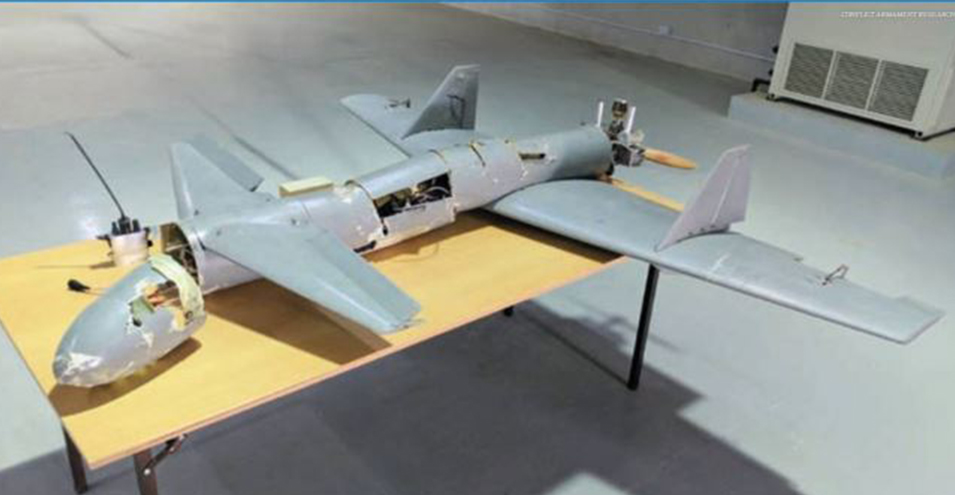
A week ago, at the end of March, the publication of an illustrated report of research conducted on the transfer of Iranian technology to Yemen largely solves the Yemeni missile mystery. According to the new report, between October 2016 and March 2017, the Conflict Weapons Research Center examined seven unmanned aerial vehicles (UAVs) and one UAV engine that were discovered. The equipment is currently in the possession of the United Arab Emirates Presidential Guard, which apparently seized the equipment in Yemen’s Marib province.
These drones were transported into Yemen via land routes from Oman. One of the drones also exploded and crashed near Aden International Airport, and a defective drone engine was recovered following a Houthi attack in Marib province.
On February 26, 2017, the Houthi forces displayed four drones that they claimed to be their own. One of the systems on display, called Qasef 1, is identical to one studied by the Conflict Armament Research Center.
The center’s research concludes that the Houthis are not the ones producing the Qasef-1 themselves, but rather that the Qasef-1 is a variant of the Ababil-2 produced by the Iranian Aircraft Industries Company. The drone displayed by the Houthis is similar to, but significantly smaller than, the Ababil-C model and closely resembles the details of the Ababil-T (an offensive variant of the Ababil group). The Qasef-1 is not only identical to the Ababil-T in terms of construction and design details, but the serial numbers of both begin with identical digits.
According to the center, on November 27, the discovery and seizure of six Qasef-1 drones being transported from Oman to Yemen (which is one of the usual smuggling routes to Yemen) indicates that the Qasef-1 was not manufactured in Yemen but was imported from Iran.
The UAE forces claim that the Yemeni Houthis, known as Ansar Allah and allies of former Yemeni President Ali Abdullah Saleh, are using Qasef-1 drones to target the Saudi coalition's MiM-104 surface-to-air missile system. This is done by exploding the drone when it hits the missiles, or radar systems (especially rotating radar systems) and using GPS.
While coalition forces use Patriot missiles to neutralize the missile threat, the destruction of the Patriot radar system would enable the Houthis to target and destroy coalition military tanks without encountering the defense system.
The use of drones by the Houthis and forces allied with Ali Abdullah Saleh shows that they can inflict significant damage on coalition forces with Saudi Arabia even at low costs and using cheap technology.
The research center's report concludes that the discovery of these drones is proof that there is a direct link between the weapons obtained from the Houthi groups and those allied with Ali Abdullah Saleh and the weapons of Iran's national reserve, and therefore, Iran's support is not limited to moral support, contrary to what is claimed, but also provides weapons support so that the Houthis can participate in asymmetric military operations. Iran has not yet officially responded to this report.
Source: Radio Farda