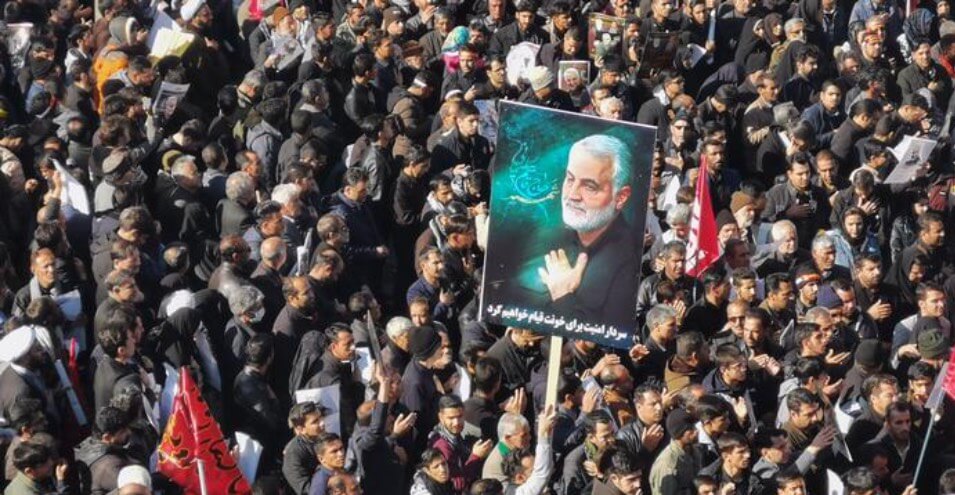
Chaos and threats, options for war or widespread pressure on Tehran?
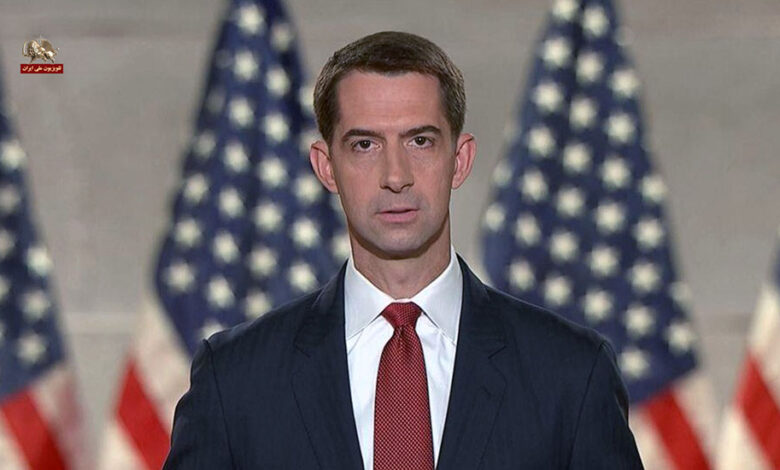
Senator Cotton issued a threatening warning, announcing a wide range of options against the Islamic Republic and increasing tensions in the region.
While nationwide protests in Iran have entered a more critical phase, with reports indicating that thousands of people have been killed by the Islamic Republic and the repression of protesters, US political and military officials have also taken harsh stances against Tehran, and whispers of broader US measures against the Islamic Republic have risen.
Republican Senator Tom Cotton stated in an interview: "Our military forces are constantly planning for multiple options in response to the threats that have been posed by the Islamic Republic of Iran for many years."
He continued by stating regarding the state of the protests in Iran that we are in the early stages of this story, and made this comment after Ali Khamenei's recent speech in Tehran.
Senator Cotton also referred to concerns about Tehran’s policies, adding: “President Trump has not forgotten that the ayatollahs have the blood of hundreds of Americans on their hands. They should take the president’s threats seriously.” Explaining the range of possible actions, he said: “This action would not be like an attack on their nuclear program or an operation to capture Nicolas Maduro, and it could be broader in scope.”
Cotton emphasized that the goal of these measures is to exert maximum pressure on the ayatollahs while minimizing civilian casualties inside Iran as much as possible, and to achieve this goal, we have a full range of options, not just military options.
In another part of his interview, he said: "Although street presence in the protests may have decreased because the regime killed its own people in the past few days, the protests have not ended."
Senator Cotton also referred to the history of historical protests in Iran, adding: "The Islamic Revolution dates back to 1979, but there was a year of protests throughout 1978."
He emphasized that the Iranian system is unable to respond to the widespread dissatisfaction of the people, because, according to him, "this system is an illegitimate repressive regime that has been imposed on them for 47 years." He also continued: "The economic situation is also such that the currency in Iran is so worthless that it is not worth printing on paper, and the people do not have the power to buy anything."
Cotton's comments come as other US officials have signaled a growing likelihood of stronger action against Tehran. Trump has reportedly warned that Iran is crossing a red line and has "very strong options" on the table, but has not said when, where or how to act.
Analyses also show that the United States has not changed its military posture in the region despite threats, and various civilian options are being explored to support the Iranian people, including intelligence measures, economic pressure, or enhancing access to free information.
But on the other hand, American media have reported that some senators have expressed skepticism about the military option against Iran, warning that such a move may unite the Iranian people against the United States rather than weaken Tehran.
Meanwhile, according to media reports, the transfer of US military forces to the Middle East has also been reported, although official officials have not confirmed this.
This series of statements and events shows that political and military tension between Washington and Tehran is at its highest level in recent months, and while some American politicians are calling for broader options against the Islamic Republic, others have expressed skepticism about the consequences of such actions.