Interior Minister's statistics on the deaths of November 2019 protests: "More than 200 people" were killed
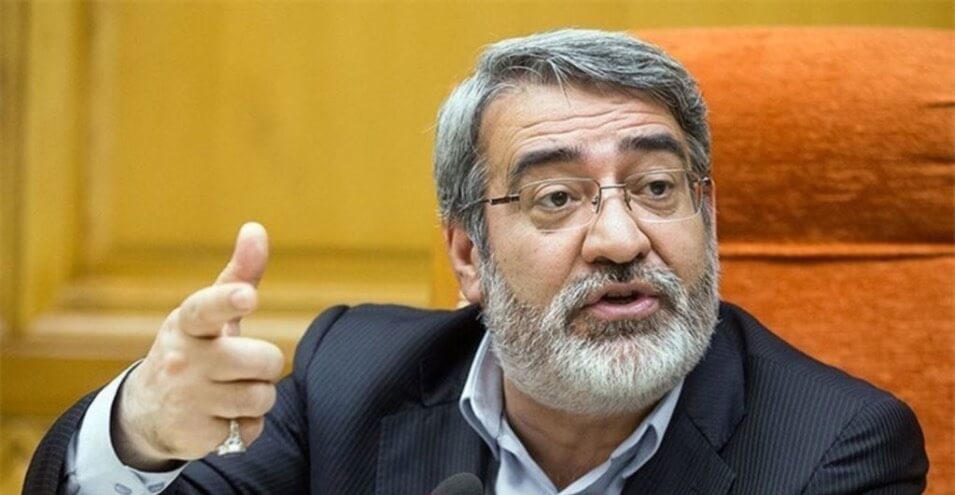
On Saturday evening, June 1, Iranian Interior Minister Abdolreza Rahmani Fazli acknowledged for the first time that 80 percent of those killed in the November 2019 protests were killed by organizational weapons.
In an interview with the "Nehaha Yak" program, Abdolreza Rahmani Fazli said regarding the number of people killed in the November 2019 protests: "About 40 or 45 people, or about 20 percent of those killed, were people who were killed with weapons that were not organizational weapons."
This is the first time that Iran's Interior Minister has implicitly stated that between 200 and 225 people were killed in the November 2019 protests, and 80 percent of them lost their lives with organizational weapons.
The statistics announced by Abdolreza Rahmani Fazli differ from the number of deaths announced by international organizations and human rights defenders.
In this regard, Amnesty International last week announced detailed death tolls, saying that at least 304 people were killed in 37 cities and eight provinces of Iran during the November 2019 protests. However, Amnesty International says that the actual number of people killed in November 2019 was likely much higher.
According to Amnesty International statistics, the poor neighborhoods on the outskirts of Tehran have had the highest number of victims with 163 deaths, followed by Khuzestan province with 57 deaths and Kermanshah province with 30 deaths.
Meanwhile, on January 19, 2019, Reuters reported that 1,500 people were killed in the November 2019 protests, citing "three sources close to Khamenei's inner circle and a fourth official" who said that the leader of the Islamic Republic had told senior officials in the country to "do whatever is necessary to stop" the protests.
The November protests, which followed the government's sudden decision to raise gasoline prices by 200 percent, took place in many Iranian cities, but were met with a crackdown by security forces. The Islamic Republic's security and intelligence agencies also completely cut off the country's internet network during the crackdown.
They wanted to "start a civil war"
In another part of this interview, Abdolreza Rahmani Fazli said that in November 2019, "all American and anti-Iranian media outlets, including the monarchists," the People's Mojahedin-e Khalq, and "ISIS were providing armed training."
The Interior Minister further emphasized that this group sought to "start a civil war in Iran."
He said: "There was no armed confrontation with the people during the November protests, and restraint and observance were recommended, and there is evidence of that."
While the Minister of Interior has claimed to have documents proving that there was no armed confrontation with the people, he has not yet officially announced the number of victims of the protests, almost seven months after the November protests.
Amnesty International also said last week about the victims of these protests: "In all but four cases, protesters were killed by gunfire from Iranian security forces, including members of the Revolutionary Guard, Basij, and police forces, who fired live ammunition at the protesters' heads or upper torsos, indicating that they were shooting with the intent to kill."
Abdolreza Rahmani Fazli continued, "But when they attack the checkpoint, they must be confronted because if the police do not defend, people will be victims."
While the Interior Minister says that security forces have fired at protesters to defend checkpoints, there have been reports of shooting at protesters on the roads and outside cities.
Eyewitnesses told Radio Farda that after protesters in Mahshahr in Khuzestan Province blocked many roads leading to the Bandar Imam Khomeini Petrochemical Complex, including the road from Chamran Town to the Mahshahr Special Economic Zone, security forces opened fire on the protesters to open the route.
Eyewitnesses said dozens of people were killed in the reeds near the clash by security forces.
US sanctions against the Minister of Interior
In this interview, the Interior Minister also criticized the sanctions imposed on him by the United States due to his role in suppressing the November 2019 protests.
The US Treasury Department says that the Iranian Interior Minister ordered the police to suppress protesters in November 2019.
Mahmoud Sadeghi, a former MP, told the Imtadat website on December 15 about the Interior Minister's meeting with MPs: "One of the city representatives announced that two people in my constituency (Karaj and Shahr-e-Quds) had died from bullet wounds to the brain. He asked Rahmani Fazli if it was possible to shoot at least in the leg or below the waist, and that such shots had been fired? The Interior Minister replied, "Well! There have been shots in the leg as well."
Mahmoud Sadeghi added that the Iranian Interior Minister's response "astonished" the members of parliament.
In addition to the Minister of Interior, the US government has placed Hossein Ashtari, the commander of the National Police Force (NAJA), and some other high-ranking commanders of this military institution on its sanctions list for "the killing of people during the November 2019 protests."
US government officials have always emphasized the high death toll from the November 2019 protests.
Brian Hook, the US State Department's special representative for Iran, announced on December 5, 2019, that the possible number of deaths in Iran was "more than a thousand."
Source: Radio Farda