The execution of Kurdish political prisoner Heydar Ghorbani must be stopped immediately.
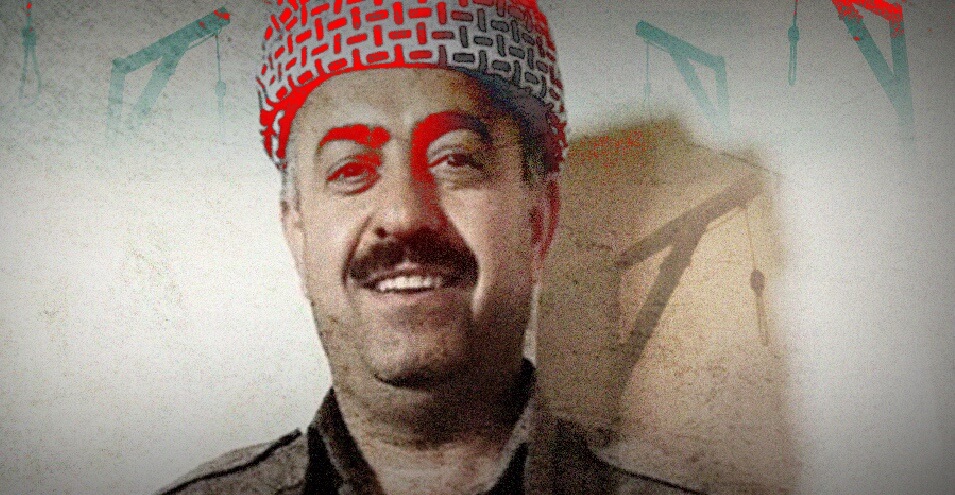
After the Supreme Court rejected the request to retry the case of Kurdish political prisoner Heydar Ghorbani, concerns about his imminent execution have increased. The extensive mental and physical torture inflicted on this political prisoner and his forced confession on television, along with the unfair and non-transparent process of reviewing the case in the judiciary that led to the issuance of the death sentence, are clear signs of the continued practice of the Islamic Republic's judiciary in insisting on the execution of political and ideological prisoners and gross violations of human rights in Iran.
Haidar Ghorbani was arrested in October 2016 and sentenced to three counts of "assistance in premeditated murder" and "collaboration with an opposition party," totaling 90 years in prison and 200 lashes. However, he was later sentenced to death in another case on charges of "rebelism."
Many documents and evidence, including statements by Heydar Ghorbani, indicate that he was repeatedly tortured throughout his detention to extract "forced confessions." His trial was also held without the presence of a lawyer.
Hadi Ghaemi, director of the Human Rights Campaign in Iran, referring to the Supreme Court's rejection of the retrial of Heydar Ghorbani's case, said: "The judicial authorities' disregard for this request, despite violating the country's existing laws and regulations, shows that the judicial process is formalistic in handling cases whose verdicts are issued by security institutions."
According to Hadi Ghaemi, "The unfair and non-transparent process of investigation and disregard for the right to defense of citizens, especially political and ideological defendants, in the Islamic Republic's judicial system has become a continuous process, as a result of which prisoners' lives are easily taken by issuing death sentences without due process."
The Human Rights Campaign in Iran, while expressing concern about the imminent possibility of the execution of Heydar Ghorbani, calls on the Iranian judicial authorities to prevent the execution of this inhuman sentence and to prepare the ground for a retrial of this political prisoner’s case. The rejection of Heydar Ghorbani’s lawyer’s request for a retrial in the Supreme Court and the lack of answers to many of the contradictions and ambiguities in the case and the legal documentation confirming the ongoing torture and ill-treatment of Heydar Ghorbani and his family, further reinforces the need for a retrial and legal retrial of this case.
On August 5, 2020, Branch 27 of the Supreme Court confirmed the death sentence of Heydar Ghorbani, and on September 27, 2020, Saleh Nikbakht, Heydar Ghorbani's lawyer, announced that Branch 27 of the Supreme Court had rejected the request for a retrial and sent the case to the Kamyaran Public and Revolutionary Prosecutor's Office for execution.
According to Saleh Nikbakht, "Heidar Ghorbani's request for a retrial was not accepted by three judges of the Sanandaj Court of Justice. As a result, the request to apply Article 477 in this case and send it to the head of the judiciary was rejected. Now, the case of my client, Heidar, has been sent to the Kamyaran Court of Justice for execution of the verdict."
Heydar Ghorbani, a 48-year-old citizen from the village of "Buzosh" in the Kamyaran county of Kurdistan province, was arrested by security forces in this city (Kamiaran) on October 10, 2016. Ghorbani was arrested because on October 23, 2016, three members of the Revolutionary Guard were killed in a village in Kamyaran county.
As Saleh Nikbakht, Haider Ghorbani's lawyer, said, "Haider was the only driver of the car in which the people inside killed three people (members of the Revolutionary Guards)."
Haidar Ghorbani's lawyer previously stated that during the court proceedings, his client "neither admitted the charge of membership in Kurdish parties nor personally took up arms, and therefore he is not charged with rebellion, but the court that issued the verdict in this case concluded that he had actually committed rebellion by aiding and abetting the murder."
According to Iranian law, the charge of rebellion is directed at those who are members of a group or organization that has taken up arms and taken armed action against the Islamic Republic of Iran.
According to the available statements and documents, none of the cases such as membership in a group or organization that supports armed struggle and taking up weapons apply to Haidar Qorbani, and his forced confessions were obtained under the most severe torture.
In March 2017, the Islamic Republic of Iran Broadcasting (IRI) aired a documentary titled "Death Driver," part of which included the forced confessions of Heydar Ghorbani.
As the possibility of Heydar Ghorbani's imminent execution grew more serious, more accounts of mental and physical torture on Heydar Ghorbani were released; the release of an audio file by Ebrahim Yousefi, who was imprisoned with Heydar Ghorbani in Kamyaran Prison in 2016, and a detailed description of the effects of torture injuries on Heydar Ghorbani's body, confirms that Heydar Ghorbani was forced to confess under torture.
Previously, the Kurdistan Human Rights Network had reported that Heydar Ghorbani had been subjected to interrogation and mental and physical torture for several months in the Sanandaj Intelligence Department and the city's Public Awareness Department.
In a report released in September 2020, Amnesty International called for immediate action to overturn the death sentence of this political prisoner, stating that "the court unlawfully relied on confessions that were obtained under torture, without the presence of a lawyer, and at a time when Heydar Ghorbani was a victim of enforced disappearance."
In the latest move to prevent the execution of Heydar Ghorbani, a group of Sunni clerics wrote a letter to Ali Khamenei, the Leader of the Islamic Republic of Iran, calling for a review of the court's ruling and a retrial of the case.
Source: Iran Human Rights Campaign