From Plasco to Gandhi Hospital; Iranian buildings remain unsafe and dangerous
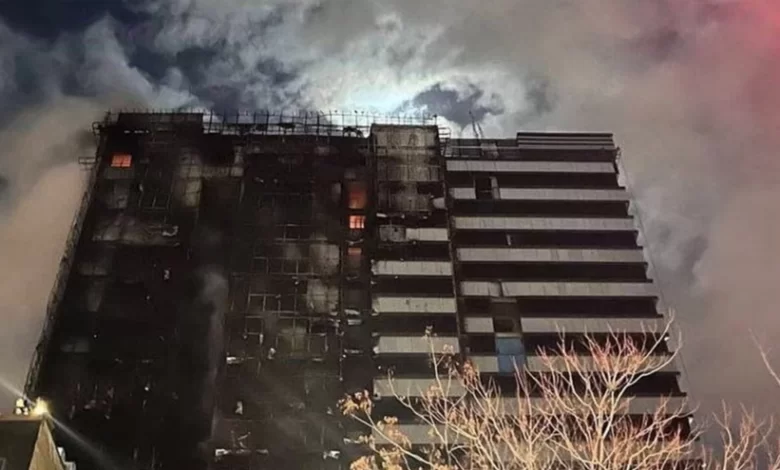
Domestic news agencies report that the fire at Tehran's Gandhi Hospital, which started on Thursday evening, November 25, was contained after a few hours with the efforts of firefighters, and according to officials, "without human casualties."
According to a spokesman for the Tehran Municipality Fire Department, the fire started on the facade of the building and then spread to the eastern part of the hospital, which mainly included the hotel and residential areas, but fortunately there were no casualties.
After the incident, the governor of Tehran said that structures at risk of accidents should be made safe as soon as possible. The crisis manager of Tehran's District 6 municipality also said that in addition to Gandhi Hospital, Dey Hospital, Shariati Hospital, and most hospitals in central Tehran had received at least three warnings to make them safe, but they had ignored them.
Pedram Pak-Ain, a spokesman for the Ministry of Health, said: "All patients from this hospital were safely evacuated and are being distributed to other hospitals in Tehran. A number of patients who were in stable condition were accommodated in a hotel adjacent to the hospital and then transferred to another hospital."
The deputy health minister of the Ministry of Health also said: "At the time of the fire, 93 patients were present at Gandhi Hospital in Tehran, 91 of whom were transferred to other medical centers. Two others who had come out of the operating room were accommodated in a safe place and then transferred to another hospital."
The cause of the fire is still unknown, but investigations are ongoing.
From January 20, 2016, when the Plasco building in downtown Tehran caught fire, killing at least 22 people, to June 2, 2022, when the Metropole collapsed in Abadan, killing 43 people, a large number of relevant and unrelated officials in the Islamic Republic have warned about the need to make public buildings in the country, especially in Tehran, safe. To this day, this warning has remained only a warning, and no practical action has been reported in this regard.
On Sunday, July 25, 1401, a few days after the Metropole incident, Mohammad Jafar Montazeri, the Attorney General of the country, attended a meeting of the Tehran City Council and stated that there were numerous unsafe and dangerous buildings in Tehran, especially in the southern areas of the capital, and said, "If for any reason the warnings and negotiations with the owners and residents of unsafe and dangerous buildings are not heeded, use the capacity of the judiciary to prevent a repeat of the Metropole incident."
Following this request, a list of 129 unsafe buildings in Tehran was published, most of which were shopping malls and residential complexes. The list also included the hospitals of Bu-Ali, Fajr, Shohada Yaftabad, Fayyaz Bakhsh, Ghiyashi, Ziaian, Tarfeh, and Shahabadi Medical Center, as well as the Shahed, Dr. Shariati, and Yadegar Imam Technical and Vocational Universities.
The president of Tehran University of Medical Sciences also said on June 8, 2022 that many private and government hospitals in Tehran have fire warnings, but if they are closed, treatment in Tehran will be disrupted, and there is not enough budget to meet the needs of the hospital's safety and reconstruction department.
The head of the Tehran Crisis Prevention and Management Organization also said on January 27, 2023, that Tehran is not in a good situation in terms of hospital management. The safety situation of some hospitals is poor, and most hospitals in Tehran are considered metropolitan areas and should be closed.
This is while Abdullah Ganji, a former member of the Government Information Council, said this spring: "Iran, under sanctions and under maximum siege, is equipping 12 hospitals in Indonesia! Isn't that interesting? Isn't it an honor?"
Source: Voice of America