Tehran Explosions Spark Israel's Preemptive War Against Iran
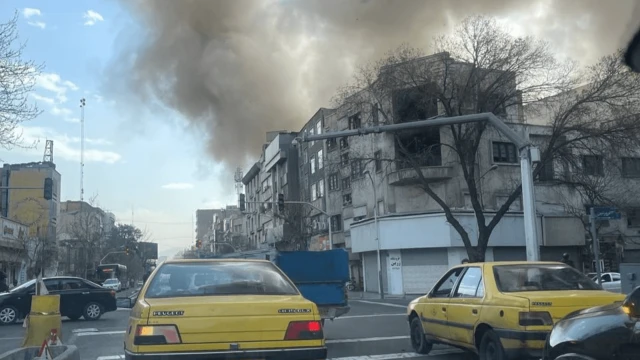
The explosions in Tehran, in the shadow of Iran-US negotiations, brought Ali Khamenei's home area to the brink of collapse.
While indirect talks between Iran and the United States had once again become the headlines of regional media in recent days, on the morning of Saturday, February 28, the sound of several consecutive explosions in Tehran disrupted the equations and cast the shadow of a direct confrontation over the country.
Domestic media reported that explosions were heard in various parts of the capital, including Jomhuri Street, the area of Beit Ali Khamenei and Seyyed Khandan; some reports have raised the possibility of missile attacks, although as of the time of writing this report, officials have not released clear details about the exact origin of these explosions.
In a rare development, Israel's defense minister announced that the country had launched a "preemptive operation" against Iran. The Israeli military also announced the closure of schools nationwide, a move seen as a clear sign of full security preparedness in the occupied territories.
The Israel Airports Authority also announced that the country's airspace was closed to civilian flights and citizens were asked to avoid airports. This level of restrictions is usually only imposed in situations of war or immediate threat.
In Tehran, confirmed reports indicate that the "Leadership Palace" (Ali Khamenei's headquarters) has been targeted. There is no exact information yet on the extent of damage or possible casualties, but international sources have reported that the Leader of the Islamic Republic has been moved to a safe location.
Reuters news agency, citing an official, reported that Khamenei was not in Tehran at the time of the attack. If confirmed, these reports could indicate prior anticipation of security threats at the highest levels of government.
In one of the most sensitive parts of the story, an Israeli defense official claimed that the operation against Iran had been planned for months and that its execution had been scheduled for weeks in advance. He also said that the action was carried out “in coordination with the United States.”
Shortly afterwards, an American official also confirmed that US attacks on Iran were underway; a matter that, if officially announced by the White House, would mean Washington's direct entry into the conflict; a scenario that could bring the entire region to the brink of a full-scale war.
As news of the explosions spread, reports of mobile phone lines being cut off in parts of eastern and western Tehran and severe internet disruptions emerged. Experience over the past years has shown that in times of crisis, the first reaction of the government is to restrict the flow of information.
The Tehran Stock Exchange also suspended trading after news of the explosions was released, a sign of a sudden shock to the capital market and concerns about an uncertain future in the country's economic climate.
Local reports also indicate explosions in Qom, Isfahan, Karaj, and Kermanshah. If these attacks were carried out in a coordinated and simultaneous manner in several provinces, it would indicate a large-scale operation with predetermined objectives, an operation that could have targeted military infrastructure or sensitive centers.
In response to recent developments, Ebrahim Azizi, the head of the National Security Commission of the Parliament, wrote on the X network: "We had warned you, but now you have started a path whose end is no longer in your hands." A sentence that smacks of a counter-threat.
The Civil Aviation Organization of Iran has also announced that, based on the NOTAM issued, the entire country's airspace is closed until further notice. In addition to the economic consequences, this action is a sign of anticipation of the possibility of continued attacks or Iranian retaliation.
The recent attacks come amid months of efforts to revive channels of dialogue between Tehran and Washington, which some saw as the last chance to contain the Iranian nuclear crisis. Now, with claims of military coordination between Israel and the United States, the main question is: has diplomacy been merely a cover for preparing a military scenario?
The Middle East region is once again on the brink of a transformation that could alter the balance of power. If Tehran decides to respond directly, the scope of the conflict will go beyond the borders of Iran and Israel, forcing regional and international actors to choose a position.
While the full extent of these attacks is still unclear, one fact is undeniable: the sound of the explosions in Tehran was not just the sound of a military operation; it was a warning sign for a future that may be much more costly than either side imagines.