United States Withdraws from ‘Treaty of Amity’ with Iran
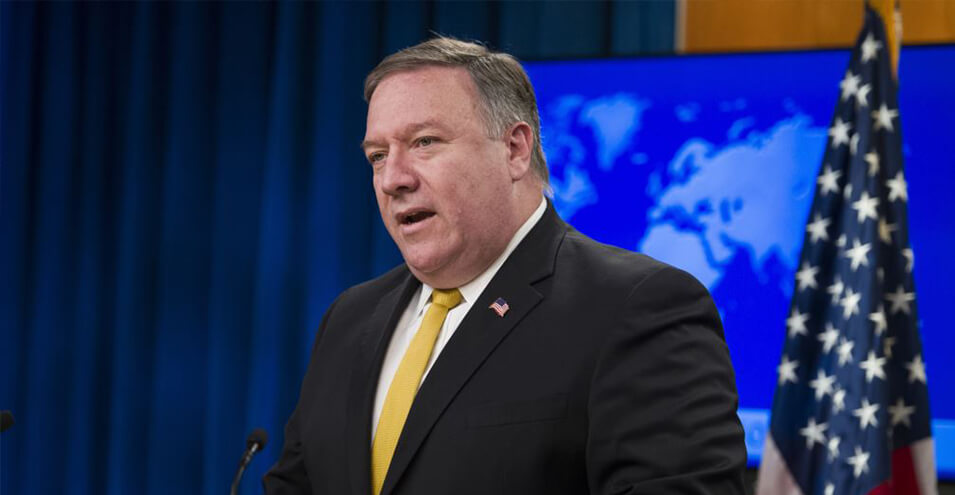
The US Secretary of State announced on Wednesday, October 2, the withdrawal of the United States from the “Treaty of Amity” between the United States and Iran.
Mike Pompeo, stating that “Iran has used the Treaty of Amity as a tool to attack America,” declared: “Today I am here to announce that the United States has terminated the Treaty of Amity with Iran.”
The treaty in question, officially known as the “Treaty of Amity, Economic Relations, and Consular Rights” by Iranian officials, was signed on August 15, 1955, in Tehran between the United States and the Imperial Government of Iran.
Article 23, Section 3 of this treaty provides that either party may terminate and abrogate it with “written notice of one year.”
The US government’s decision to withdraw from this treaty comes hours after a ruling by the International Court of Justice in The Hague in favor of Iran. The court issued a provisional ruling stating that the United States must ensure that its unilateral sanctions against the Islamic Republic do not adversely affect essential goods or the safety of passenger flights.
The Islamic Republic filed a complaint with the International Court of Justice accusing the Donald Trump administration of violating the Treaty of Amity between Iran and America by withdrawing from the nuclear agreement between Tehran and six world powers.
Mike Pompeo, in his Wednesday remarks, accused Iran of misusing the Hague court for its political and propaganda purposes.
The US Secretary of State said: Iran in July brought “a baseless case” to the International Court of Justice, accusing the United States of violating the Treaty of Amity between the two countries.
“We were disappointed that the court was unable to rule that it lacked jurisdiction over US sanctions matters, because America’s actions against Iran are in line with safeguarding its vital security interests.”
Calling the court’s Wednesday ruling in favor of Tehran “illegitimate,” he said: “Given Iran’s history of supporting terrorism, ballistic missile activities, and other acts of sabotage, Iran’s recourse to the Treaty of Amity is ridiculous.”
Mr. Pompeo, however, clarified: The court’s ruling today “constitutes a defeat for Iran. In fact, this court rejected all of Iran’s baseless claims.”
He emphasized that “our existing exceptions and permits for humanitarian exchanges and flight safety remain in place. Decisions made today inside Iran to spend money to fuel terrorism around the world are dollars that Iran’s leaders are wasting.”
The US Secretary of State expressed hope that Iran’s leaders will reach the conclusion that the only way to secure their people’s future is to abandon the campaign of terrorism and destruction around the world.
Mr. Pompeo said that Iran has violated the Treaty of Amity for years and added that this treaty should have been terminated 39 years ago.
Apparently, this American official’s reference was to the time of the hostage-taking of American diplomats by forces called “Followers of the Imam’s Line” at the US Embassy in Tehran, which occurred on November 4, 1979.
During the attack on the US Embassy in Iran, 52 diplomats of this country were taken hostage and held captive for 444 days. This attack led to the severance of relations between Tehran and Washington and decades of hostility between the two countries.
This event, which was in fact a complete negation of the “Treaty of Amity” between Iran and America, was the first instance in which the two countries referred a case to the Hague court based on the treaty.
During the hostage crisis, the United States, invoking Article 4 of the 1955 Treaty of Amity and the consular rights mentioned therein, filed a complaint against Iran in the International Court of Justice, and the court, by issuing a ruling in favor of the United States, demanded the immediate release of the hostages.
Over the next decade, Iran also filed two cases against the United States in the Hague court based on this treaty. First, after an attack on an Iranian passenger aircraft over the Persian Gulf that resulted in the deaths of 290 passengers on the plane, and second in 1992 due to attacks by US forces on Iranian oil platforms in the Persian Gulf.
“Source of Threat” Against Americans in Iraq
The US Secretary of State, in another part of his remarks, accused Iran of being a “source of threat” against Americans in Iraq.
Mr. Pompeo said: “Our intelligence on this is substantiated. We see the hand of Ayatollah Khamenei and his followers in supporting these attacks against the United States.”
The United States said last Friday that due to threats from Iran and Shiite militias supporting it, it is closing its consulate in Basra and withdrawing its diplomatic personnel from this southern Iraqi city.
Source: Radio Farda