Iran: Americans must guarantee they will not withdraw from the JCPOA
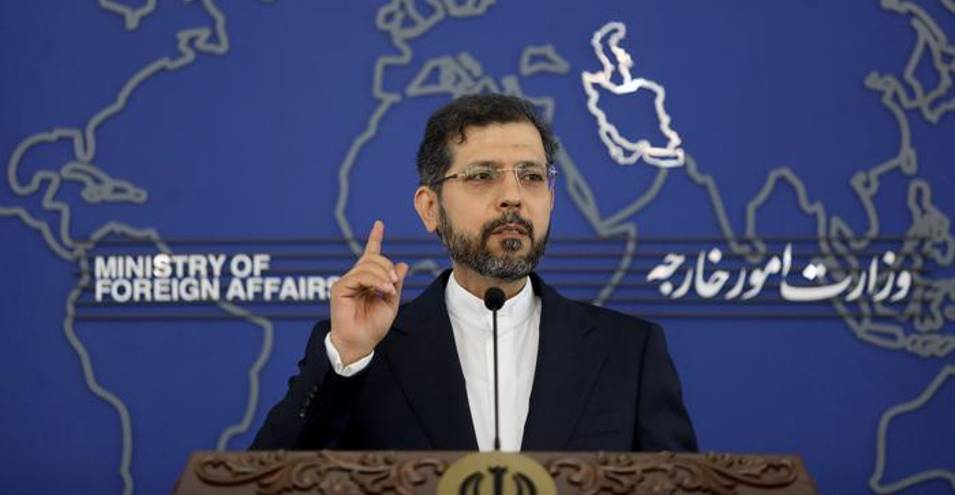
The spokesman for the Islamic Republic’s Foreign Ministry says Iran is moving forward with the Vienna talks with a “national consensus.” Saeed Jalili is said to have written a 200-page letter to the Islamic Republic’s Supreme Leader opposing the Vienna nuclear talks.
Saeed Khatibzadeh, spokesman for the Ministry of Foreign Affairs of the Islamic Republic of Iran, responded to reporters from Iranian and international media outlets at a press conference on Monday, January 31.
Regarding the differences in the Vienna nuclear talks, Khatibzadeh stated: "In the area of guarantees and verifications, the Americans must guarantee that they will not once again mock international law like they did a few years ago. They will not once again take our citizens hostage under the false pretext of circumventing sanctions and create the conditions for Iran to benefit from the economic benefits of the JCPOA."
Officials from the United States and other European countries that are parties to the JCPOA have repeatedly stated that no president in the United States can decide on the decisions of the heads of government after him; therefore, Iran's demand is "unrealistic."
The Iranian Foreign Ministry spokesman stated that in the Vienna talks, “ideas have been written down and we have passed the ideas phase and are awaiting the response of the other parties.”
Saeed Jalili's 200-page letter opposing nuclear talks
According to ISNA news agency, Khatibzadeh responded to some published news that Saeed Jalili, the former secretary of the Supreme National Security Council, had written a letter to some officials in the country about the Vienna talks and criticized them, saying: "I have no knowledge of this issue; it would be appropriate for you to ask him about this issue."
He added: "We are moving the talks forward in Vienna with a national consensus and using all domestic capacities."
According to the "Arman Melli" newspaper, yesterday some media outlets reported that Saeed Jalili wrote a 200-page report against the new round of negotiations and considered the Bagheri-Kani team's progress to be detrimental to Iran.
The newspaper's report also states: "Jalili claims that in the current circumstances there should be no negotiations and that only measurable and verifiable concessions should be obtained from the Americans. He sent this letter to Ali Khamenei, the leader of the Islamic Republic."
Arman Melli writes that, from Jalili's perspective, there should have been a "revolutionary entry" into the negotiations, with the explanation that he "only got points" and could not bear to hear no.
Jalili's comments were published at a time when, according to the Foreign Ministry spokesperson, "the negotiations over the past three weeks have made significant progress in all four areas of lifting sanctions, nuclear commitments, verification, and obtaining guarantees."
Khatibzadeh said that the slowdown in the negotiations was "due to the other party's inaction, failure to obtain the necessary guarantees, or lack of initiative and creativity from the other parties."
He clarified: "If the opposing parties, especially the Americans, have made their decisions when they return to Vienna, endorse Iran's legitimate demands, and do not demand more than the JCPOA, and we do not accept less than the JCPOA, we can quickly reach a stable, good, and reliable agreement."
Representatives of the countries participating in the Vienna nuclear talks have now returned to their capitals for consultations.
In response to a question from an Al Jazeera reporter regarding direct talks between Iran and the US in Vienna, the Iranian Foreign Ministry spokesman said, "What is being done as informal correspondence between Iran and the US through the European Union coordinator is the path that has been followed to date, and as long as necessary, talks will be conducted through this path, and this path will continue."
The Iranian government's information website reported on Sunday, February 10 (30), a telephone conversation between French President Emmanuel Macron and his Iranian counterpart Ebrahim Raisi on the evening of Saturday, February 29.
In a conversation with Emmanuel Macron, Ebrahim Raisi emphasized the lifting of sanctions and "valid verification and guarantees," and claimed that the pressure of US sanctions on Iran had been "ineffective."
Source: DW