Interrogation in the Iranian Judicial System: Violated Rights of Detainees and Continued Illegal Behavior of Interrogators

For years, former prisoners or those still in prison have recounted numerous accounts of their interrogations in detention centers and prisons; accounts in which what is most evident and common to all of them is the illegal and inhumane behavior of interrogators who, through various methods and techniques, impose deep psychological and emotional pressure on the detainee in order to force him to confess.
Behaviors that cause irreparable psychological and sometimes physical harm to the detainee; prolonged interrogations, repeated threats, sexual insults, and beatings of the detainee during interrogation are common examples of interrogators' behavior. This is despite the fact that such actions are prohibited under existing laws and regulations.
First-hand accounts of prisoners enduring pressure during interrogation have revealed in recent years some of the methods used by interrogators to extract confessions, and have even led to international reactions, such as the US government's sanctions on two IRGC interrogators in March 2020. However, this trend continues, and many aspects of the pressure exerted on detained citizens by interrogators and the diversion of judicial cases by these same interrogators have not yet been clarified.
The influence and power of security interrogators in political and ideological cases
Although preliminary investigations at the prosecution stage should in principle be conducted by the investigator as a judicial authority, in most human rights cases in the Iranian judicial system, these investigations are conducted by interrogators from intelligence and security agencies under the title of “judicial officers.” What was stipulated in Article 98 of the Criminal Procedure Code of 1392 was that “the investigator must personally conduct the necessary investigations and measures to collect evidence of the crime” and emphasized that “in cases other than those covered by paragraphs (a), (b), (c), and (d) of Article (302) of this law, he may refer the investigation, questioning of witnesses and informants, collecting information and evidence of the crime, or any other legal action he deems necessary to uncover the crime to judicial officers after providing the necessary training, who in this case, while supervising, will make an appropriate decision if he deems it necessary to complete them.”
Therefore, given this restriction and the prohibition of the above rows for referral to bailiffs, it was intended that only cases related to "political and press crimes" (the subject of paragraph e of Article 302, which was not prohibited in the above rows) would be referred to this category of bailiffs as security interrogators. However, two years later, in a series of strange amendments and additions that were made to the Criminal Procedure Code in late June 2015, this note was added to Article 98 of this law: "In paragraphs (a), (b), (c), and (d) of Article (302) of this law, the investigator may also conduct the necessary investigations in cooperation with bailiffs." In other words, with the addition of this note, in none of the serious crimes such as "crimes punishable by deprivation of life", "crimes punishable by life imprisonment", "crimes punishable by amputation or intentional crimes against physical integrity with half of the full blood money or more" or "crimes punishable by third-degree and higher ta'zir punishment", the investigator is no longer required to "personally" conduct preliminary investigations. In fact, in political and ideological cases that are often accompanied by heavy punishments, it can be seen that the pulse of the work is in the hands of interrogators from intelligence and security institutions under the title of "judicial officers". Special officers such as "agents of the Ministry of Intelligence, the Intelligence Organization of the IRGC, and agents of the Basij Resistance Force of the Islamic Revolutionary Guard Corps" who were "added" to Article 29 of the Criminal Procedure Code in the same strange amendments and changes in June 2015, in the form of paragraph (b).
From thousands of hours of interrogation to threats and insults
Various accounts of the arbitrary treatment of detainees by interrogators demonstrate the influence and power of interrogators in the course of cases. Prolonging the interrogation of many detainees and leaving them in limbo is one of the most common methods used by interrogators in political and ideological cases; not long ago, Maryam Klaren, the daughter of Nahid Taghavi, a 66-year-old dual-nationality prisoner imprisoned in Evin, spoke of over a thousand hours of interrogation of her mother, and considered this a clear example of torture. A few years ago, Niloufar Bayani, an environmental activist imprisoned in Evin, wrote in several letters to senior regime officials such as Ali Khamenei about the imposition of 1,200 hours of interrogation on her.
Other aspects of the illegal and inhumane treatment of detainees by interrogators have also been described in prisoners' accounts of their interrogations in prisons or detention centers across the country, ranging from physical torture to sexual threats and insults.
Legal provisions regarding interrogation
A review of some of the principles of the Iranian Constitution clearly shows that the conduct of interrogators in mainly political cases is completely illegal; Article 22 of the Constitution stipulates: “The dignity, life, property, rights, residence and occupation of individuals are immune from attack, except in cases prescribed by law.” On the other hand, Article 37 of the Constitution also states: “The principle is innocence and no one shall be considered guilty by law unless his guilt is proven in a competent court.”
Article 38 of the Constitution also states: "Any form of torture to extract a confession or obtain information is prohibited. Forcing a person to testify, confess, or swear is not permitted, and such testimony, confession, or oath is void of value and validity. Violators of this principle will be punished according to the law."
In addition to these principles of the constitution, clauses of the single article of the Law on Respect for Legitimate Freedoms and Protection of Citizens' Rights, such as clause 9, state: "Any torture of the accused in order to obtain a confession or coerce him into other matters is prohibited, and the confessions obtained thereby will not have religious or legal validity." Also, Article 60 of the Criminal Procedure Code, 2013 edition, emphasizes that "During interrogations, coercing or coercing the accused, using derogatory words, asking suggestive or misleading questions, and questions outside the subject of the charge are prohibited, and the statements of the accused in response to such questions, as well as statements resulting from coercion or coercion, are not valid..."
Basic rights of defendants
At the same time, detainees are entitled to basic rights that are less widely respected and respected during arrest and interrogation, which are often long and grueling:
1- The accused's right to remain silent: This right is mentioned in Article 197 of the Criminal Procedure Code, but despite the legislator's emphasis that "the accused may remain silent," this legal right is usually met with harsh treatment or ridicule from bailiffs or interrogators and investigators.
2- The right to have a lawyer: The legislator stated in Article 190 of the Code of Criminal Procedure that "the accused may have a lawyer with him during the preliminary investigation stage" and emphasized that "this right must be communicated and explained to the accused by the investigator before the investigation begins. If the accused is summoned, this right shall be stated in the summons and communicated to him. The accused's lawyer, upon obtaining information about the accusation and its reasons, may state the matters he deems necessary to discover the truth and defend the accused or enforce the law. The lawyer's statements shall be recorded in the minutes of the session." However, in practice, in political and ideological cases, on the one hand, this group of political defendants are in a situation where neither they themselves nor their lawyers or families are aware of the arrest and investigation process for a long time, and it is not known exactly what happened to them. On the other hand, after the family obtains initial information, they are practically faced with an obstacle such as the note in Article 48 of the same law and are deprived of access to their chosen lawyers.
3- Prohibition of suggestive questions: Although Article 195 of the Criminal Procedure Code states that the investigator's duty is to "propose suggestive questions or questions that involve deception, coercion, or coercion of the accused are prohibited," given that this group of defendants do not have access to their chosen lawyer during arrest, detention, interrogation, and investigation, there is practically no lawyer by their side to ensure the implementation of the note to the same legal article, which states: "The defendant's lawyer may warn the investigator if suggestive questions or other illegal matters are raised."
The practice of well-known interrogators
Despite such emphases and prohibitions in existing laws and regulations, the usual practice of interrogators, especially in political and ideological cases and civil activists, has been the opposite and has actually acted against these laws; the narrative of political prisoners about the methods of Ali Hemtian, known as Rauf, one of the interrogators at the Sarollah headquarters of the Revolutionary Guards, shows how the interrogators' methods put pressure on the detainees.
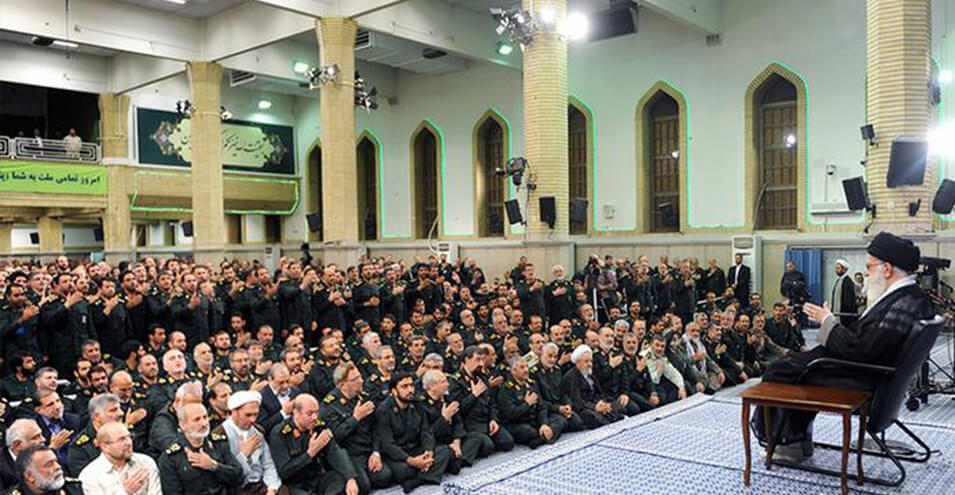
It was in December of last year that a photo posted on Twitter of students meeting with Ali Khamenei led to the identification of one of the IRGC interrogators, Ali Hemtian, known as Interrogator Rauf, among those meeting with Ali Khamenei by political activist and former prisoner Mahdieh Golroo. Rauf has a history of interrogating a number of political and civil activists or families of prisoners in offices affiliated with the IRGC in Tehran. After he was identified, accounts of his interrogation methods were published on social media.
A former political prisoner, who asked not to be named, told HRANA: "Rauf had a leather belt with which he would always start beating me. For no reason and like a madman, he would sometimes continue doing this for up to 10 minutes and then he would start beating me and swearing at me and my family."
Another former political prisoner had reported on the role of this interrogator in the televised confessions, saying that Rauf's interrogator "wrote the texts and provided them to the film crew."
Ali Hemtian, known as Interrogator Rauf, and Masoud Safdari, another IRGC interrogator, were sanctioned by the United States in March 2020, a few months after Joe Biden took office in the country.
Special interrogation of women
Despite the emphasis of Article 42 of the Criminal Procedure Code that “interrogations and investigations of women and minors should, if possible, be carried out by trained female officers and in compliance with Islamic principles.” And despite the employment of many women as officers, one of the things that has been violated in the interrogation of women in prison has been their formal or informal interrogation by male interrogators. In February 2019, parts of several letters from Niloufar Bayani, an activist and environmental expert imprisoned in Evin, were published about the behavior of officers during her interrogation. In one of these letters, Niloufar Bayani wrote that the interrogators pressured her to “imitate” the sounds of wild animals and threatened to “inject her with a paralytic and air ampoule.” In a letter to Ali Khamenei on February 12, 2018, Niloufar Bayani wrote that during interrogation, she was "taken to a private villa in Lavasan with seven armed men, and despite her refusal, she was forced to watch their immoral and un-Islamic behavior in a private swimming pool."
Describing some of the shameless behavior of her main interrogator, under the pseudonym Hamid Rezaei, Niloufar Bayani writes: "My fear that he would commit sexual assault and violence if I did not write everything he wanted intensified. His unexplained and unexpected presence in places like the dark corridor and the courtyard of the detention center and his disgusting behavior made me feel unsafe anywhere, and my unbearable anxiety would never cease because of this."
Conclusion
Several factors play a role in the violation of the rights of detainees during the preliminary investigation and interrogation process in the judicial system of the Islamic Republic of Iran; some of these factors are "individual" and as long as the existing method prevails in the selection and employment of interrogators and there is no supervision over their performance, the violation of the rights of detainees will not stop. Some of these other factors are "structural"; in the sense that the violation of existing laws and the lack of strict supervision for the implementation of the law have caused the deviation from the existing minimum regulations to be repeated and become a fixed procedure. But the third group of these factors, which seems to be even more radical, are "legal" factors; that is, the text of some existing laws is formulated, approved and implemented in a way that automatically results in the violation of the rights of detained citizens.
Therefore, the most important appropriate measures to eliminate or stop the widespread violation of the rights of citizens detained during interrogations could be as follows: 1) Amending Article 98 of the Criminal Procedure Code and removing its additional note, which requires that in human rights cases, the investigator, as a judicial authority at the prosecution stage, personally and independently conduct preliminary investigations in accordance with the established principles of criminal procedure and be accountable. 2) Removing the note of Article 48 of the Criminal Procedure Code and allowing the accused access to his chosen lawyer from the very first moment of arrest, which, on the one hand, will ensure the basic rights of the accused, such as the right to silence and the right to defense, while respecting Article 35 of the Constitution, and on the other hand, will help to ensure that contradictory claims by interrogators and accused in cases such as torture can be verified. 3) Amending Article 29 of the Criminal Procedure Code and eliminating special officers, which will focus the legal activities of judicial officers on trained police forces and prevent the entry and infiltration of security forces into judicial cases, influencing these cases, and ultimately widespread violations of human rights.
Source: Human Rights Campaign