Trump announces 'significant' escalation of Iran sanctions
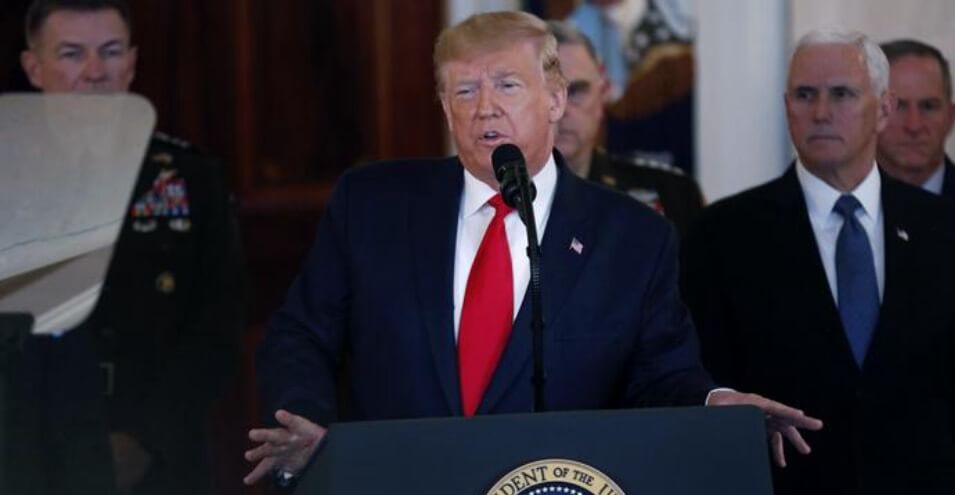
The US President announced that he has approved new sanctions against the Islamic Republic, which will intensify previous sanctions. At the same time, Donald Trump said yesterday that America's arms are open to negotiations and peace.
On Thursday, January 9, Donald Trump announced to reporters at the White House that a decision had been made regarding new economic sanctions against the Islamic Republic, and that he had approved them shortly before.
According to AFP, the US President said that the sanctions imposed on the Islamic Republic have been very severe so far, but have now been "significantly" intensified.
He declined to elaborate on the nature of the sanctions, noting that details of the latest decisions would be announced soon. The US Treasury Department is expected to issue a statement on the matter.
On Wednesday, Trump said that new sanctions against Iran were on the way, in response to the launch of several missiles by the Revolutionary Guards Aerospace Force towards two US bases in Iraq.
The IRGC missile attack, which Trump and Iraqi officials said caused no casualties, was carried out in retaliation for a drone attack a few days ago by American forces on two vehicles carrying Qassem Soleimani, commander of the IRGC's Quds Force, and his companions near Baghdad airport.
In a US drone strike on the morning of January 4, Soleimani, four other IRGC members, and five senior members of the Shiite Popular Mobilization Forces (PMF) militia, including Abu Mahdi al-Muhandis, the group's deputy commander, were killed.
Following this incident, Supreme Leader Ali Khamenei and many senior Iranian political and military officials threatened that “harsh revenge” awaited the United States. Most of these figures have said, either explicitly or implicitly, that the IRGC’s missile launch into Iraq was retaliation and that further operations would occur if the United States took action.
Maximum pressure for a comprehensive agreement
Donald Trump withdrew from the nuclear deal in May last year, and subsequently reimposed sanctions that had been lifted or suspended on the Islamic Republic. He describes the motivation for these sanctions, which have been tightened in recent months, as “maximum pressure” to force Iran to negotiate a comprehensive agreement.
The US President believes that the nuclear deal will not permanently prevent Iran from obtaining an atomic bomb, will not limit its missile programs, and will not prevent "destabilizing" actions in the region and support for groups that the US calls terrorists.
Trump on Wednesday insisted he would not allow Iran to obtain a nuclear bomb as long as he was in the White House. He called on the five remaining countries in the nuclear deal (Britain, France, Germany, China and Russia) to withdraw from the deal and work with Washington on a comprehensive agreement.
Yesterday, Donald Trump, while threatening the Islamic Republic, announced his readiness to cooperate with Tehran in some areas and added that the United States is ready to embrace peace.
Majid Takht-Ravanchi, Iran's representative to the United Nations, called Trump's remarks dishonest in an interview with the Iranian state news agency and said his claims about cooperation and negotiation were not credible.
Source: DW