Intensified Judicial and Security Crackdown on Citizens’ Peaceful Protests Against Mandatory Hijab
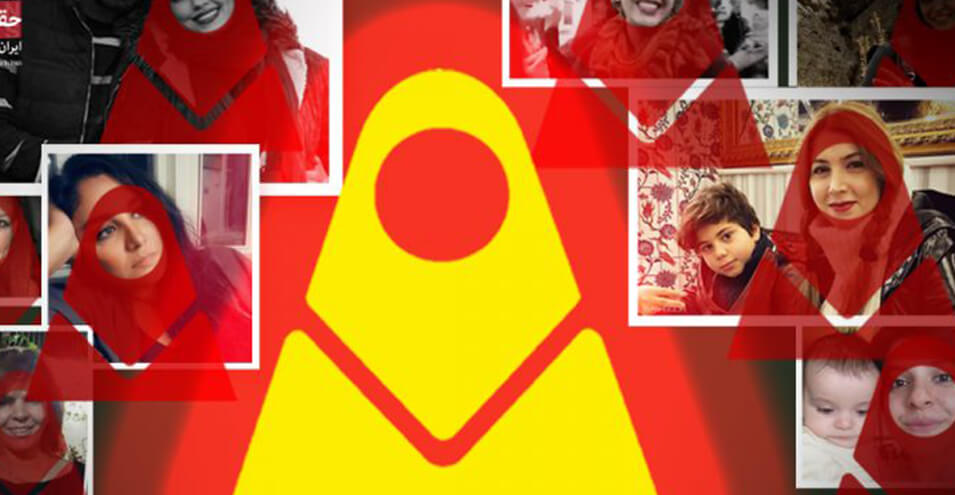
August 18, 2019 – Despite repeated prison sentences and severe punishments, women and men in Iran continue to express their opposition to mandatory hijab law in various forms, and in many cases disregard it, demonstrating that such protests against this law persist.
Based on investigations conducted by Iran Human Rights Campaign, since winter 2017, at least 12 people have been sentenced to between six months and 33 years in prison for removing their headscarves and other civil activities against mandatory hijab, and 32 others have been arrested.
Beyond cases of civil protest that attract media attention, millions of women annually who do not comply with the government’s dress code are arrested by police for “not wearing hijab,” and the cases of tens of thousands of them are referred to judicial authorities.
Hadi Ghemi, the campaign director, said about this: “Having or not having a hijab is related to individuals’ freedom of expression and is a fundamental and undeniable human right that must be defended.”
He added: “Iranian authorities use all available resources of the country to suppress opposition to mandatory hijab. However, given that more than half of the population has stood against them, the likelihood of the government’s victory in this regard is very slim.”
A report on hijab that was written using polls compiled by Iran’s Student Opinion Research Center in 2006 and 2014, and published in 2018 by the Rouhani government, shows that 49.2 percent of Iran’s population believes that hijab is a personal matter and should not be enforced. The report acknowledged that “demanding the implementation of desired and formal patterns of women’s clothing in a society where at least 41 to 50 percent consider hijab a personal and optional matter is very difficult.”
Similarly, a report from Iran’s Parliament Research Center published in August 2018 indicated a weakening of Iranian society’s support for hijab and suggested reconsidering the mandatory hijab law as a possible approach, but no action has been taken in this regard since its publication.
Even these government reports clearly show that Iranian society is rapidly changing, but so far the government’s security and judicial forces have preferred to continue suppressing and increasing legal severity to impose hardline views, viewing opposition to mandatory hijab as equivalent to challenging government authority.
The Iran Human Rights Campaign calls on Iranian authorities to immediately release women and men imprisoned for their peaceful protest against mandatory hijab and to cease punishing freedom of expression and suppressing peaceful protest, which is a fundamental right.
The campaign further calls on UN human rights bodies, including the UN Special Rapporteur on the situation of human rights in Iran and the UN Special Rapporteur on the promotion and protection of the right to freedom of opinion and expression, as well as governments around the world, to demand the immediate release of those imprisoned for peaceful protest against mandatory hijab.
Iranian Courts Equate Not Covering Hair With Obscenity
Following initial activities and civil protests by citizens against mandatory hijab, authorities have accused protesters of crimes related to disrupting national security.
These accusations not only aim to discredit these protesting women and men and delegitimize them before the public, but also deny them the right to a fair trial. This is because national security charges in Iran give the judiciary the authority to deprive them of access to a lawyer during the investigation phase.
Protesters against mandatory hijab are typically prosecuted under moral charges such as “inciting people to debauchery and obscenity,” “insulting sacred values,” “appearing in public places without proper religious hijab,” and “publishing, distributing, and dealing with content violating public decency in cyberspace.” These charges clearly reveal authorities’ attempt to suppress and discredit protesters in the eyes of the people.
Article 639 of Iran’s Islamic Penal Code prescribes one to ten years imprisonment for “anyone who establishes or runs a center of debauchery or obscenity” or “anyone who incites people to debauchery or obscenity or provides the means for it.”
Mr. Ghemi added: “Judicial authorities in Iran equate peaceful defense of freedom of expression with obscenity and immorality, which demonstrates the bankruptcy of Iran’s judicial policy.”
Increase in Number of Punishments: 10 Women and 2 Men Prosecuted Since the Beginning of 2018
Since the beginning of 2018 (December 2017), at least 10 women and 2 men in Iran have been convicted of moral and security crimes for participating in peaceful protests against mandatory hijab.
It is possible that some defendants decided to keep their cases private, so the actual number of such sentences is likely much higher. Iranian authorities often pressure prisoners to keep their cases out of the media in hopes of receiving lighter sentences.
Manizheh Arabshahi and Yasmin Aryani (Ms. Arabshahi’s daughter) were sentenced to 16 years in prison on August 30, 2019, in Branch 28 of the Tehran Revolutionary Court. (10 years for “inciting to debauchery and obscenity,” 5 years for “assembly and conspiracy against national security,” and 1 year for “propaganda against the system”)
Mojgan Keshavarz was sentenced to 23 years and 6 months in prison on August 30, 2019, in Branch 28 of the Tehran Revolutionary Court (10 years for “inciting to debauchery and obscenity,” 5 years for “assembly and conspiracy against national security,” 1 year for “propaganda against the system,” and 7 years and 6 months for “insulting sacred values”)
In a video widely circulated on social networks on March 8, 2019 (International Women’s Day), Arabshahi, Aryani, and Keshavarz handed flowers to people in the Tehran metro and reminded them that hijab should be optional. One month after the video was posted, all three were arrested at different times: Aryani on April 11, Arabshahi on April 12, and Keshavarz on May 25. All three appeals are being reviewed.
Prominent human rights lawyer Nasrin Sotoudeh was sentenced in June 2018 to 33 years and 8 months in prison and 148 lashes for accepting to defend mandatory hijab protesters. (Under Article 134 of Iran’s Islamic Penal Code, she must serve 12 years of this sentence in prison.) She has been in Evin Prison since winter 2017 and has refused to file an appeal in protest of the country’s illegal judicial process.
Reza Khandan and Farhad Meysami were both sentenced to six years in prison in winter 2017, banned from traveling, and banned from online activity for two years. They were punished for peaceful protest against mandatory hijab law and using pixelated images with text reading “I oppose mandatory hijab.” Khandan, who is Nasrin Sotoudeh’s husband, has been free on bail since winter 2017.
Mohammad Moghimi, Meysami’s lawyer, wrote on his Telegram channel on August 20 of this year that the appeals court upheld Meysami’s six-year prison sentence and reduced the two-year ban on online activity to one year. Meysami has been in Evin Prison since winter 2017.
Azam Jangravi was sentenced to three years in prison for “inciting to debauchery and obscenity” on an unspecified date in 2018. After being arrested in autumn 2017 for removing her headscarf on Enghelab Street in Tehran, she left Iran for Canada on an unspecified date.
Shima Babaei published a video on her Instagram account in June 2018, stating that Branch 1090 of the Tehran Guidance Court had sentenced her to two months in prison and a fine of one million tomans for “appearing without hijab in public” and “publishing indecent content in cyberspace.”
It is unclear when and where she was arrested, but she was released on bail in late 2017 and left Iran on an unknown date shortly after.
Shaparak Shajarrizadeh first removed her headscarf in the Qeytariyeh neighborhood of Tehran in February 2017 and waved it like a flag, and was later arrested in Kashan on May 16, 2017.
She was sentenced in summer 2018 to two years in prison and 18 years of suspended imprisonment for “displaying improper hijab” and “inciting to debauchery,” and Nasrin Sotoudeh took on her defense. She traveled to Canada in summer of that year and has not returned to Iran.
Maryam Shariatmadari was arrested on February 23, 2017, for removing her headscarf on a busy street in downtown Tehran and waving it on a stick. According to her lawyer Nasrin Sotoudeh, Shariatmadari was sentenced to one year in prison by Branch 1091 of the Tehran Criminal Court for “inciting to debauchery by removing hijab.” She was released on bail in spring 2018 and has left the country on an unspecified date that year.
Narges Hosseini, a sociology graduate student from Kashan in Isfahan Province, was also arrested in winter 2017 for removing her headscarf on a busy street in downtown Tehran and waving it on a stick. Two months later in February 2017, she was sentenced to 24 months in prison for “failure to observe proper religious hijab,” “appearing to commit a forbidden act,” and “inciting to debauchery.” Her lawyer Nasrin Sotoudeh announced at the time that they intended to appeal the sentence. She was released on bail in December 2016 and left the country on an unknown date that year.
Vida Movahed was arrested in winter 2016 after standing on an electrical box and waving her headscarf in protest on Enghelab Street in Tehran. She is a young mother who has become known in international media as a symbol of protest against mandatory hijab under the title “Girls of Revolution.” After her release, she repeated the act and was arrested again, and was ultimately sentenced to one year in prison by Branch 1091 of the Tehran Guidance Complex for “inciting to debauchery and obscenity” and was released in June 2019.
Ghemi emphasized: “These harsh punishments demonstrate the failure of government forces in enforcing hijab. Despite years of police surveillance on the streets, an increasing number of women are refusing to comply with the government’s dress code rules.”
He added: “As a result, authorities resort to harsh measures and abuse of power, but this only deepens the gap between the government and society.”
Source: Iran Human Rights Campaign